
Please see this week’s Markets in a Minute update below from Brewin Dolphin, received yesterday afternoon – 11/08/2026.
AI stocks rebound from sharp downturn
AI stocks took a sharp downturn in July after a strong Q2. While performance has rebounded, some investor caution remains.
Key highlights
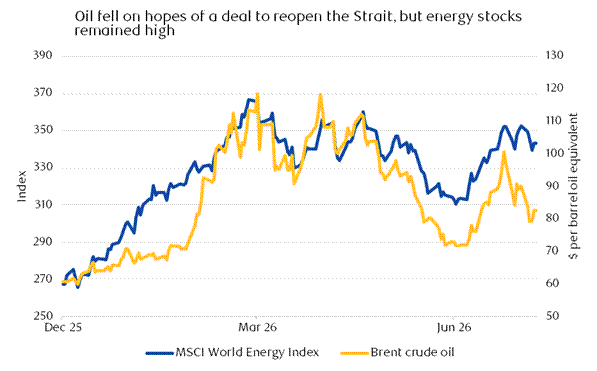
- Gulf de-escalation: Oil fell from a high of $100 per barrel to below $80 per barrel amid reports of a possible agreement to reopen the Strait of Hormuz.
- AI equity volatility: July saw a rotation out of AI infrastructure stocks, driven by efficiency gains in open-weight models and a forced hedge fund unwind.
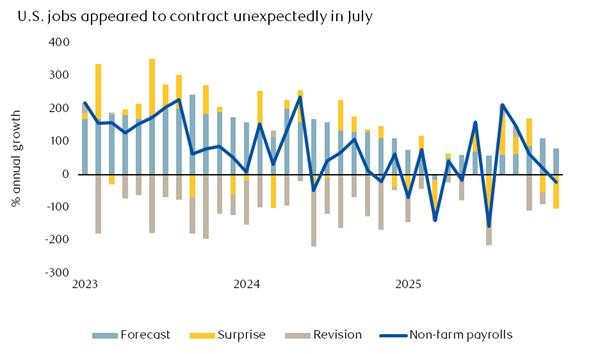
- U.S. labour market: Jobs data pointed to broad stability, but the July payrolls report showed a surprise decline of 23,000 jobs, keeping interest rate decisions finely balanced.
Gulf tensions ease – oil retreats
Markets opened the week by responding to reports of a possible de-escalation in the Persian Gulf.
Source: LSEG Datastream
Oil fell from a July high of $100 per barrel to below $80 per barrel – a striking move given the collapse of the previous U.S.-Iran ceasefire. A new agreement to reopen the Strait of Hormuz appears to be in preparation, which would entail inbound shipping via Iran, outbound shipping via Oman, both sides clearing mines and no tolls charged. President Donald Trump sounded constructive, while retaining the threat of military action.
Since the onset of the conflict, crude prices have remained lower than analysts would have expected given the scale of supply disruption, and they have tended to fall on any sign of de-escalation. Barriers to a full reopening of the Strait remain high, with Iran appearing to have demonstrated that it can wield influence over the waterway at will.
For portfolios, the practical implication is familiar: energy prices feed through to inflation, central bank thinking, and the cost of everything from a refinery run to an airline ticket. It’s best to avoid getting whipsawed by headlines that change by the day.
AI stocks and shifting sentiment
Alongside the Gulf, AI remained the dominant concern for equity markets.
July saw a sharp rotation out of the AI spending beneficiaries – the companies that sell the equipment used by the AI ecosystem. Bottlenecks in the supply of specific components, most notably high-bandwidth memory (a specialist chip used in AI servers), drove a substantial rally from March to June while July brought a sharp reversal.
The sell-off reflected several factors. Open-weight models (AI systems whose underlying code is publicly available) have been making significant advances in efficiency, suggesting that less server capacity may be required to run them. Hyperscalers – the large cloud providers driving the bulk of investment – have also depleted their free cashflow and may face funding constraints. A significant factor, however, appears to have been a single hedge fund forced to unwind well-known leveraged positions; once the situation resolved, the stocks rallied, though some nervousness persists.
SpaceX captured the market’s conflicting mood. Results beat on earnings and revenue, but were overshadowed by a sharp rise in AI-related capital spending. The stock fell 7% after hours (having gained 9% during the previous session).
Real economy signals a mixed picture
The week brought a range of U.S. jobs data, with stability the best overall description. There was little change in job openings, resignations and layoffs, and jobless claims nearly reached an all-time low. Purchasing managers’ surveys (which track activity across manufacturing and services) showed employment increasing modestly alongside a broad improvement in economic activity across regions and sectors.
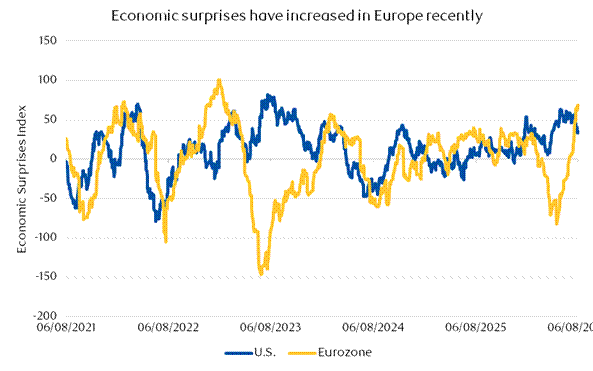
It’s notable that the U.S. no longer stands out as the sole beacon of growth. European economic surprises have exceeded those of the U.S. recently, and the stock market is no longer being driven by a narrow group of AI-related stocks, having seen much broader participation recently.
Source: LSEG Datastream
The synchronicity of that improvement should be enough to shift the window of anxiety from growth towards inflation. However, at a time when numerous sources seem to be showing an improving employment picture, the July employment report from the Bureau of Labor Statistics showed a surprise decline of 23,000 jobs. This fell far short of forecasts, which had predicted an increase of up to 80,000 new jobs. Wage and pay growth also slowed.
This may confuse the outlook for the U.S. jobs market, but it should be reassuring for investors, as many have been concerned about the potential need for interest rates to rise. An increase in September was hanging in the balance, but this seems a bit less likely now.
Source: LSEG Datastream
Please continue to check our blog content for advice, planning issues and the latest investment market and economic updates from leading investment houses.
Charlotte Clarke
12/08/2026