
Please see this week’s Markets in a Minute update below from Brewin Dolphin, received yesterday afternoon – 13/10/2026
What could U.S. midterms mean for investors?
The Democrats are expected to win seats in the upcoming elections, which could affect economic priorities.
Key highlights
- Oil and geopolitics: Brent crude pushed back above $103 per barrel as energy prices remain the dominant cross-asset driver, keeping inflation pressure alive in bond markets.
- U.S. midterm elections: Prediction markets give Democrats near-certainty of taking the House of Representatives and a 65% chance of the Senate, signalling legislative gridlock ahead.
- Labour market: Employers are holding onto staff while employees aren’t moving – a signal of job insecurity rather than weakness, which is helpful for the inflation outlook.
Oil still calls the shots
Energy and geopolitics continue to set the tone across every asset class and last week offered a textbook illustration.
Brent crude pushed back above $103 a barrel after reports that the White House asked the Pentagon to draw up strike options against Iran that could be implemented before the midterms. With energy prices anchored at these levels, inflation remains the dominant cross-asset driver and the pressure has been felt in bond markets, where yields have reached multi-decade highs.
The conflict has also widened. Houthi attacks have reached Saudi airports, including strikes on Riyadh’s main international airport, which killed three people and injured dozens more. Iranian attacks on shipping have stepped up, even as flows through the Strait of Hormuz have shown some signs of improvement.
None of this is accidental. With the midterms less than a month away, the political pressure on the Trump administration from that quarter is at or around its peak, so it’s entirely rational for Iran to be as antagonistic as it can be while its leverage lasts.
That calculation cuts both ways, and by the close of the week it had produced something closer to a thaw. By the end of the week President Trump confirmed he won’t conduct further military action ahead of the midterms and that productive discussions are ongoing.
It’s fair to say that the administration’s commentary on the state of negotiations should be met with a degree of scepticism, but they’re signalling to Iran that they do not consider that they will accept heavier losses in the midterms rather than softening their negotiating stance. Once the votes are counted, Iran’s perceived leverage diminishes, which could prompt either side to re-evaluate their position. Oil prices are modestly lower as a result, which is where last week left us – a little relief, no resolution.
Midterms
Looking in more detail at the U.S. midterms, there are a few things to observe. It’s normal for a sitting president’s party to lose seats. The president is not on the ballot, but his popularity affects the 435 races in the House and the 35 in the Senate.
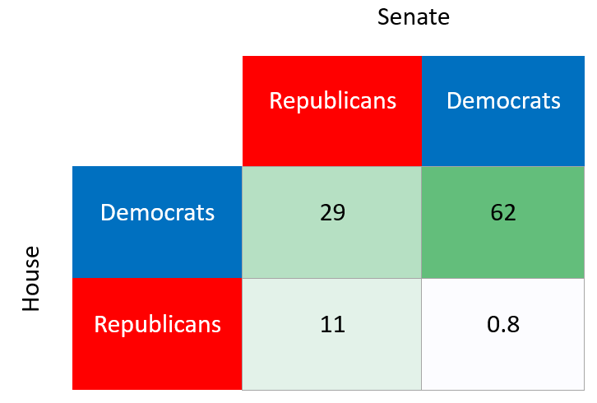
Prediction markets now give the Democrats a virtual certainty of taking the House and a 65% chance of winning the Senate as well. The bottom line is that once the new Congress is sworn in on 3 January, there will be major constraints on the president’s ability to guide domestic policy.
The prediction market implied chances of each party winning each chamber of Congress
Source: Kalshi
Three consequences follow. Legislative gridlock is the first: given how far apart the two parties have become ideologically, little of consequence will pass beyond what is strictly necessary.
The second is fiscal. Brinkmanship becomes a feature of divided power in the U.S. Last year’s reconciliation bill lifted the debt ceiling from $36tn to $41tn, and over half that additional capacity has already been used. The limit is expected to be reached in the spring of 2027, after which accounting measures could extend it for roughly six to nine months.
Shutdowns and debt ceiling negotiations have tended not to have a big impact on markets but chip away at the global investors’ ebbing willingness to finance the U.S. More immediately the Trump administration will need a budget and will want more military spending, but the Democrats will have a voice in those negotiations and are likely to demand more healthcare funding. That should eventually be good for the healthcare sector, which already benefits from longevity and from AI’s ability to reduce costs. It is unlikely to address the issue of America’s rising debt-to-GDP.
In 2011, a standoff was resolved two days before the deadline and contributed to a downgrade of the U.S. credit rating; in 2023, Republicans extracted substantial spending concessions while controlling only one chamber.
The third consequence is investigations: committee control, subpoena power and the ability to sue in court would all shift to the Democrats. Two areas are largely untouched. Foreign policy remains the president’s to direct, including command of the military and trade negotiations.
Appointments are the live question.
Jerome Powell has not vacated his seat on the Federal Reserve’s (Fed) board, having said he would stay until the investigation into the renovation cost overruns was well and truly over. The Fed’s internal watchdog found mismanagement but no criminal violations, and the Justice Department won’t reopen a criminal case, though the attorney general hasn’t closed the door entirely. That falls short of Powell’s test, so he will most likely stay for now. If the Democrats took the Senate, they would be able to block his eventual replacement, which most observers would regard as good news for Fed independence.
Equity returns in the year after a midterm has historically been the strongest of the presidential cycle, however the same logic would suggest we’re currently in one of the weaker years of the cycle, so it seems like the normal pattern hasn’t been in place this year. Furthermore, we’re always conscious that a six-foot man can still drown in a river that’s five feet deep on average.
Low hire, low fire
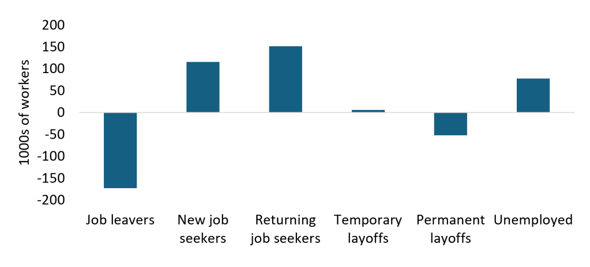
Unemployment rose during September because more people looked for work despite
fewer people quitting or being laid off
Source: LSEG Datastream
The American labour market is sending a consistent and rather particular signal: employers are content to hold onto staff and employees are not looking to move. The payroll report showed job growth below the pace needed to keep unemployment stable and the rate duly ticked up to 4.2%. But the rise came mostly from people entering or re-entering the workforce, not from layoffs – which barely show up in the data. Voluntary departures, meanwhile, fell sharply.
Jobless claims last week were similarly benign. What that describes is a prevailing sense of job insecurity, not outright weakness.
For inflation, this is helpful. Wage growth has continued to slow, which has taken the heat out of inflation expectations – a process that has been running since the end of April, interrupted only recently by higher energy costs.
Growth is cooling gently rather than stalling: the Atlanta Fed’s running estimate of consumption growth has slipped from 2.8% to 2.2%, and the September services surveys showed the global sector still expanding, with Europe accelerating and the UK expanding more slowly. The U.S. picture is muddier, with the ISM manufacturing index reading more sedate than the S&P version. On this occasion we’d lean towards the ISM, since a sharp jump in American activity last month looks implausible.
Three hikes priced, one forecast
The minutes of the latest Fed meeting showed a committee that agreed on the destination, but not the route. Members voted unanimously to raise rates, yet gave clearly different reasons for doing so, which does nothing to clarify where policy goes next. The Fed chair’s reluctance to offer forward guidance leaves markets to work it out for themselves, and they’ve taken a hawkish view.
From a base rate of 4%, markets now discount up to three further increases. Professional forecasters, weighted towards the most recent estimates, expect just one, unwound towards the end of next year. That’s a wide gap and one of the more consequential disagreements in markets today.
The cost of money is also being allocated with more discrimination. Sovereign bond markets have been weak but bifurcated, with strong credits holding up and weaker ones punished. France stands out as the weakest of them all, with French government bonds underperforming the broader market and the euro soft.
Emmanuel Moulin, France’s representative on the European Central Bank’s (ECB) governing council, described the situation as complicated and serious while making clear it doesn’t warrant intervention from Frankfurt. History suggests the ECB has found reasons to step in before and has shown some ingenuity in explaining why such action isn’t a fiscal measure. More stress would usually be needed to trigger such a move, but Christine Lagarde confirmed late last week that the ECB has the tools ready if needed.
Please continue to check our blog content for advice, planning issues and the latest investment market and economic updates from leading investment houses.
Charlotte Clarke
14/10/2026