
Please see below, today’s Daily Investment Update from Brooks Macdonald which highlights the key factors currently affecting global investment markets.
What has happened?
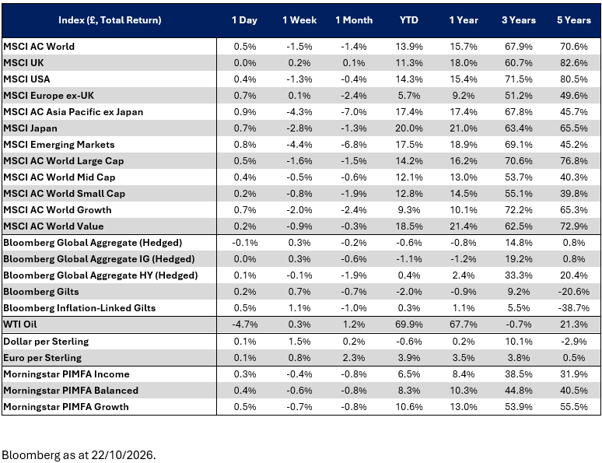
US equities extended their recent recovery yesterday, with the S&P 500 (+0.58%) posting a third consecutive gain and finishing within 1% of its record high. Technology stocks led the advance, helped by encouraging signals from the previous evening’s SpaceX earnings release, which reassured investors about the durability of AI-related spending. The Philadelphia Semiconductor Index (+1.97%) continued its rebound, while the Nasdaq (+1.05%) delivered another strong performance. The positive mood was also reflected in Europe, where the STOXX 600 (+0.92%) and other major indices moved higher, again led by tech stocks.
A more challenging backdrop for UK consumers
Yesterday’s UK inflation data came in slightly above expectations, with headline CPI rising to 3.5% in September and core inflation remaining elevated at 2.8%. Combined with this week’s strong labour market data, the figures reinforced expectations that the Bank of England will raise interest rates again in November, with markets pricing a near-certain probability of a move by yesterday’s close. At the same time, consumer confidence weakened. The latest British Retail Consortium survey showed households becoming more pessimistic about both the economic outlook and their personal finances. Although spending intentions improved as consumers looked ahead to the holiday season, the survey suggested that some households may increasingly rely on savings to support spending amid ongoing cost-of-living pressures.
The mood soured overnight
The tone became more cautious after the US close. While Meta delivered results that exceeded expectations, Tesla disappointed investors by cutting its 2026 capital expenditure target, raising questions about the pace of its ambitions in AI and robotics. As a result, futures on the Nasdaq 100 were down -1.32% this morning. Meanwhile, France’s fiscal position remained under scrutiny, with the country’s 10-year government bond yield closing above 5% for the first time since 2002. Geopolitical tensions in the Middle East also intensified overnight, adding further uncertainty. Reports of potential future strikes involving Iran, alongside continued attacks on energy infrastructure in Saudi Arabia, reinforced concerns about global energy supplies and lifted Brent crude (+1.73%) to $110.70/bbl, a five-month high.
What does Brooks Macdonald think?
The combination of persistent inflation pressures, higher-for-longer interest rate expectations and rising energy prices could create a more challenging backdrop for markets. From an investment perspective, the recent rise in oil prices warrants close attention. If sustained, higher energy costs could complicate the inflation outlook and reduce central banks’ flexibility to adjust monetary policy. For now, markets can take comfort from resilient economic growth and generally supportive corporate earnings. However, investors are likely to remain sensitive to any signs that higher energy prices begin to feed through into inflation expectations or weigh on economic activity. The key question in the months ahead will be whether the global economy can continue to absorb higher energy costs without a meaningful deterioration in growth.
Please continue to check our blog content for the latest advice and planning issues from leading investment management firms.
Andrew Lloyd
22nd October 2026