
Please see below, Brooks Macdonald’s Daily Investment Bulletin which provides a brief analysis of the key factors currenting affecting global investment markets. Received today – 09/10/2026
What has happened?
Markets remained under pressure as higher oil prices renewed concerns about inflation and interest rates. Brent crude briefly approached $106/bbl amid ongoing disruption to shipping through the Strait of Hormuz and escalating Middle East tensions, before easing back after President Trump stated that the US would not attack Iran before November’s midterm elections and described discussions with Tehran as productive. Nevertheless, investors continued to price in the possibility of a more prolonged period of elevated energy costs. European assets bore the brunt of the move. The STOXX 600 fell to its lowest level since June, while bond markets remained sensitive to inflation concerns and fiscal risks, particularly in France. UK gilt yields reached fresh post-2007 highs, reflecting a global repricing of inflation and policy expectations. In the US, Treasury markets stabilised following strong auction demand and softer oil prices late in the session, with the 10-year Treasury yield ending lower despite earlier testing multi-decade highs. Economic data continued to point to labour-market resilience, with US jobless claims falling to 197,000, reinforcing expectations that central banks still have room to prioritise inflation.
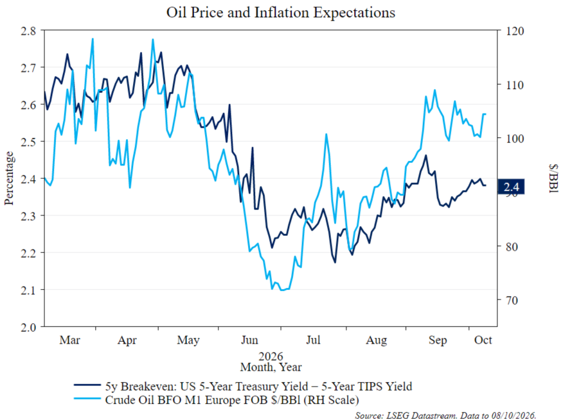
Oil Shock Meets Tight Monetary Policy
The latest market volatility highlights a familiar but important tension; financial conditions are tightening while energy-driven inflation risks are re-emerging. While bond markets have periodically rallied on concerns that higher yields or market stress could slow growth, policymakers continue to stress that inflation remains the primary challenge. Recent comments from Federal Reserve officials, alongside ECB and Bank of England communications, suggest that further tightening remains possible even as markets digest higher borrowing costs. The interaction between energy prices, inflation expectations and policy rates remains one of the key drivers of cross-asset market performance.
What does Brooks Macdonald think?
The market reaction reflects a growing recognition that inflation risks have not disappeared. While oil prices have retreated from recent highs and diplomacy may limit near-term escalation with Iran, disruptions to global energy flows continue to warrant close monitoring. Importantly, resilient economic data reduces the urgency for central banks to pivot towards easier policy. For investors, the key question is whether higher energy prices prove temporary or become embedded in inflation expectations. While elevated yields are creating a more attractive opportunity set within fixed income, they also raise the hurdle rate for equity valuations. We continue to see broadly resilient economic growth and healthy labour markets as supportive for risk assets, but the combination of geopolitical uncertainty, elevated oil prices and restrictive monetary policy is likely to keep market volatility elevated in the near term.
Please continue to check our blog content for the latest advice and planning issues from leading investment management firms.
Alex Kitteringham
9th October 2026