
Please see below the daily update article from Brooks Macdonald, received this morning – 13/08/2026:
What has happened?
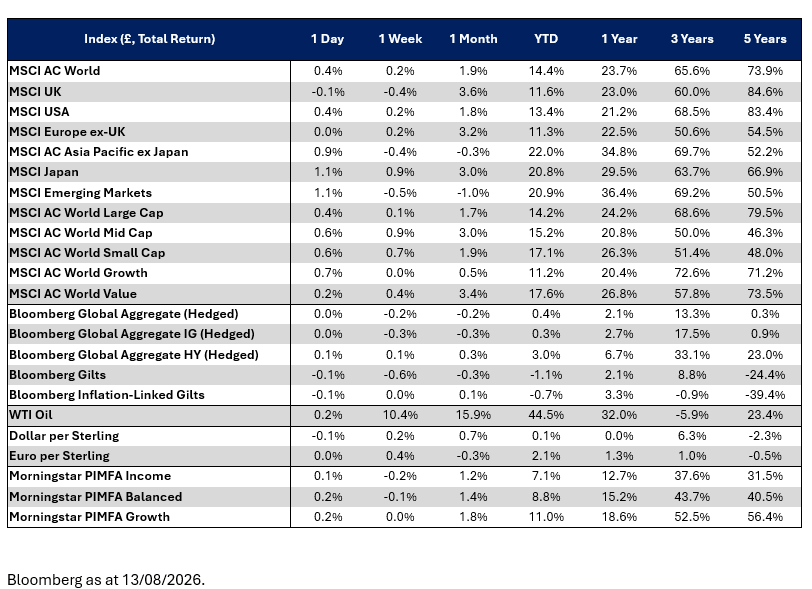
Markets took a modestly positive view of July’s US inflation data, with easing concerns about another near-term Federal Reserve rate hike helping risk assets gain ground. Headline and core inflation both came in as expected, and following last Friday’s softer employment report, investors saw less urgency for the Fed to tighten policy again in September. Shorter-dated Treasury yields edged lower, while continued strength in semiconductor stocks helped push the S&P 500 (+0.26%) to within a sliver of its record high. The equal-weighted S&P 500 (+0.16%) also reached a fresh high, pointing to broader market participation. The Philadelphia Semiconductor Index rising +2.49%. Gains have been supported by strong demand for AI infrastructure, with CoreWeave (+19.28%) and Super Micro (+19.02%) surging after delivering upbeat outlooks earlier in the week.
Inflation cools but not all price pressures have disappeared
The CPI report largely reinforced the narrative of gradual disinflation. Headline prices rose 0.1% month-on-month and 3.4% year-on-year in July, while core inflation increased by 0.2% on the month and 2.5% on the year, matching its slowest annual pace since March 2021. There were several encouraging details beneath the headline figures. Energy and gasoline prices fell for a second consecutive month, grocery prices declined for the first time since March, and so-called “supercore” inflation remained relatively subdued. However, the report was not entirely free of inflationary signals. Core goods prices recorded their strongest monthly increase since last September, driven in part by sharp rises in computer software and accessories prices. With memory chips increasingly being directed towards data-centre demand, it is a reminder that the AI investment boom may be creating pockets of pricing pressure within parts of the consumer technology supply chain.
What does Brooks Macdonald think?
The market response suggests investors viewed the CPI report as supportive, but not decisive. Expectations for a September Fed rate hike eased modestly, yet the overall repricing was relatively limited. This nuance was reflected across asset markets. While shorter-dated Treasury yields fell, longer-dated yields were little changed. Meanwhile, oil remained close to $90/bbl, and European gas prices moved higher as hopes for a swift US-Iran agreement continued to fade. Taken together, inflation concerns may be easing, but risks linked to energy prices and geopolitics have not disappeared. Attention now turns to today’s US producer price inflation (PPI) report. Beyond the headline figure, investors will be paying close attention to categories such as healthcare services, airfares and portfolio management, which feed into the Fed’s preferred inflation measure, core PCE. With investors still divided on whether another Fed rate increase will be needed this year, each inflation release has taken on greater significance.
Please continue to check our blog content for advice, planning issues and the latest investment market and economic updates from leading investment houses.
Cameron Owen
13/08/2026