
Please see this week’s Markets in a Minute update below from Brewin Dolphin, received yesterday afternoon – 03/03/2026.
Conflict in the Middle East: Understanding the market response
With conflict in the Middle East escalating, Chief Strategist Guy Foster breaks down what’s happening across investment markets – from immediate volatility to long-term positioning.
Key highlights
- Historical perspective: While current oil price fluctuations are notable, they remain significantly lower than the structural shocks of the 1970s and 90s, suggesting a more resilient global energy market.
- Modern diversification: The global economy’s reduced reliance on Middle Eastern oil, coupled with the UK’s shift toward U.S. liquified natural gas (LNG) supplies, can provide a buffer against traditional energy-driven inflation.
- Strategic resilience: Heightened volatility often unearths unique investment opportunities; we continue to manage your portfolio with a focus on long-term stability and proactive adjustments.
With the U.S. and Israel having launched meaningful attacks on Iran and counterattacks underway, it’s a time of significant uncertainty. While there are many important dimensions to these events, we want to share what they mean for investment markets and your portfolio.
The immediate market response
The immediate impact of the strikes has seen most equity prices drop lower on Monday morning. This is quite a normal reaction and reflects a primary concern: that conflict in the Middle East will drive energy prices higher. Any increases would be reflected in higher inflation, which raises costs for businesses and households, reducing economic growth and profits. But how severe might this impact be?
Oil shocks: Then vs. now
Investors with long memories will remember when the oil price rose sharply in response to conflict in the Middle East in the 1970s, and then again in 1990 due to the Gulf War. For context, those price surges were far more severe than what we’ve seen so far. In early trading, oil prices rose 10% – whereas previous shocks have tended to see increases of at least 100%.
Could prices rise much further? That’s the most difficult thing to forecast. Iran’s oil production comprises about 3-4% of global supply. Although it’s heavily sanctioned by Western powers, there are still buyers – of which China is by far the largest – which means that Iranian oil still affects global prices.
Iran’s geopolitical isolation also limits its ability to sustain major supply disruptions. Even China, its key ally, needs Iranian energy to keep flowing.
The Strait of Hormuz: A critical passage
Iran’s influence on the global oil and gas market extends beyond its own production. The most sensitive factor is the ability of tankers to navigate the Strait of Hormuz – a narrow maritime passage that serves as the world’s most critical energy chokepoint. Bordered by Iran’s coast, prolonged disruption to shipping here would cause oil prices to spike.
While disturbing the Strait might be Iran’s most potent means of harming its aggressors, it will come at the cost of lost oil revenue and that cost will be borne by all the Gulf states who currently export via the Strait. The other party losing out is China.
While U.S. confidence in keeping the Strait navigable remains unknowable, we can be certain they’ve considered the implications if it remains closed. Polls of U.S. registered voters suggest that military action against Iran was only supported by around a third of respondents and that inflation remains the most important issue¹ during this mid-term election year.
Crucially, the global economy is becoming less dependent on oil in general and Middle Eastern supplies in particular. As oil consumption relative to GDP steadily declines, the market is showing greater resilience; while prices exceeded $120 per barrel in 2022, they remain below $80 even after the latest jump (correct at the time of writing).
Impact on your energy bills
Nobody likes paying a lot to fill their car with fuel, but Europeans tend to be less sensitive to oil price changes because the impact is dulled by fuel duties. They are, however, more sensitive to changes in utility bills and will remember the dramatic changes following Russia’s invasion of Ukraine.
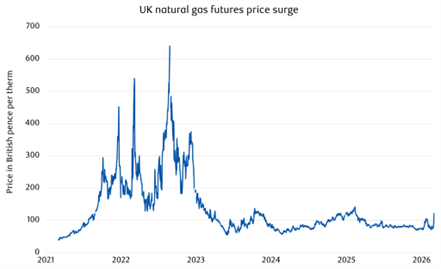
In fact, inflation is expected to decline this year as falling natural gas prices slowly filter through to consumers – the UK’s energy price cap policy delays the passthrough of energy prices into household bills.
As a rule of thumb, if wholesale gas prices rise on a sustained basis by 10%, that could increase headline consumer price inflation by around 0.5%. Recent sustained price declines mean that inflation is likely to fall in April by 0.4%. However, Iranian drone attacks on the Qatari LNG export facility have caused its closure, leading to a sharp rise in LNG prices. If those higher prices were to be sustained, then UK-regulated prices would eventually increase. Although for context, prices after the closure have returned to the level they were at a year ago, and remain a fraction of those seen during 2022. Importantly, the UK has reduced its Middle Eastern LNG dependence in recent years, increasingly relying on U.S. supplies instead.
Bond market implications
Bond markets have reflected the potential increase in inflation to a small extent. They would be most concerned if there was any expectation that it would mean higher interest rates. Before the attacks, two UK rate cuts were expected over the coming year, after those, that second cut hangs in the balance.
Whilst energy prices could generate upward inflationary pressure, it would also dampen consumer spending on other goods and services. So whilst the impact on most bonds is mixed, the prospect of higher inflation has helped the performance of inflation-linked bonds.
Spending on defence will add to pressure on the U.S. public finances. This is one reason why gold – rather than traditional bonds – is currently serving as a more effective hedge against geopolitical risk. We are also seeing the U.S. dollar strengthen as global risks rise, following a familiar historical pattern.
The resilience of your portfolio
The main impact of these events on financial markets is the uncertainty they create. We manage diversified portfolios to help protect against volatility. While uncertainty is elevated, some assets rise in value and, if the moves are sharp, it can be worth taking profit on them.
The history of financial markets shows volatility increasing, and then ebbing again. The best investment opportunities often come at times when uncertainty is at its highest. An example of this was the market falls after the global tariff announcements last year, which marked the start of a strong market rally.
We don’t yet know whether the current violence will last days, weeks or longer. However, as always, we’ll be following events closely to see what opportunities they produce.
Please continue to check our blog content for advice, planning issues and the latest investment market and economic updates from leading investment houses.
Charlotte Clarke
04/03/2026