Team No Comments

Brooks Macdonald: Daily Investment Bulletin

Please see today’s Daily Investment Bulletin from Brooks Macdonald received this morning, 22/02/2024.

What has happened

Nvidia’s announcement of strong guidance has positively impacted the markets, with the company’s shares experiencing a gain of 9% in after-hours trading. This surge has contributed to a broader market uplift, a 0.74% rise in S&P 500 futures. Elsewhere, Japan’s Nikkei index has achieved a historic milestone by surpassing its previous all-time intraday high from 1989, marking a continuation of its impressive performance with a 16.5% gain throughout 2024.

Nvidia’s impressive earnings

Nvidia has surpassed expectations for both revenue and earnings in the fourth quarter, with Data Centre revenue notably exceeding projections. The company announced $22.1 billion in Q4 revenue, a substantial 265% increase from the previous year, which was well above the $20.4 billion anticipated by analysts. The company’s guidance for the current quarter’s revenue and gross margin has also surpassed expectations. Nvidia’s management has expressed a confident outlook on Generative AI, highlighting the strong and growing demand that is outpacing supply. The anticipation surrounding Nvidia’s financial results has been evident in the options market, which indicated a significant move in the stock price following the earnings announcement.

What does Brooks Macdonald think

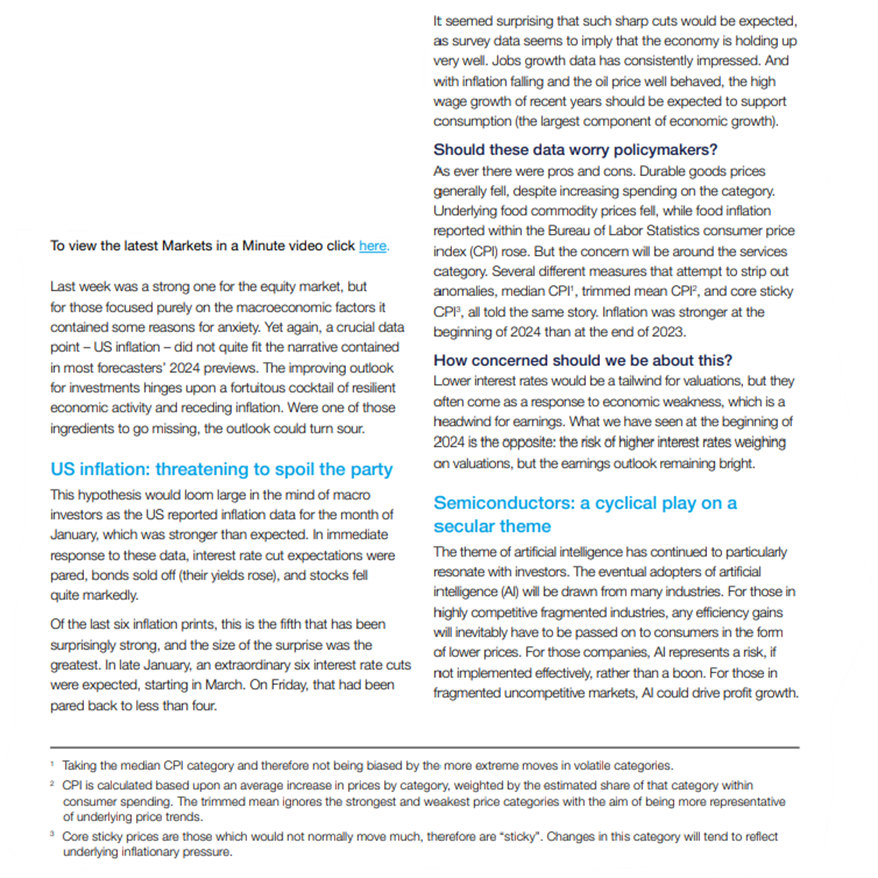
The 2024 earnings revisions are outperforming historical trends, with the market still anticipating low double-digit percentage growth in S&P 500 earnings. However, this growth is primarily driven by the top seven companies, the ‘Magnificent 7,’ while the remaining 493 companies in the index have experienced downward revisions in earnings and margins. This situation certainly exacerbates concerns regarding market concentration.

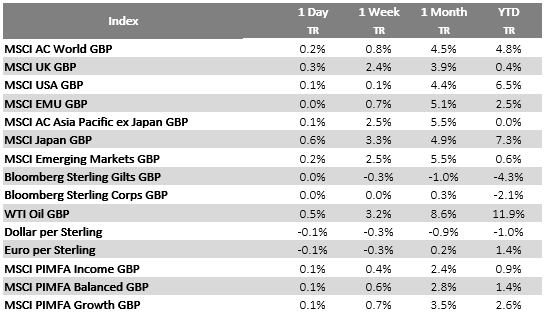
Bloomberg as at 22/02/2024. TR denotes Net Total Return

Please continue to check our Blog content for advice and planning issues and the latest investment, markets and economic updates from leading investment houses.

Charlotte Clarke

22/02/2024

Team No Comments

Brewin Dolphin – Markets in a Minute

Please see below this yesterday’s global market round-up from Brewin Dolphin, which was received late yesterday afternoon – 20/02/2024:

Please continue to check our blog content for advice and planning issues and the latest investment, markets and economic updates from leading investment houses.

Carl Mitchell – DipPFS

Independent Financial Adviser

21/02/2024

Team No Comments

Brooks Macdonald Daily Investment Bulletin

Please see todays Daily Investment Bulletin from Brooks Macdonald providing a brief analysis of markets:

What has happened

Global markets have been rather quiet over the last 24 hours given Presidents’ Day holiday in the US. The STOXX 600 index edged up by 0.16%, continuing its four-week streak of gains and reaching a new two-year high. The index now hovers just shy of its record high from January 2022, suggesting the potential for a new milestone in the near future.

A big week for corporate earnings

Attention is turning to a series of corporate earnings reports. Walmart is anticipated to report at noon London time today, setting the stage for Nvidia’s highly anticipated report after market close tomorrow. Nvidia’s performance is particularly noteworthy as it leads the S&P 500 with an impressive 46.6% surge this year, contributing to the ‘Magnificent 7′ stocks’ collective 10.65% year-to-date advance. In the UK, major banking institutions such as Barclays, HSBC, Lloyds, and Standard Chartered are scheduled to report earnings throughout the week. It’s expected that the UK’s five largest banks will announce a combined record-breaking £50 billion in profits, reaping the benefits of increased borrowing costs. While last year’s results hold importance, the focus is likely to shift towards future outlooks, especially with the Bank of England’s anticipated rate cuts. Despite a positive valuation outlook from analysts, the UK banking sector faces challenges from broader economic concerns and regulatory and political pressures.

What does Brooks Macdonald think

While this week may be characterized by a scarcity of macroeconomic data, it is nonetheless punctuated by a series of critical earnings reports that are likely to capture the attention of investors. We will see the market narrative shift from a macro-level, top-down approach to a micro-level, bottom-up analysis as investors seek to dissect the granular details of company reports. The guidance and forward-looking statements provided by these companies will serve as a barometer for the underlying economic health and could potentially offer insights into future market trends and corporate strategies.

Please check our blog content for advice, planning issues and the latest investment, market and economic updates from leading investment houses.

Andrew Lloyd DipPFS

20/02/2024

Team No Comments

Tatton Investment Management – The Monday Digest

Please see the below article from Tatton Investment Management providing a brief analysis of markets and the key news from global economies over the past week.

Overview: The UK is not growing in real terms or nominal terms

The UK is in a technical recession, defined as two quarters of real growth contraction. Meanwhile, last week’s release of UK jobs market data for December showed surprising tightness. The unemployment rate fell back to 3.8% rather than the expected rise to 4%. Both labour force data and GDP data are suspect, but price data are a bit more reliable. The measure of prices used to compute GDP data on a real basis is called the deflator and differs from the more usually quoted consumer price indices. Last quarter’s deflator growth was very low at less than +0.7% quarter-on-quarter annualised, indicating that nominal growth is now very weak as well.

The market is pretty convinced interest rate cuts will have happened on or by the 20 June Bank of England Monetary Policy Committee (MPC) meeting. We think there is enough fuel for a rate cut either at the meetings scheduled for 21 March and 9 May, but the dynamics of the MPC make this unlikely. As we discuss later, there is a high probability that tax cuts will happen on 6 March and that the ensuing small fiscal boost might lead the MPC to delay.

A number of emerging market central banks have already started easing rates. but developed markets are being dominated by the path of US rate expectations. Perhaps the similarities in the tightness of labour markets in the UK and Europe might cause one to think this is reasonable. Yet the paths of domestic inflation and money supply growth are differing enough to suggest that the European Union and the UK will have to forge their own paths, and that the US be stuck at higher rates.

Meanwhile, for Europe and the UK, energy prices are a big factor in business input costs. The rise in oil prices might make one think things are going badly, and that energy costs are rising. The good news is that natural gas prices continue to decline, and that is a decisive factor in the downswing in electricity prices. This will benefit manufacturers as long as demand holds up. Signs are that manufacturers are feeling less awfully negative, but there’s a long way to go to get to outright positive. Part of the story ought to be that central banks recognise the declining inflation environment and don’t allow real interest rates to become higher through neglect.

The anatomy of asset bubbles

Since the release of ChatGPT in late 2022, the tech-heavy Nasdaq index has gained nearly 50%, and no stock encapsulates the AI (artificial intelligence) fever better than Nvidia. If you had bought Nvidia stock in 2019 and held on, your stake would currently be up 17-fold. As in any bull market, sustained price increases make investors nervous that stocks are, or will soon become, overvalued. But AI-related companies keep pushing ahead, with the Nasdaq already up 6.6% year-to-date at the time of writing. Naturally, warnings of an AI bubble abound in financial media.

The biggest fear with bubbles – indeed, the reason people call them bubbles in the first place – is that they will suddenly burst, leaving investors with severe losses. Even if the current AI craze is a bubble, it could fizzle out or gradually unwind. That might take some time, and in the meantime, AI investors may well be in for some more stellar returns. This is not to say that all is well. US stocks, particularly the mega-tech sector, are extremely expensive even if they have solid fundamentals. The best strategy for the long-term, as usual, is diversification. We have to keep an eye on AI stocks, and particularly their volatility. But without any glaring warning signs usually observed with bubbles, there is no reason to think things are about to burst.

The UK’s fiscal bind tightens

With the Spring Budget fast approaching, tax cuts are reportedly top of Chancellor Jeremy Hunt’s agenda. According to multiple news outlets, these giveaways might have to be funded by additional public spending cuts – though the latter would likely be delayed beyond an upcoming UK election. Hunt will not want to do anything that might get in the way of Bank of England (BoE) interest rate cuts. Even so, the UK will almost certainly need to tighten fiscal policy after the election. According to the Institute for Fiscal Studies (IFS), Britain is in a fiscal bind and needs tough action. High public debt means spending is severely constrained which, in turn, means that public institutions are stretched thin. These institutions might just about cope in normal times, but when shocks and crises break, there is no more capacity to pick up the slack. This can be clearly seen in the long-term stresses on the National Health Service (NHS), for example.

Tight funding makes budget rebalancing extremely difficult. The Labour Party has said it wants to divert more funds to preventative services if elected, but doing so would either mean spending increases or cuts to non-preventative services – neither of which politicians are willing to do. Whether money is being reallocated across departments or to different regions of the country, rebalancing will inevitably mean short-term costs that no one seems willing to bear. Again, these decisions would be so much easier if the UK could generate strong growth. That needs investment in productive sources – both public and private. But according to Oxford Economics, the UK’s public and private investment over the last three decades ranks 32nd out of 34 major economies. Only the severely constrained economies of Argentina and South Africa see less investment as a percentage of GDP than our 17.4%.

Unfortunately, the dire state of public finances means investment is likely to fall in the short term, rather than rise. Both Labour and the Conservatives have made promises to increase or incentivise investment, but these plans are usually the first to go when confronted with difficult budgetary decisions – as seen in Labour’s abandonment of its green investment targets. These moves stave off short-term pain and, hence, might increase electoral chances. But they make the longer-term problems worse. Addressing Britain’s long-term malaise requires bold changes – but these are extremely hard to implement thanks to a cocktail of fiscal and political realities. Heading into an election, both parties are preaching caution when courage is arguably needed more. With finances already so tight, politicians will have to confront these issues sooner rather than later.

Please check our blog content for advice, planning issues and the latest investment, market and economic updates from leading investment houses.

Alex Clare

19/02/2024

Team No Comments

Brooks Macdonald: Daily Investment Bulletin

Please see below, Brooks Macdonald’s ‘Daily Investment Bulletin’ which covers the key factors currently affecting global markets. Received this morning – 16/02/2024

What has happened?

Yesterday’s US retail sales delivered a surprising contrast to economic narrative. The report for January indicated a bigger than expected decline in retail sales, with a 0.8% m-o-m decrease (vs consensus 0.1% drop). Factors such as seasonal adjustments and inclement weather in January may have contributed to this weakness. Additionally, revisions to the data from the previous two months prompted some analysts to revise their Q4 GDP projections downward, signalling a potential deceleration in growth as we move into early 2024. Despite these conflicting messages, market sentiment remained positive, with the S&P 500 rising by 0.58% to close at a new record high, and the small mid cap Russell 2000 index climbing 2.45%, reaching its highest point this year, just two days after experiencing its most significant decline since June 2023.

 UK already on the road to recovery?

 In the UK, retail sales experienced a robust recovery in January, posting a 3.4% month-on-month surge, which exceeded consensus expectations. The Office for National Statistics (ONS) noted that this was the most substantial monthly increase since April 2021. Y-o-y, sales saw a modest 0.7% increase, which stands in stark contrast to the forecasted 1.4% decrease and the previous 2.4% decline. This data lends support to the analysis and the Bank of England’s (BoE) projections that the UK economy is on the mend from the recession experienced last year, which was confirmed by contraction in GDP figures released earlier in the week.

What does Brooks Macdonald think?

Although individual economic indicators could sometimes provide insights into the economy’s underlying strength, they can often be clouded by extraneous fluctuations such as seasonality. The Federal Reserve’s primary gauge in assessing the disinflationary trajectory is the Personal Consumption Expenditures (PCE) inflation. The forthcoming release of the US Producer Price Index (PPI) later today is poised to be especially telling. This PPI report is anticipated to shed light on key aspects of PCE inflation, particularly in healthcare, air travel, and portfolio management services.

Please continue to check our blog content for advice and planning issues and the latest investment, markets and economic updates from leading investment houses.

Alex Kitteringham

16th February 2024

Team No Comments

Brooks Macdonald: Daily Investment Bulletin

Please see today’s Daily Investment Bulletin from Brooks Macdonald received this morning, 15/02/2024.

What has happened

Yesterday saw a more subdued trading session as the market attempted to recover from the Consumer Price Index (CPI) driven sell-off on Tuesday. This rebound aligns with the prevailing belief that the broader trend of disinflation is still in play, and the orderly nature of the market’s pullback, which lacked any signs of panic selling, indicates that investors are still optimistic, focusing on a potentially less aggressive Federal Reserve pivot and a more robust US economic outlook.

UK GDP

The UK concluded 2023 in a recession, but the emphasis is now on recovery prospects. The latest UK Gross Domestic Product (GDP) figures revealed a 0.3% contraction in the fourth quarter, which was more severe than the 0.1% decline anticipated by analysts and followed a 0.1% decrease in the third quarter. Despite this, the economy is estimated to have grown by 0.1% compared to the previous year. The Governor of the Bank of England, Andrew Bailey, has pointed to more positive signals from forward-looking indicators, such as Purchasing Managers’ Indexes (PMIs), as well as rising consumer confidence and business sentiment.

What does Brooks Macdonald think

In light of the lower-than-expected inflation figures and the contracting economy, there is mounting pressure on the BoE to consider reducing interest rates. During a recent session with UK lawmakers, Governor Bailey maintained a cautious stance, noting that inflation in the services sector and wage growth remain concerningly high. The probability of a 25 basis point rate cut by June, as inferred from market data, is now over 50%, and the market anticipates roughly three rate cuts by the end of the year.

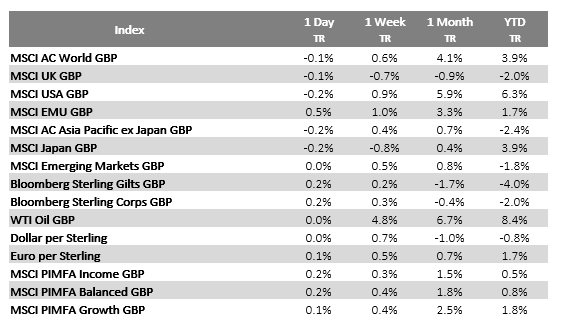
Bloomberg as at 15/02/2024. TR denotes Net Total Return

Please continue to check our Blog content for advice and planning issues and the latest investment, markets and economic updates from leading investment houses.

Charlotte Clarke

15/02/2024

Team No Comments

Evelyn Partners Update – UK January CPI inflation

Please see below article received from Evelyn Partners this morning, which provides their thoughts on this morning’s UK inflation announcement for January.

What happened?

UK January annual headline CPI inflation came in lower than expected at 4.0% (consensus: 4.2%), versus 4.0% in December. In monthly terms, CPI was -0.6% (consensus: -0.3%), compared to 0.4% in December.

Similarly, core CPI inflation (ex energy, food, alcohol and tobacco) came in at 5.1% (consensus: 5.2%) vs 5.1% in December. In monthly terms, core CPI was -0.9% (consensus: -0.8%), compared to a rise of 0.6% in December.

What does it mean?

The broad downward trend in inflation is continuing, as disinflationary pressures are likely to drive the rate down towards the Bank of England’s (BoE) target of around 3% in Q4’24.

In the data, upside to inflation was driven by a roughly 5% increase in the Ofgem cap on household energy that fed through to gas and electricity prices. On the downside, goods price disinflation continues as retailers offer discounts at the start of the year, as seen in monthly falls from both furniture/household goods and food/non-alcoholic beverages CPI categories.

On balance, upside inflationary risks appear to be contained. First, wage rates are slowing and that is putting downward pressure on services inflation. Providing that headline CPI inflation continues to slow there will likely be less demand for higher wage rates. In other words, this reduces the circular risk of an upward spiral in wages and inflation.

Second, so far there is little sign of a significant pick-up in consumer prices from supply chain disruption and rising shipping costs caused by Houthi attacks in the Red Sea. Energy prices are also stable: Brent crude oil is still falling on a year-on-year basis. This reduces the risk of upside in retail petrol and diesel fuel prices.

Third, lead indicators point to more disinflation ahead. Given their statistical relationship with underlying producer prices, both core goods CPI inflation and services inflation are set to come down over the coming months. For instance, core goods CPI prices could well be flat on a year-on-year basis by the Spring from rising around 2%.

Bottom Line

The broader trend of inflation deceleration is continuing. Importantly, headline CPI inflation is running slightly below the BoE’s forecasts over the last few quarters. This supports the narrative that we have reached the end of the interest rate hiking cycle. Expect the BoE to cut interest rates in the coming months and provide some support to the gilt market.

Please check in again with us soon for further relevant content and market news.

Chloe

14/02/2024

Team No Comments

Brewin Dolphin – Markets in a Minute

Please see below this yesterday’s global market round-up from Brewin Dolphin, which was received late yesterday afternoon – 13/02/2024:

Please continue to check our blog content for advice and planning issues and the latest investment, markets and economic updates from leading investment houses.

Carl Mitchell – DipPFS

Independent Financial Adviser

14/02/2024

Team No Comments

Brooks Macdonald Daily Investment Bulletin

Please see below article received from Brooks Macdonald this morning, which offers a global market update.

What has happened

Yesterday’s trading session saw a notable divergence with the Magnificent Seven underperforming the broader market. This underperformance was primarily driven by a significant drop in Tesla’s shares, which fell by 2.81%, making it the second-worst performer in the S&P 500 index for the year 2024, with a 24.3% YTD loss. In contrast, Nvidia managed to carve out a new record high, closing up by 0.16% and securing its status as the top-performing stock in the S&P 500 for this year, boasting a 45.9% YTD increase. Meanwhile, market optimism continued to flourish in Japan, with the Nikkei index climbing 2.57% this morning to reach a 34-year peak.

US CPI preview

Looking ahead to the US CPI report, the mood was bolstered by the New York Fed’s inflation expectation survey, which indicated a decline in 3-year inflation expectations to 2.35%, the lowest since 2013, from a previous level of 2.62%. The 1-year inflation outlook remained relatively stable at 3%. With the upcoming release of the US CPI data, Wall Street analysts are predicting a reduction in the core y-o-y CPI to 3.7% and a decrease in the headline CPI to 2.9%.

What does Brooks Macdonald think

We are closely monitoring the upcoming release of the US CPI data, scheduled for 1300 GMT today. This report is anticipated to be a critical indicator for the Federal Reserve’s monetary policy decisions, particularly any potential interest rate cuts for the remainder of the year. The Fed is looking for further evidence that inflation is headed to its 2% target before considering cutting rates; hence confirmation of a continuing downward trend could significantly influence market expectations and Fed commentary.

Please check in again with us soon for further relevant content and market news.

Chloe

13/02/2024

Team No Comments

Tatton Monday Digest

Please see this weeks Tatton Investment Management providing a brief analysis of markets and the key news from global economies over the past week:

Overview: Overview: are US stocks bubbling up?

Last week, the US large-cap equity market shook off the rest of the world, and the S&P 500 marched to another new milestone, trading above 5,000 for the first time. But the stand-out performer of the week was a homegrown success story. ARM Holdings PLC, the world-leading designer of computer chips, listed with 10% of the company value since last autumn on the US NASDAQ exchange in the form of American Depository Receipts (ADRs). Last Thursday, ARM’s share price rose 50%, following its fourth-quarter results. Its projected revenue for the current quarter is over $850 million, way above analyst projections of $778 million. Meanwhile, fellow AI microchip company Nvidia threatens to overtake Amazon as the fourth-most valuable US company. Its market cap is now $1.72 trillion, with Amazon at $1.76 trillion at Thursday’s close. Nvidia has added $600 billion in the past two months alone, about the same as Tesla is worth in total.

So is this a repeat of the dot.com bubble of 2000? The first thing to note is that contrary to back then, ARM’s rally was based on hard revenue and profit, and both are growing extremely quickly. Nvidia is doing the same. Its expected next 12 months’ earnings are almost four times the level of one year ago, and that was already after the release of ChatGPT demonstrated to the world the potential of artificial intelligence (AI) and saw Nvidia become the main provider of the required computer chips. The other thing to note is that, unlike the dot.com bubble, there are few stocks involved. The rally in the ‘Magnificent 7’ has been responsible for almost all of the performance of the US stock market this year. Indeed, the group seems to have become the ‘Magnificent 6’, with Tesla doing rather poorly.

Positivity about the mega-caps and AI stocks in the US (and that small number listed outside the US, like ASML and ARM) seems unshakeable, but of course, one might think that this makes these companies dangerous to invest in, given the high valuations. Can earnings growth that is currently expected to be sustained for quite a while justify those valuations? And, even if they cannot – as Tesla is finding out – can people believe so for long enough as they did in the late 1990s? What should one do if this is another asset bubble? We will delve into this conundrum further over the coming weeks.

Bad news for banks as US commercial real estate loan losses continue

Following the collapse of several regional US banks last year, many investors started to think that after the clear-out, life would get easier for lenders. However, as we noted last week, recent events have delivered a reminder that, for some, trouble still lies ahead. New York Community Bancorp (NYCB) made international headlines after it announced a surprise Q4 2023 loss, cut its dividend, and set aside $500 million to cover potential loan losses. Markets sent NYCB shares down 44% in two days and tried to guess who else might be in a similar position. Japan’s Aozora Bank said it expects a $191 million loss for the current financial year, while Deutsche Bank lifted provisions for loan losses tied to US commercial real estate to €123 million, up from €26 million a year ago. Share prices fell for both banks. The fallout continued when analysts at Morgan Stanley recommended clients sell senior bonds issued by Deutsche Pfandbriefbank AG, triggering losses in most real estate bonds from German lenders.

Global trends and accounting timelines mean it is no surprise banks far and wide are facing issues simultaneously. And naturally, when multiple banks start failing all at once, people get very concerned. Just like last year, when the demise of Silicon Valley Bank and Signature Bank spread shockwaves across the Atlantic, talk of financial contagion and flashbacks to the 2008 global financial crisis has been prominent in the last two weeks. But problems with a common cause are not the same as systemic weakness, much less contagion. Commercial property across the Western developed world is ailing because the trends underlying it – digitalisation of the workplace and a sharp increase in interest rates – are global. This is without mentioning China’s longstanding property woes, albeit with different origins.

Overall though, the specific US commercial real estate issue may exist because the US economy is extremely dynamic. The ‘old’ is failing faster there because of rapid investment in the ‘new’; new homes, new ways of working, new plant and machinery. It is important to note that the available balance sheet reserves outweigh the current losses (and the US is helped by the fact that losses are also borne by capital from overseas). Meanwhile, the investment is creating significant growth. The dangerous period comes not now but when investors in the new want to see that new investment come good.

Will South Africa decide on a change for the better?

South Africa has long been a key Emerging Market (EM) destination for international investors. But it is also a classic EM for all the wrong reasons: widespread corruption, institutional instability, and extreme economic and financial volatility have blighted it for a decade. South Africa’s issues have become progressively worse over recent years. Jacob Zuma’s presidency was one of outright corruption and cronyism, which clearly eroded the state’s capacity to provide public goods and services. Indeed, corruption at all state levels has continued or even worsened under Zuma’s successor, Cyril Ramaphosa, leading to the state’s incapability to fulfil some of its most basic functions. It is not uncommon to hear – anecdotally and in the media – that South Africa is close to being a failed state.

There are opportunities for change, however. South Africa faces another general election this year and, for the first time since the democratic version of South Africa was born in 1994, the African National Congress (ANC) Party is unlikely to win a majority. Current polling puts Ramaphosa’s party at 42% of the national vote, which will likely mean some form of power-sharing deal. However, it is unlikely that the ANC would share any power with its closest competitor, the Democratic Alliance, which is still seen as a predominantly white party. The most worrying outcome, at least for EM investors, would be if the ANC chose instead to share power with one of the more militant populist parties, such as the Economic Freedom Fighters (EFF). The EFF’s involvement in a coalition government looks unlikely, but the risk is there and will be pored over by markets in the run-up to the elections.

But we should remember that the time when things look bleakest is sometimes the time of maximum opportunity. If newer parties can come in – albeit only as junior coalition members – and improve the state’s capacity, that would go far in unlocking South Africa’s growth potential. If they could tackle the underlying exclusion and inequality, it would go even further. In that case, South Africa would start to look extremely attractive to foreign investors.

Please check our blog content for advice, planning issues and the latest investment, market and economic updates from leading investment houses.

Andrew Lloyd DipPFS 12/02/2024