Team No Comments

Brewin Dolphin – Markets in a Minute

Please see the below article from Brewin Dolphin detailing their analysis of the U.S. job data and the impact on financial markets. Received yesterday 08/10/2024.

While there was some reassuring news on the economy last week, there was some concerning news on the geopolitical front. It’s worth considering how these trends can become intertwined.

It’s been a year since Hamas launched its unprecedented attacks on Israel from Gaza. Since then, Israel has conducted an extensive ground operation in the region. Conflict has also continued between Israel and the Houthis in Yemen and Hezbollah in Lebanon.

In recent weeks, the conflict has intensified significantly around the Lebanese border, with some ground operations by Israeli forces in Lebanon. Last week, Iran launched 180 ballistic missiles against Israeli targets. The two sides differed in their reports of the operation’s success but thankfully, casualties were low.

Nevertheless, speculation has risen that Israel could attack Iran’s oil infrastructure in retaliation, as predicted by former Israeli Prime Minister Ehud Barak. This speculation was fanned by comments from U.S. President Joe Biden. When asked whether the U.S. would support such a move by Israel, Biden responded: “we’re discussing it”.

What’s at Risk?

The events in the Middle East are very troubling from a human perspective, but we know that markets and to a large extent economies, are dispassionate about such things. If the conflict were to impact energy production, markets and economies would begin to react quickly. Indeed, following Biden’s comments on Thursday, oil rose around 4% and ended the week 9% higher.

In previous notes, we have discussed the benefits of an energy position within portfolios. The bull case here is that energy stocks stand to benefit from a reluctance to invest in new energy supply. Constraints on energy investment are more politically acceptable than taxes on energy consumption, which have the same effect of driving energy prices higher. The difference between the two is that taxes would create revenue for governments, whereas supply constraints increase profits for suppliers.

This capital cycle argument has in recent months been overwhelmed by a gloomy outlook for energy demand. In the U.S., the change in consumer behaviour over the summer months has raised fears that gasoline demand could be weak. Across the U.S. and Europe, evidence last week continued to suggest that the manufacturing sector is suffering from an ongoing recession. But the main factor weighing on energy demand has been China.

We discussed a couple of weeks ago how the China situation has changed significantly, with a forceful monetary and fiscal stimulus unveiled over a few days the week before last. While the Chinese mainland market was closed for most of last week due to the country’s Golden Week national day celebrations, Hong Kong shares rallied, meeting the threshold for a bull market (a 20% gain). Prior to this, Hong Kong-listed Chinese shares had seen a decline of 50% since early 2021.

Historic worries over oil prices

Anxiety over the energy supply has haunted investors since the 1970s. Why? Well, oil price increases can act as a tax on consumers and cause them to reduce other forms of spending.

Here’s a brief recap of the major incidents since the ‘70s:

  • The 1973 oil embargo by the Organization of the Petroleum Exporting Countries (OPEC+) in protest of the Arab Israeli war caused prices to quadruple and triggered a global recession
  • A second oil price shock at the end of the 70’s was triggered by production disruption caused by the Iranian revolution
  • The Gulf War precipitated an oil price spike and led to the early 1990s recession
  • Sharp energy price increases were also present when the tech bubble burst in early 2000 and at the outset of the global financial crisis in 2007

It can be a little unclear how a central bank would react to a price spike. If it happens when the labour market is healthy, there’s a higher chance of workers demanding their wages keep pace with inflation. If unemployment has been increasing, they may cut back on discretionary spending instead. This will determine the extent to which the central bank feels it needs to increase interest rates, given that a rise in oil prices can be destructive to demand on its own.

What’s happening now?

That brings us on to the current state of the U.S. economy.

We have talked a bit about management commentary, which has suggested things are stable, and that the summer slowdown was a seasonal lull rather than a terminal decline. Last week’s labour market data backs that up.

Early last week, the U.S. Bureau of Labor Statistic (BLS)’s Job Openings and Labor Turnover Survey showed fewer people are quitting their jobs. This suggests less need for high interest rates because the rate of job quitters is a good leading indicator of wage growth. Encouragingly, the number of job openings increased, suggesting that labour demand remains robust.

The non-farm payrolls employment report seemed to confirm this on Friday, as it showed an acceleration in jobs growth to the fastest rate since March.

This followed the purchasing managers indices, which suggested that U.S. services sector activity remained very robust – however manufacturing remains very weak.

Meanwhile, continental Europe is suffering a slowdown that seems to be leaking from manufacturing into services. Some U.S. services sector anecdotes seemed to suggest this was happening there too, while others expressed concerns over the forthcoming election in early November.

What’s Next?

It was a surprising week even for those of us who believe the economy will buck the historical trend and avoid recession. From an investment perspective, we’ve seen a lot of liquidity added to markets. This will continue with the large-scale Chinese stimulus announced the week before last. Further action is expected, particularly from the European Central Bank. Even Bank of England Governor Andrew Bailey talked about being more aggressive with rate cuts if the inflation data remains under control.

That should provide a decent environment for assets like equities, but we find diversifiers like gold have a role to play as well. Bonds saw some selling because of the good news on the economy, and gold was certainly caught up with that to an extent. But the risks that remain from high oil prices and fiscal largesse from the U.S. electoral candidates are factors that would encourage investors to flock to gold.

The current environment is one that seems well suited to real assets like gold and oil, not least because of the uncertainty that prevails at the moment. While the soft-landing scenario got a boost last week, we have long felt it was the most likely scenario in the absence of an economic shock. The most obvious source of such a shock would be the oil price, and Middle Eastern tensions serve as a reminder of how fragile a solid economy can quickly become.

This week will see further evidence of the inflation moderating in the U.S. before earnings season starts on Friday. A number of banks, including JP Morgan, will announce their results, but they will also be asked about the state of the American consumer, and with sight of household bank balances and spending patterns, what they say will go a long way to setting the tone for earnings season as a whole.

Please continue to check our blog content for advice, planning issues, and the latest investment, market and economic updates from leading investment houses.

Alex Clare

09/10/2024

Team No Comments

EPIC Investment Partners – The Daily Update | US Debt Crisis Ahead?

Please see the below daily update article from EPIC Investment Partners received this morning 08/10/2024:

A recent report by the non-partisan Committee for a Responsible Federal Budget (CRFB) indicates that Donald Trump’s economic proposals would more than double the increase in US debt compared to Kamala Harris’s plans. Both presidential candidates have put forward new tax and spending initiatives aimed at attracting voters. However, budget analysts are struggling to keep up with these rapidly evolving proposals, and further details may emerge before the November 5th election. According to CRFB estimates, Trump’s plans could raise the national debt by USD 7.5tn by 2035, compared to a USD 3.2tn rise under Harris. 

Trump’s proposals include sweeping tax cuts for individuals and businesses, higher tariffs on imports, increased military spending, and the deportation of millions of immigrants, all of which are expected to greatly inflate the national debt. Harris’s approach, on the other hand, focuses on expanding tax credits for small businesses and families, paired with higher corporate taxes.  

A key distinction between the two candidates is their stance on the 2025 expiration of Trump’s individual tax cuts. Trump has vowed to make these cuts permanent, including for high earners, which could reduce federal revenues by USD 3.3tn to USD 4tn over ten years. Harris would extend the 2017 cuts only for those earning less than USD 400,000, potentially adding USD 2.5tn (from the currently estimated USD 2tn) to the deficit over a decade, according to the CRFB report. 

Trump has suggested using tariffs and economic growth to mitigate some of the debt increase, but we remain doubtful. His proposed 10% global tariff and 60% tariff on Chinese imports could generate up to USD 3.8tn over a decade, but these tariffs would harm the economy and fail to fully offset the debt increase. 

Harris’s platform includes revenue-raising measures, such as lifting the corporate tax rate to 28%, to help finance her plans. Overall, her approach is viewed as more fiscally responsible than Trump’s, although both candidates’ policies are expected to contribute to significant rising national debt in the long term. 

The CRFB report, published just weeks ahead of the election, underscores the substantial fiscal challenges awaiting the next president. The Committee cautions that national debt could climb to as high as 133% under Harris, while Trump’s plans could push it to a substantial 142%, by 2035.  

The CRFB warns that: “Our large and growing national debt threatens to slow economic growth, boost interest rates and payments, weaken national security, constrain policy choices, and increase the risk of an eventual fiscal crisis.” 

Please continue to check our blog content for advice, planning issues and the latest investment, market and economic updates from leading investment houses.

Charlotte Clarke

08/10/2024

Team No Comments

Tatton Monday Digest – Why are markets so calm?

Please see below article received from Tatton Investment Management this morning for your perusal.

Middle Eastern tensions dominated the headlines, but markets were surprisingly muted. Oil prices and the dollar gained, but risk assets remained strong. Markets clearly think pro-growth signals, like US employment and Chinese consumer spending, are more important. We don’t think the Israel-Iran conflict will have lasting impacts on risk assets.

Since the 1973 oil shock, conflicts have only had short-term effects on oil. Of course, a full Israel-Iran war – and especially a Saudi-Iran conflict – would be a different story. But the wider context is a global oil oversupply: Libyan production has come back online and Saudi Arabia is pumping to regain market share. The conflict introduces uncertainties, but the fundamentals are still against a higher oil price.

Markets are more preoccupied with central banks. The signs last week were that the Bank of England, European Central Bank and the Bank of Japan will be looser than previously expected. This is good news for liquidity, but a note of caution: the current easing cycle is ‘old school’ liquidity creation (banks creating money) rather than ‘new school’ quantitative easing (inject money directly), so it relies on banks transmitting liquidity. The banking system is not what it was, so this transmission might not be as strong. It’s positive for risk assets nonetheless.

The US non-farm payroll surprised by adding 254,000 jobs (versus 150,000 expected) in September, while unemployment fell and earnings growth rose. This seemingly confirms that the US soft patch bottomed in the summer, and the economy should strengthen from here. Even before that, the US Federal Reserve said that rate cuts would be moderate (as we predicted, contrary to market pricing). Bond yields moved up and rate cut expectations came in – though they are still on the table. Commentators talk about the ‘soft landing’ – lower rates without recession – but the US landing seemed to be so soft we didn’t feel it. If energy doesn’t shock, today’s market strength is justified.

September asset returns review


Sterling-based global stocks grew 0.3% in September – surprisingly flat considering the positive global growth signals. We had a larger-than-usual interest rate cut from the US Federal Reserve and a double boost of Chinese stimulus at the end of the month. This is partly down to sterling’s strength; returns were more positive in dollar terms.
 
Markets started September with a sell-off, but spent the rest of the month recovering – just like in August. Early nerves were relieved by the Fed’s 50 basis point rate cut, which was called a ‘surprise’ but was actually quite predictable after chairman Powell’s comments. Markets are pricing in several cuts from here, but we think this is a little optimistic, given US economic resilience. China’s stimulus packages were a genuine surprise – since all the signs before were that Beijing would keep things tight. That’s why Chinese stocks surged 21.5%, but this just shows how unpredictable and risky its market can be.

There was negativity around the UK Labour government’s expected tax raising, but this is probably unrelated to the FTSE 100’s 1.5% fall. UK stocks were in line with Europe and better than Japan, for example, while sterling strengthened. The move was more about the fact that UK rates are not expected to fall as steeply as elsewhere, as well as falling commodity prices. UK large-cap features many commodities companies, who did less well globally.

Falling crude oil prices were particularly stark – down 8.7%. Production is back on in Libya and Saudi Arabia will likely increase output to regain market share, meaning oil is in oversupply. Dramatic escalation in the Middle East obviously complicates this story, but at the moment the supply outlook still looks strong. That is all pretty decent for global growth going forward – particularly if the US and China start expanding in tandem.

Where do cars go next?


The automotive industry has disappointed in 2024 – highlighted by recent profit warnings from European carmakers. The biggest problem is China’s weak demand and overproduction, which resulted in an inventory overhang for electric vehicles (EVs). Tellingly, China’s recent stimulus announcements have boosted carmaker stocks.

But there are structural problems too: the EV transition has upended what was for decades a remarkably stable market. Current stock prices show big changes are expected. Tesla is worth 15 times Volkswagen’s market cap, despite currently earning a third of its revenue. Trade wars also weigh on the sector, with no one quite sure what tariffs will come next or how badly they might impact trade in cars.

Autos account for 3-5% of global GDP, employing millions across the world. The revenues of Germany’s top carmakers are worth 14% of its GDP, and that figure is 12% in Japan. The US autos sector accounts for less of its GDP and total jobs, but it is still culturally and politically important. Its workers are an influential constituency, one that Donald Trump had success in appealing to with his promises of rebuilding American industry. That’s partly why tariffs are Washington’s new orthodoxy, though ironically these tariffs have hurt carmakers globally.

There’s a solid case for a rebound in autos: central banks are cutting interest rates, China is enacting stimulus, and there is a global oil oversupply which should encourage driving through lower fuel prices. But you can challenge each point in that case. The US Federal Reserve is cutting rates because it’s nervous about unemployment, Chinese policy is notoriously erratic, and middle eastern conflict could raise oil prices. 

The deeper structural problems are even harder to untangle. Will governments continue pushing for EVs? Or will rivalry with China dictate industrial policy? We will know more after the US election.

Please check in again with us soon for further relevant content and market news.

Chloe

07/10/2024

Team No Comments

EPIC Investment Partners – The Daily Update

Please see the below article from EPIC Investment Partners detailing their discussions on France’s significant fiscal policy shift. Received this morning 04/10/2024.

Earlier this week, France announced a significant fiscal policy shift, unveiling plans to implement €60 billion in spending cuts and tax increases in 2025. This move, spearheaded by Prime Minister Michel Barnier, aims to address the country’s widening budget deficit, and restore investor confidence.

As of 2024, France’s debt-to-GDP ratio stands at approximately 112%, significantly above the Maastricht threshold. This high level of debt is a result of increased public spending to support the economy during the pandemic and subsequent recovery efforts. The government’s plan to slice spending and hike taxes is a direct response to this fiscal imbalance, aiming to bring the deficit down to 5% of GDP from an estimate of over 6% this year.

Getting the right balance of measures in next year’s budget is a delicate challenge for Barnier, whose premiership is tenuous given his centrist coalition does not have the numbers to ward off a concerted opposition attempt to topple the government. Adding to the pressure, investors have been dumping French assets in recent months on concerns over slippage from deficit reduction goals and political stability after snap elections delivered a deeply divided lower house.

The budget will be submitted to cabinet and parliament on October 10 for debate and amendments. It is likely that Barnier will resort to a constitutional tool to bypass a vote as he has no majority and there is a convention in France for opposition lawmakers to oppose budget bills. However, if he does use that option, it gives lawmakers another chance of tabling a no-confidence motion to try to bring down the administration. 

Current parliamentary math means the greatest threat to his government’s survival would come from Marine Le Pen’s National Rally backing a censure motion from the left. For now, she has said her far-right party would refrain from such a move to avoid being responsible for plunging the country into political “chaos” again.

Still, Barnier must also manage criticism within his own camp. Some lawmakers in the narrow group backing the minority government have warned they would not support tax increases that risk undoing seven years of pro-business policies during Emmanuel Macron’s presidency.

It appears Mr Barnier could be caught between a rock and a hard place, and this could just be the opening act of what becomes a drawn-out saga, or worse.

Please continue to check our blog content for advice, planning issues and the latest investment, market and economic updates from leading investment houses.

Alex Clare

04/10/2024

Team No Comments

Brooks Macdonald – Daily Investment Bulletin

Please see below, today’s Daily Investment Bulletin Brooks Macdonald providing a brief analysis of the key factors currently affecting global investment markets:

What has happened

Equities struggled to make headway on Wednesday – in the end, the US S&P500 equity index was effectively flat, up just +0.01%, while the pan-European STOXX600 equity index finished up just +0.05% (both in local currency price return terms). There was a little more direction in currency markets meanwhile, with the US dollar up as markets dialled down US interest rate cut hopes a little on the back of stronger US private jobs data – the US dollar currency index (DXY), which is an index of the US dollar against a selection of major developed currencies globally, yesterday rose to its highest level in around 3 weeks. The better US private jobs data also pushed US 10-year government bond yields higher, with bond prices lower.

 Middle East

Middle East news continues to dominate newspaper headlines even if the broader market impact is proving to be relatively measured for now. While Israel’s prime minister Benjamin Netanyahu has warned that Iran “will pay” for its latest missile attack on Israel, the US is putting pressure on all sides to avoid further escalation. The oil price (for Brent crude oil) is still hovering around US$75 per barrel – it is off recent lows, but for context it is still towards the lower end of its past 2-year range.

 US private jobs data pushes back on fears of labour weakness

US private payrolls data from the ADP Research Institute (ADP) for September showed job gains above forecast on Wednesday. The gain of 143,000 jobs in September was above expectations for a gain of 125,000 jobs. For context, ADP is based on payroll data covering private-sector employees only, whereas the broader US non-farm payrolls data, which is due this week on Friday and is published by the US Bureau of Labour Statistics, captures both private and public sector employees.

 What does Brooks Macdonald think

The stronger ADP US private jobs data yesterday has dampened hopes a touch for more super-sized interest rate cuts from the US Federal Reserve (Fed), with 2 more Fed meetings scheduled for the rest of this year. Following the data yesterday, as of this morning, derivative markets (US Fed Funds Futures) are currently pricing in 34.4 basis points (bps) worth of easing when the Fed next announces on interest rates in early November, implying a 37.6% chance for a 50 bps cut. Cumulatively, markets are currently seen to be pricing in 69.2 bps of interest rate cuts across the 2 Fed meetings taken together, before the end of 2024.

Please continue to check our blog content for the latest advice and planning issues from leading investment firms.

Andrew Lloyd

3rd October 2024

Team No Comments

Brewin Dolphin – Markets in a Minute

Please see the below article from Brewin Dolphin detailing their thoughts on the recent Chinese stimulus measures. Received yesterday 01/10/2024.

September was the month of monetary stimulus, with the European Central Bank cutting interest rates a few weeks ago and the Federal Reserve cutting rates the week before last. But neither move has had quite the same market impact as the latest stimulus measures from China.

A banner week for Chinese stocks

Chinese equities rallied last week following a range of stimulus measures announced by the Chinese state. Economists remain sceptical that China can overcome the massive structural problems that have grown in the world’s second largest economy, but investors have embraced the move wholeheartedly.

Hong Kong-listed shares rose 12% last week, while the Shanghai and Shenzen-listed CSI 300 index rose by more than 16%. They started this week in rude health too.

What exactly was announced? Unfortunately, Chinese policy operates very differently to those in regions we’re more familiar with, so it can seem a bit confusing.

Quite commonly, monetary stimulus comes through cuts to the reserve requirement ratios (RRR) of banks. The RRR is the percentage of deposits that commercial banks are required to hold in reserve, rather than using them to make loans or invest in other assets.

For example, if the RRR is 10%, a commercial bank with ¥100 in deposits must hold ¥10 in reserve and can use the remaining ¥90 to make loans or invest in other assets. Thus, cutting the RRR means more credit can flow into the economy.

Last week was no exception, with the RRR cut by 0.5 percentage points. For context, the RRR for small banks has now been cut to 6.5%, just 0.5% above its all-time low, and the governor of the People’s Bank of China, Pan Gongsheng, seemed to suggest further cuts are coming.

That said, the RRR was 15% in 2018 and has been cut many times since. The cuts so far this year look pretty average for what we’ve seen in recent years, as policymakers have been reluctant to see big increases in borrowing as a way of arresting the growth slowdown.

Lowering the cost of borrowing

Over recent years, borrowing has slowed, because giving banks capacity to lend doesn’t help if nobody wants to borrow.

One way of encouraging borrowing is to make it cheaper by cutting interest rates. China also did that last week. They have a plethora of different interest rates directly manipulated by the central bank, as well as “effective” interest rates, which are heavily centrally influenced. This means the government influences the interest rates paid by businesses and households more directly than is the case in other countries.

Like in any economy, the policy interest rate is a factor affecting the cost of money to banks, which then determine the rates they charge customers. But in China, these lenders are often state-owned, and their lending is driven by state objectives rather than a quest for profitability.

There have been various reforms to the interest rate[1]setting environment in recent years, but the crucial one – allowing interest rates to be set by market forces rather than political dictate – remains a step the government is unwilling to take. This means that China’s perennial problem of misallocated resources will likely continue.

Will it be enough?

Even cutting interest rates may not be enough to encourage lending if potential borrowers feel over[1]leveraged or don’t expect to make a positive return on their borrowing. Here lies the central challenge for the Chinese economy.

China’s relationship with property has been a complex and variable one.

In the early decades of the People’s Republic, a person’s home was an asset of the state. Although private ownership of property was possible following reform in 1980, it was still very unusual. It took until 1998 before widespread commercialisation of property was possible. Since then, property has become a mainstay of economic activity and wealth accumulation, leading to a substantial property bubble.

The current status of the Chinese economy is that most consumers have the majority of their wealth tied up in housing, but property values have been declining. As a result, many households are in negative equity, while others are discouraged from buying homes because of the decline in property values. Meanwhile, developers are discouraged from embarking on new building activity.

This leaves little appetite to spend from both the household and ‘private’ commercial sectors of the economy, resulting in slowing economic activity and falling interest rates. Chinese industrial profits fell almost 18% in the 12 months to August.

What to do?

The prescription is for government demand to pick up the slack left by the lack of private sector demand. This requires a big increase in spending at a time when the Chinese government is already running a substantial budget deficit of around 5%. The main impediments to growth are a willingness to take on sufficient debt to offset private sector deleveraging, and the availability of projects to deploy government investment spending.

Perhaps the most meaningful announcement was that the Ministry of Finance is planning a significant fiscal support package. It’s expected that part of this will be used to subsidise upgrades to existing consumer goods (most notably cars), as well as an explicit payment per child for families having more than one child – a significant incentive to have more children at a time when China’s demographic woes are coming into sharp focus.

The main question is how long these fiscal stimuli will last. Without a firm commitment, the child benefit could be expected to expire at some stage, in which case it forms a temporary compensation for having had children (which would likely be saved by the households receiving it).

Alternatively, if the Chinese public can be convinced payments will continue in perpetuity, this is far more likely to bring about the kind of change in behaviour that would see them spending their windfalls.

Despite the uncertainty about what exactly the fiscal support package will look like, the stock market rallied as there were measures within the stimulus package that affected it directly. The People’s Bank of China announced a swap programme, whereby institutional holders of risky assets could swap those assets with the central bank and receive liquidity in return – if they then invested that liquidity in stocks. Unsurprisingly, this has had a catalytic effect on Chinese stocks.

Aside from these fireworks in China, last week was relatively quiet.

The U.S. economy shows some fragility

From an economic perspective, there was further evidence of a slowdown in manufacturing activity. The flash purchasing managers indices suggested the sector remained weak in most jurisdictions during September.

The U.S. saw a particularly abrupt slowdown in activity, though its services sector remained quite robust.

Other data last week continued to suggest that growth in the U.S. is running at a healthy 3% as we approach the end of the third quarter, essentially maintaining the pace of the second quarter.

In Europe, there was some evidence the manufacturing slump is continuing. The services sector seems to be losing momentum as well. The case for interest rate cuts in Europe is strong.

Is the government talking down the economy?

Although interest rates in the UK will inevitably decline as well, the need is a little less pressing than on the continent.

Economic activity levels remain high, but higher interest rates are gradually offsetting the boost from wage increases and tax cuts.

Business leaders have warned the downbeat tone from the government risks damaging the economy. This was hinted at the week before last by market research company GfK’s consumer confidence index, and partially reflected in a decline in the British Retail Consortium’s measure of consumer expectations.

In response, the tone from the Labour Party conference was one of continued tough choices, emphasising fiscal credibility to avoid spooking global bond markets. However, Chancellor Rachel Reeves’ speech hinted at a relaxation of rules that would currently restrain investment in the economy, and news at the end of last week suggested plans to end the non-domicile tax regime will be tweaked to reduce the draining effect on spending and investment that a widescale departure of influential businesspeople could have.

Japan elects a new Prime Minister

Finally, Japan’s governing Liberal Democratic Party has selected its new leader, Shigeru Ishiba. He was confirmed as prime minister this morning.

Although there were monetary policy differences between the two run-off candidates, Ishiba and Sanae Takaichi, it was unlikely there’d be much government influence on interest rates. The Bank of Japan would be too concerned about the impact on borrowing costs as a result of even a suggestion of government influence.

Despite this, speculation of a victory for the more dovish Takaichi had weighed on the yen and been supportive for Japanese stocks. The yen rallied hard on Friday after the result was announced, and stocks suffered a sharp decline when the stock market opened on Monday.

This week, China’s stock market is closed for Golden Week, its national day celebrations. We’ll also see some important speeches from policy makers, but the highlight, as ever, will be Friday’s U.S. employment report.

Please continue to check our blog content for advice, planning issues, and the latest investment, market, and economic updates from leading investment houses.

Alex Clare

02/10/2024

Team No Comments

Brooks Macdonald – Daily Investment Bulletin

Please see below, an article from Brooks Macdonald providing a brief analysis of the key factors currently affecting global investment markets. Received this morning – 01/10/2024

What has happened?

While the China equity market was up again aggressively yesterday on the back of last week’s Beijing-government promised stimulus, what is interesting is there was a lack of follow through in broader equity markets around the world on Monday. Indeed, on Monday, despite the Chinese CSI300 equity index up a huge +8.48%, the UK FTSE100 and the pan-European STOXX600 equity indices both ended Monday’s trading session down around -1%. Over in the US, for much of yesterday it was a similar story for the US S&P500 equity index, with only a late rally leaving the index up +0.42% on the day (all in local currency price return terms).

Israel launches ground invasion into Lebanon

Israel has launched a ground invasion of Israeli forces into southern Lebanon. While Israel is seeking to frame the ground operation as limited and targeted, it is nonetheless a major escalation in the conflict between Israel and the Lebanon-based and Iran-backed Hezbollah militant group; keep in mind that Israel is now having to contend with intense fighting on two fronts, given the ongoing war against Hamas – another Iran proxy – in Gaza. While the Brent crude oil price, a little over US$71 per barrel currently appears to have brushed off this latest escalation, should the Middle East tip into a wider regional war, possibly directing bringing in Iran and if so, likely the US, that could change very quickly.

Japan’s new prime minister calls general election on 27 September

Following his win in the governing Liberal Democratic Party (LDP) leadership elections at the end of last week, Shigeru Ishiba, as Japan’s new incoming prime minister on Monday said he planned to call a snap general election to be held on 27th October. Justifying the decision, Ishiba said that “it is important that the new government be judged by the people as soon as possible”. As far as markets are concerned, during his leadership campaign, the 67-year-old Ishiba has expressed support for the Bank of Japan’s interest rate policy normalisation, hence the market’s initial reaction earlier this week to mark the Japanese yen currency higher and Japan equities lower.

What does Brooks Macdonald think?

The late rally in US equities yesterday appeared to be somewhat at odds with the latest speech from US Federal Reserve (Fed) Chair Powell who was speaking yesterday at the National Association for Business Economics (NABE) conference. In his speech, Powell signalled that the Fed was in no rush to cut rates, that the US economy was on a solid footing, and that the Fed would remain data-dependent, with interest rates not on any pre-set course. Despite this more cautious messaging, markets by the end yesterday continued to forecast material cuts to interest rates in the coming months – around 70 basis points of cuts across the last 2 Fed meetings of 2024 in early November and mid-December – that suggests there is a lot riding on the economic data, with the US non-farm payrolls on Friday this week especially key in the short-term.

Please continue to check our blog content for the latest advice and planning issues from leading investment firms.

Alex Kitteringham

1st October 2024

Team No Comments

Tatton Investment Management – Monday Digest

Please see the below article from Tatton Investment Management detailing their thoughts on markets over the past week, received this morning:

Global growth tailwinds

For once, markets were preoccupied with non-US news last week – after China’s double shot of economic stimulus boosted Chinese (and European) stocks. Our verdict is that they will be impactful – just not quite the ‘bazooka’ levels of 2015-16. Markets seemed to ignore the second clause, with strong gains for stocks exposed to Chinese demand, including European luxury goods maker LVMH. The longer term implication is that Beijing’s loosening of financial conditions plugs what was a significant drain on global liquidity – benefitting markets all over. Slightly less positive was Shigeru Ishiba’s appointment as Japanese Prime Minister. He’s seen as a conservative candidate that might dampen Japan’s positive corporate reforms.

Interestingly, oil prices fell – the opposite of what you would expect in an environment of rebounding Chinese demand. This is a supply-side story: Libya’s fractured government approved a new central bank head, which should release the country’s huge supply potential. At the same time, Saudi Arabia will reportedly increase production to regain market share (as we thought it might). Lower oil prices should ultimately be pro-growth, supporting consumers and non-energy businesses.

Energy disinflation is especially important if China recovers from its malaise. Chinese disinflation was a key part of the ‘soft landing’ narrative (central banks cutting interest rates without a recession) that has underpinned market upside for most of this year. Without it, central banks will need another source of disinflation, and lower energy prices fit the bill. The current outlook is that a rebounding China should at least counterbalance a slowing US – but US growth might improve too, looking at recent data. The world’s two largest economies expanding at the same time would mean strong global growth, but it is too early to say for sure.  We will know more next week, when important US jobs data comes out. US news will then dominate markets again.

Will Chinese stimulus lead to long-term profit?

China unveiled significant policy stimulus last week, in a dramatic change from the week before. The People’s Bank of China (PBoC) will inject Rmb800 billion into its financial system, cut several policy rates and support house-buying. Shortly after that announcement, the politburo said it will pursue fiscal expansion to support consumption and “the driving role of government in investment”. Chinese stocks surged 15% through the week in response. This shift came a week after the PBoC declined to cut loan prime rates – a stasis which made global onlookers (ourselves included) conclude that Beijing had a strong hawkish bias. Chinese policy can be frustratingly unpredictable.

Last week’s PBoC announcement was reportedly put together just two days in advance, after high-ups became concerned about overproduction and deflation. The catalyst seemed to be officials in a major coastal province warning that they might miss the 5% GDP growth target. That shows how seriously the government takes GDP figures – even though the weakness was already clear from consumption and profit numbers (a weakness covered up by industrial production). Industrial profits are 17.8% down year-on-year, meanwhile.

The stimulus packages show Beijing’s intent – which is why stocks rallied so strongly. But it isn’t the ‘bazooka’ stimulus we saw in 2015-16. The deeper question is whether Chinese companies will be able – or permitted – to make long-term profits. President Xi has cracked down on excess profit-making many times over the years, and fears of intervention have stymied private sector activity. It’s notable that mortgage rates on second homes have been lowered, given Xi’s previous clampdowns on property speculation. The current signs are that profit-making will be encouraged, but the sudden change feeds into the ‘whack-a-mole’ policy approach we have come to expect from Beijing. The problem is what we said at the start: Chinese policy is frustratingly unpredictable.

Global liquidity is improving

Western central banks have started easing monetary policy. Interest rates have been cut in the US, UK and Europe, and markets expect more to come. Market expectations for Federal Reserve rate cuts are probably too optimistic, but the easing trend is clear and should boost global liquidity. Interestingly, broad global liquidity has been improving since 2022 – according to our friends at CrossBorderCapital. Their research suggests global liquidity fluctuates in long cycles, and this one has a way to run yet. That should support markets.

Fed easing is the lynchpin of this story. While we think the US economy is too strong to vindicate markets’ steep rate cut predictions, the Fed clearly has a dovish bias – and we should interpret its 2% inflation target more like a minimum. Asian central banks are also part of the story: the Bank of Japan and the People’s Bank of China have been detracting from global liquidity for a while, but those liquidity drains will probably be plugged. The BoJ basically capitulated to markets after Japan’s summer crash, promising not to raise rates in times of stress. The PBoC, meanwhile, has just announced significant stimulus measures.

 Greater money supply means greater demand for risk assets. It should eventually boost global growth and risk appetite too, but the benefits aren’t evenly spread. Long-term bonds could actually underperform on a relative basis¸ since the ‘term premium’ (the extra returns demanded for long-versus-short lending) goes up when investors want to buy riskier assets instead. More liquidity can also be accompanied by pockets of volatility, like we saw in the summer sell-offs. The main takeaway from August’s sell-off, though, was encouraging. Volatility was extremely short-lived, because there is plenty of money around. That should continue to be the case.

Please continue to check our blog content for advice, planning issues, and the latest investment market and economic updates from leading investment houses.

Andrew Lloyd

30/09/2024

Team No Comments

EPIC Investment Partners – The Daily Update | Steady as the UK Goes

Please see below article received from EPIC Investment Partners this morning, which provides an economic update for the UK.

The Organisation for Economic Co-operation and Development (OECD) has provided an updated economic outlook for the United Kingdom, projecting modest growth in the coming years. According to the latest forecasts, the UK economy is expected to expand by 0.8% in 2024, followed by a slight increase to 1.5% in 2025. While these projections indicate a gradual recovery from post-pandemic challenges and the economic impact of Brexit, they still represent relatively subdued growth compared to pre-pandemic levels. However, despite this moderate outlook, the UK’s growth is anticipated to be stronger than several of its European counterparts, including Germany, which is forecast to experience slower growth due to structural economic challenges. 

The OECD attributes the UK’s tepid growth to several factors, including persistent inflationary pressures, rising interest rates, and global economic uncertainties. The organisation noted that while the UK has made progress in stabilising its economy, it faces structural challenges that could hinder more robust growth. These include a tight labour market, stagnant productivity growth, and lingering uncertainties surrounding trade relations with the European Union. 

In its broader economic outlook, the OECD highlighted the importance of global fiscal discipline in sustaining economic stability and growth. The organisation emphasised that while short-term fiscal support measures were necessary during the pandemic, countries must now focus on prudent fiscal policies to manage public debt and support long-term economic resilience. According to the OECD, excessive public debt and deficits could undermine global economic stability, especially if combined with high interest rates and reduced market confidence. 

For the UK, this means balancing the need for public investment to support growth and the imperative of maintaining fiscal responsibility. The OECD recommends that the UK government should prioritise investments in infrastructure, education, and innovation to boost productivity while ensuring that these investments do not lead to unsustainable fiscal positions. 

Globally, the OECD pointed out that coordinated fiscal discipline among advanced economies is crucial to mitigating potential financial risks. The organisation suggested that countries should work together to avoid competitive devaluations and protectionist policies that could further destabilise the global economy. The OECD also warned that failure to adhere to sound fiscal practices could lead to increased volatility in global markets, higher borrowing costs, and reduced investment, which would be particularly detrimental for countries like the UK that are already navigating a challenging economic environment. 

Separately, for those planning to indulge in a restaurant meal this weekend, be sure to read the fine print! One Florida restaurant has taken things to a new level by slapping a “crime” fee on diners who dare to share a meal. Yes, sharing is now a luxury service! The menu reads more like a legal contract, insisting that every guest order their own entrée. So, unless you want to be penalised, keep your fork to yourself! 

Please check in again with us soon for further relevant content and market news.

Chloe

27/09/2024

Team No Comments

Brooks Macdonald Daily Investment Bulletin

Please see below the Daily Investment Bulletin from Brooks Macdonald, received on 26/09/2024:

What has happened

Equity markets looked to be running out of steam for the most part yesterday. That changed however when, after hours, US semi-conductor manufacturer Micron Technology published better-than-expected results. The Micron news fired-up after-hours equity futures markets and has fed through into better equity market performance overnight in Asia and also coming into this morning in Europe.

UK gets an OECD growth upgrade

Yesterday saw a decent upgrade to the UK’s economic growth outlook from the ‘Organization for Economic Co-operation and Development’ (OECD). In its latest global economic outlook, the OECD now sees UK real (constant prices) Gross Domestic Product (GDP) calendar-year growth at +1.1% this year, followed by +1.2% in 2025 (and up from old estimates of +0.4% and +1.0% respectively previously back in May). The cumulative size of the OECD upgrade to their UK outlook over the next two years is the most of any G7 (Group-of-7 advanced economies) country.

Sabre-rattling

Investors were reminded that geopolitical risk continues to stalk markets – China yesterday launched an InterContinental Ballistic Missile (ICBM) test into the Pacific Ocean, its first public test of such a missile in international air space in over 44 years, since May 1980. Designed to carry a nuclear payload, a US Pentagon spokesperson later said the US had been given “some advanced notification” by China. The timing of the launch, signalling China’s modernisation of its nuclear capability, was thought to intentionally coincide with the start of the latest UN General Assembly meeting, and ahead of a planned telephone call between China and US presidents Xi and Biden expected in the coming weeks.

What does Brooks Macdonald think

The flipside to the OECD’s better UK economic growth outlook yesterday was stickier inflation pressures. The OECD forecasts UK core inflation (excluding energy and food prices) running at +3.7% this year, and +2.8% next (up from +3.3% and +2.5% respectively back at its May estimates). Those price pressures underscore why the Bank of England has been at pains lately to signal that it will need to move somewhat cautiously on any further interest rate cuts over the coming months.

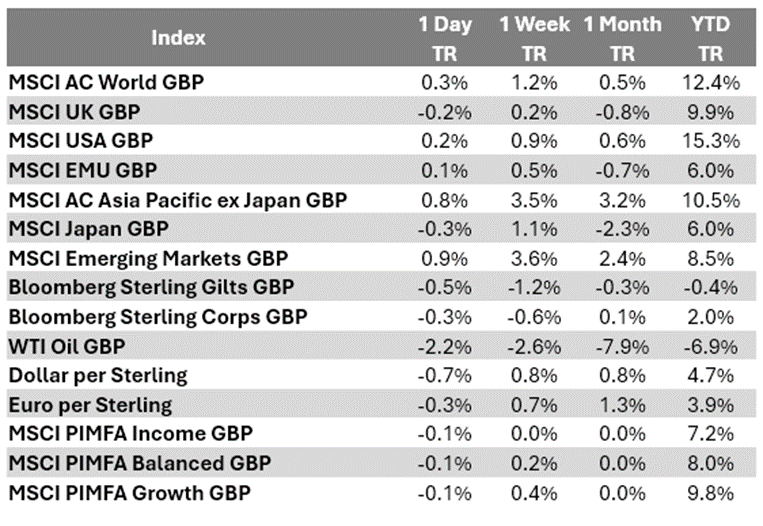
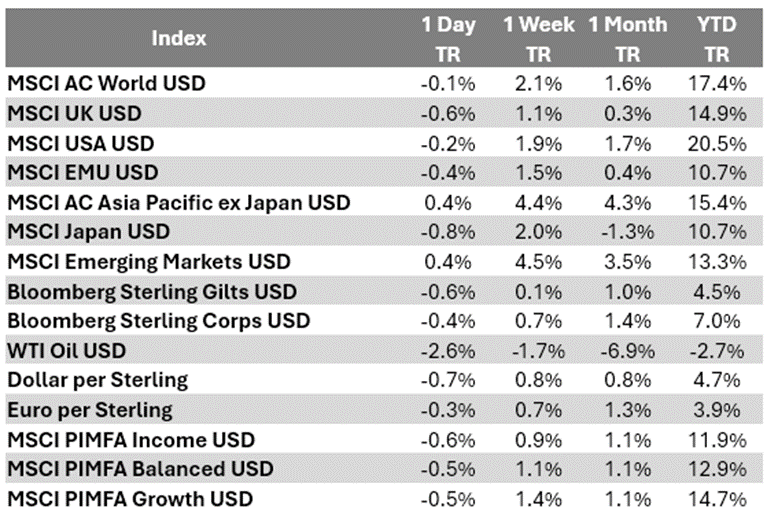
Bloomberg as at 26/09/2024. TR denotes Net Total Return.

Please continue to check our blog content for advice, planning issues and the latest investment, market and economic updates from leading investment houses.

Charlotte Clarke

26/09/2024