
Team No Comments

Brewin Dolphin – Markets in a Minute

Please see this week’s Markets in a Minute update below from Brewin Dolphin, received yesterday afternoon – 12/11/2024.

As anticipated, last week was very significant for investments. It was dominated by the U.S. elections, but also included some key interest rate decisions and some additional political developments.

We won’t dwell on the elections as we covered those last week. At the time of writing, it remains likely the Republicans will achieve a clean sweep of both chambers of the U.S. Congress (the Senate and the House of Representatives) as well as the presidency. However, the race for the House of Representatives has not yet been called definitively.

The reaction to the results was largely intuitive. Equities generally benefitted, reflecting the prospect of less regulation and potentially lower taxes. However, some investors have a slight concern on two fronts. On one hand, the erratic nature of President-elect Donald Trump could warrant an increased premium for risky assets, suggesting their price should fall. On the other hand, the imposition of tariffs, which should reduce global growth, could weigh on equities. 

That said, it shouldn’t come as a great shock that the more optimistic interpretation of a Trump presidency outweighed these concerns, which mimics the market reaction to his first tenure.

The potential impact of Trump’s tariffs

Tariffs, according to economic theory, are a negative sum game. There may be winners and losers, but in aggregate, growth should be reduced – not least because typically, tariffs imposed by one country will be met by retaliatory tariffs. However, due to the U.S.’s current account deficit, tariffs are likely to reduce imports and therefore increase growth.

While the U.S. equity market does not perfectly reflect the U.S. economy, and the same is true for most other regions to differing degrees, it still seems safe to believe that tariffs improve the outlook for U.S.-listed companies relative to the outlook for companies in other jurisdictions. The main burden of tariffs falls upon companies selling goods cross border, but in time, they’ll be able to mitigate this challenge if they can relocate their manufacturing to the U.S. and get behind the tariff barrier.

Indeed, President-elect Trump sees them as a means to encourage foreign direct investment into the U.S. That, alongside reduced environmental protection and regulation, is expected to provide a boost to growth through investment. This was reflected in gains for companies that will facilitate this investment.

The costs of renewed global trade friction would fall on economies that are very open and run current account surpluses in goods. The Eurozone meets these criteria, so the election result is an undesirable development alongside a host of additional challenges the region is facing, such as the loss of gas supplies from Russia, and weakness in the Chinese export market.

Germany divided on government borrowing rules

So great are these challenges that Germany has been considering radical changes to its fiscal framework to address them. But opinions are divided on the best course of action, with German Chancellor Olaf Scholz having effectively triggered an early election this week, reflecting divisions within his three-party coalition.

Scholz fired Finance Minister Christian Lindner, who’s the chairman of the pro-business Free Democratic Party (FDP), over a refusal to suspend rules limiting new government borrowing. Scholz has now called for a confidence vote in January, which he seems certain to lose. Next year’s federal election will therefore be brought forward to March from September.

As it stands, the Social Democratic Party (SDP) has moved from first place to third in the polls. The centre-right Christian Democratic Union (CDU) would likely be the biggest party, but the further-right Alternative für Deutschland (AfD) would also have a good chance of being the official opposition, representing a very meaningful shift in the political landscape of Germany.

The coalition had been quite dysfunctional but seems to have collapsed most tangibly due to the FDP’s intransigence on the topic of German rules limiting new borrowing. Two of the coalition partners, the SDP and the Greens, favour expanding debt to fund initiatives like tackling climate change and strengthening the military.

The rules restrict annual structural deficits to 0.35% of GDP and were enshrined within the German constitution in 2009. The debt brake has historically had quite broad support, including from the SDP and CDU, which were the big two parties in German politics. Most major parties are, however, having some internal debate on the topic, and support typically ebbs the further to the left you go. But even within the CDU, relaxation of the debt break is being discussed.

So far, the far-right AfD party still seems quite unified in its support of the debt brake. This is perhaps not what you’d expect from a party that can be seen as socially populist. The far-left Die Linke has been the only consistent opponent of the rule.

European services activity remains weak

Last week’s economic surveys offered an opportunity to test the health of different regions. They showed Europe still seems to be missing out on the ongoing global expansion in services activity, with the region’s weakness stemming from its core in France and Germany. Other parts of Europe have seen some improvement, and the U.S. remains the relative bright spot. The UK saw only a slight moderation in services activity but has the prospect of higher employment taxation to wrestle with.

UK and U.S. see interest rate cuts

The Bank of England cut interest rates by 0.25% on Thursday. It acknowledged that it may only cut rates slowly, because despite the tax increases announced in the Autumn Budget, the government will pump more money into the economy through public spending – particularly over the next two years.

The Federal Reserve also cut interest rates by 0.25% this week, but it will want to see how tax policy evolves before deciding on the impact this will have on interest rate policy.

A less than impressive dragon

Looking to China, and its economic activity continues to underwhelm. Last week, all eyes were again on another political press conference following a meeting of the Standing Committee of the National People’s Congress.  

Hopes that further fiscal stimulus would be launched were again dashed. Instead, confirmation was given of a six trillion yuan plan to swap the expensive liabilities of local government financing vehicles for cheaper debt issued by the local government itself.

Please continue to check our blog content for advice, planning issues and the latest investment market and economic updates from leading investment houses.

Charlotte Clarke

13/11/2024
Team No Comments

The Daily Update | Trumped-Up Delusions and the Madness of Crowds

Please see below article received from EPIC Investment Partners this morning, which provides advice to investors in the current market climate.  

The notion that increased government borrowing always drives up Treasury yields is deeply ingrained in financial markets, often treated as an indisputable truth. Yet, as Charles Mackay cautioned in his 1841 classic, “Extraordinary Popular Delusions and the Madness of Crowds”, markets have a peculiar tendency to cling to assumptions that crumble under scrutiny. Could this seemingly self-evident relationship between debt and yields be another “popular delusion”? 

Conventional wisdom suggests that higher government debt issuance floods the market with bonds, forcing yields higher. But this view is overly simplistic, especially when the Federal Reserve is actively managing monetary policy. Large-scale U.S. Treasury issuance does increase the supply of bonds, but it also drains liquidity from the financial system. When investors purchase these bonds, they do so with cash, effectively reducing the amount of money circulating for other investments. This “cash drain” acts much like a tightening of financial conditions, making it more costly for businesses and individuals to borrow. 

This liquidity reduction can lead to “crowding out,” but not in the traditional sense. Rather than directly competing with the private sector for loanable funds, government borrowing reduces overall liquidity. This can push investors away from riskier assets and toward the relative safety of government bonds, stabilising or even lowering yields rather than pushing them up. 

The Fed’s actions add another layer to this dynamic. When the central bank eases policy, it typically lowers short-term interest rates by buying bonds on the open market. These actions inject liquidity back into the system, offsetting the drain caused by Treasury issuance. This creates a nuanced effect on supply: while Treasury issuance drains liquidity, Fed purchases restore some or all of it, creating conditions that can contribute to a flatter yield curve rather than the anticipated steepening. 

These dynamics challenge the belief that “more debt equals higher yields.” In fact, empirical data reveals that budget deficits have minimal predictive impact on Treasury yields. Instead, Treasury issuance and Fed easing together are more likely to contribute to curve flattening than to any significant yield increase. This is evident in the sharply flattening yield curve observed recently, as investors position themselves for the reality that safe-haven demand, liquidity flows, and central bank interventions are often stronger influences on yield dynamics than raw debt levels. 

For a clearer view of how the yield curve is truly shaped, investors would do well to consider the broader forces at play—liquidity, central bank policy, and demand for safety—rather than blindly following the crowd. While challenging conventional wisdom can be daunting, making independent, well-informed decisions is often far more effective than succumbing to the “madness of crowds.” 

Please check in again with us soon for further relevant content and market news.

Chloe

12/11/2024

Team No Comments

Tatton Investment Management – The Monday Digest

Please see the below article from Tatton Investment Management detailing their thoughts on the US election results and the potential impact a Trump presidency could have on markets. Received this morning 11/11/2024.

Known winner, unknown outcomes

We expect some risks but potentially higher rewards for US assets under a second Trump term. Markets are clearly excited, but some of the equity rally was about pent-up demand – as investors had de-risked ahead of an uncertain election. The policy details are still murky, and economists worry that tariffs (which would reach record highs if they matched Trump’s campaign promises) and deportations could stoke inflation. The timeline for policy implementation therefore matters as much as the policies themselves, so we expect stimulatory supply side measures like tax cuts before the restrictive measures like tariffs. 

We might see protectionist policies in Germany too, following the government’s collapse and upcoming election (in which the centrist parties will try to appeal to the growing populist vote). The German economy has been stuck between a rock and a hard place: energy prices hit by Ukraine, industrial profits squeezed by Chinese overproduction. Both could improve, if Ukraine cedes territory (likelier under Trump) and China succeeds in stimulating its domestic demand. We just hope Germany has a functioning government to guide toward that light at the end of the tunnel. 

Almost lost in the news this week was the US Federal Reserve and the Bank of England both cutting interest rates. UK and US bond yields fell in response, and the two bond markets remain closely tied. That won’t change soon, but we could see some divergence in the long-term if UK bonds come closer in line with Europe, and US bonds are weighed down by debt deterioration. 

Trump’s second term could be very different to his first. Markets liked his previous tax cuts, but there was a sense that turbulence and drama were barriers to achieving more. His “promises made, promises delivered” victory speech suggests he is aware of this, and might try to keep a stable cabinet for the next four years. We will need to keep an eye on who is appointed ahead of inauguration. Markets seem to be betting that policy will be more coordinated and less disruptive this time around. For investors’ sake, we hope so.

What does Beijing do now?

Chinese assets sold off after Donald Trump’s election win. His 7.5%-25% tariffs on Chinese imports in his first term already hurt Chinese producers, and he supposedly wants to hike them to 60%. That would compound China’s disinflation problem – which recently spurred the government into announcing economic stimulus. There have been mixed messages from Beijing about how much actual support they are willing to give, as some policymakers (and possibly Xi Jinping himself) seem reluctant to wholeheartedly boost consumer demand – as previous stimulus created the credit bubble that led to the current downturn.

60% tariffs would force Beijing to confront its demand problem. Last week, policymakers announced a 10 trillion yuan ($1.4tn) debt plan, but this mostly amounted to relocating debt from local to central government. There were suggestions that Beijing was waiting for the US election before committing to a plan – a reasonable tactic. We expect a plan to boost consumption, possibly after December’s economic conference for the communist party. Chinese stocks will rise if markets like the proposals, but we would caution that long-term profit improvement is needed before China can be seen as a good long-term investment.

Business sentiment is improving faster than expected among manufacturers and service providers – but some of this is due to exporters rushing out orders ahead of tariffs coming in. Xi has talked up the need to draw in foreign capital, but that requires removing some structural barriers and building domestic citizens’ confidence in their own asset markets first. Oddly enough, the US-China decoupling could actually help build that domestic focus. 

We should note that China’s market impact goes beyond just its domestic risk assets. China is heavily invested in US treasury bonds, and it remains to be seen what happens to those holdings in Trump’s second term. It’s possible that Chinese growth could suffer even if global growth benefits – due to Beijing’s demand stimulus.

US debt risk

Donald Trump’s tax cuts threaten US bond markets in a way that’s hard to quantify. Government bonds are called ‘risk free’ – but only because governments can theoretically print money to pay back debts. Prices can still be volatile (as we know all too well from the ‘Liz Truss moment’) and one way people try to measure this risk is through the so-called ‘term premium’, the difference between long and short-term yields. However, this measure is blurred by the fact yields at different maturities also reflect economic expectations. 

Another good way to measure bond risk is by comparing yields to swap rates between banks, where one bank swaps a long-term interest-paying instrument for a secured overnight lending rate. After the global financial crisis of 2008, the Federal Reserve effectively guarantees this lending, making the swap rates even more ‘risk free’ than government bonds. 

Please continue to check our blog content for advice, planning issues and the latest investment, market and economic updates from leading investment houses.

Alex Clare

11/11/2024

Team No Comments

What Trump’s win may mean for the markets and economy

Please see below article received from Invesco this morning, which considers how Trump’s approach to five key policies may impact on the markets.

Now that the election is over, and Donald Trump is set to take office on January 20, 2025, investors are wondering what his policies may mean for the markets and economy. Based on pledges made on the campaign trail, here are five key things we’ll be watching for from the President-elect.

We believe, however, that investors often overstate the impact that the federal government has on broad financial markets. In fact, monetary policy is likely to have greater influence on markets in the next few years than any forthcoming legislation or executive action. Ultimately, policymaking is about setting priorities. No administration gets everything they want, nor do markets necessarily respond to the political initiatives in the “obvious” way.

Trade and investment

  • Pursue “America First” agenda
  • Implement universal baseline tariff of 10%
  • Increase tariffs on Chinese goods to “more than 60%”
  • Impose 100% tariff on cars made outside the US
  • Use blanket tariffs to penalize companies that outsource US jobs

Market implications

  • Policy uncertainty.A period of trade policy uncertainty could potentially weigh on markets until greater clarity emerges.
  • Strong US dollar.Despite the latest reporting that Trump is considering forcing a weaker dollar to encourage exports, the US dollar would likely strengthen amid expectations that policies would result in stronger US growth compared to the rest of the world.
  • Protection for select industries.Tariffs on European and Chinese goods could benefit US companies in certain industries such as steel, aluminum, and paper.

Tax policy

  • Cut funding for the Internal Revenue Service
  • Cut corporate tax rate to 15% for companies that produce their goods in the US
  • Remove tax from Social Security benefits  
  • Work with Congress to make individual tax cuts for those above and below $400,000 income level and estate tax thresholds permanent
  • Could extend the TCJA special 20% tax deduction for pass-through businesses that’s set to expire
  • Withdraw from or renegotiate the international tax agreement
  • Remove tax on tipped income and on overtime pay

Market implications

  • Reduced demand for tax-advantaged investment vehiclesbecause historically, there has been lower demand for them during periods of lower taxes.
  • Real estate investment trusts (REITs) are likely to benefit if the special 20% pass-through tax deduction is extended, that would allow REIT shareholders to deduct 20% of taxable REIT dividend income they receive, not including dividends that qualify for capital gains rates.

Immigration

  • Implement a sweeping mass deportation program to remove all illegal immigrants from US
  • Issue executive orders to place conditions on immigration
  • Resume the building of wall at US southern border
  • End automatic citizenship for children of undocumented immigrants born in US
  • Partner with local law enforcement on “catch and release” strategy

Market implications

  • Negative impact to certain industriesthat utilize immigrants for labor such as hospitality, health care, manufacturing, construction, and agriculture, which could face challenges like higher labor costs and lower profit margins
  • Potential demographic and growth challengesgiven the relatively low birth rate for US citizens

Federal Reserve (Fed)

  • Could resume dovish pressure/rhetoric toward the Federal Open Market Committee
  • Potential plans to make the Fed less independent
  • Uncertain whether Fed Chairman Jerome Powell would be reappointed when his term expires in 2026
  • May propose non-traditional candidates for Fed Chairman and Governors

Market implications

  • Challenges to Fed independence raises risks to markets and inflation expectations could potentially reaccelerate, resulting in higher interest rates and lower equity valuations.

Fiscal Policy

  • Rein in government spending on foreign aid, clean energy and climate mitigation funds, and immigration
  • Protect Social Security and Medicare reforms from benefit cuts
  • Extend tax cuts implemented in first administration
  • Establish “Department of Efficiency” under Elon Musk with goal of cutting $2 trillion in spending

Market implications

  • Level of fiscal discipline will depend on whether there’s a split government; if there’s a one-party sweep, we’re likely to see higher fiscal deficits

Please check in again with us soon for further relevant content and market news.

Chloe

08/11/2024

Team No Comments

Now that the dust has settled … My thoughts on the Budget

A week has now passed since Rachael Reeves delivered the first Labour budget in 14 years. There was plenty to unpack, as the Chancellor sought to raise £40 billion to fund large increases in public spending.

Below is a short summary of the key points and areas that might have the biggest potential impact on financial planning.

Income Tax

The headline rates of income tax remain unchanged, with income tax thresholds continuing to be frozen until April 2028. From April 2028, the thresholds will rise in line with inflation, measured by th CPI.

With the thresholds frozen, more income will be subject to income tax as wages increase. More people will be dragged into the higher and additional rate tax brackets, too. Structuring income in the most tax-efficient manner, when you have control, helps to grow and sustain assets for the future.

Capital Gains Tax

From the day of the Budget, the headline rates of Capital Gains Tax were increased to 18% and 24% for gains within the basic and higher rate bands respectively, up from 10% and 20% previously. The rates of Capital Gains Tax for residential properties remain at 18 and 24%.

Business Asset Disposal Relief (previously Entrepreneur’s Relief), available on the sale of qualifying businesses, will also be increased over time, rising from 10% to 14% from 6th April 2025, and again to 18% from April 2026.

These changes highlight that tax-efficient planning is now more important than ever. We have already seen the Capital Gains Tax Annual Exempt Amount slashed from £12,300.00 in 2022/23, down to £3,000.00 this tax year. Using a blend of different tax wrappers and utilising all available allowances will help to protect your assets for the long-term.

State Pensions

The State Pension is to remain protected by the ‘triple lock’, rising by 4.10% in April 2025, an increase of £471.60 per annum on a full State Pension.

This is an above inflation rise, providing a ‘real’ increase to State Pension incomes. A bit of balance for those that have lost the Winter Fuel Allowance.

Inheritance Tax

The Chancellor confirmed that the current Nil Rate Band and Residence Nil Rate Band will remain at £325,000 and £175,000 respectively until 2030.

Like with income tax, the freezing of these thresholds means more and more estates will become liable to inheritance tax as asset values rise with inflation.

A big change is coming from April 2027, as unspent pension funds will be brought inside the scope of inheritance tax. More detail around this change is needed and a consultation is now underway to determine how it will be implemented.

Pensions forming part of the estate for inheritance tax is likely to significantly increase liabilities, as well as reducing the effectiveness of using pension funds as an intergenerational wealth planning tool. When we have the detail, we will discuss tailored strategies with our clients for pensions and long-term planning.

The Chancellor also confirmed that Business Property Relief and Agricultural Property Relief will now be subject to a limit of £1 million per investor from April 2026, above which, a reduced rate of 20% inheritance tax will be due on these qualifying assets.

AIM investments will also cease to benefit from 100% inheritance tax relief from April 2026 and will instead be subject to the reduced tax rate of 20%. AIM investments must still be held for 2 years prior to death to benefit from this reduced rate.

The above changes will increase the amount of estates liable to inheritance tax, and the amounts of inheritance tax due, making comprehensive inheritance tax planning more relevant than ever to ensure that your estate can be preserved and passed down as you wish.

Utilising gifting allowances, trust planning, investing in Business Relief assets and insuring inheritance tax liabilities with Whole of Life Assurance policies are just some of the strategies we can use to mitigate inheritance tax. These strategies need to be tailored to individual requirements.

Employer National Insurance Contributions

From April 2025, the threshold on employee earnings above which National Insurance Contributions are paid will reduce from £9,100 to £5,000. Alongside this change, the rate of National Insurance for employers will increase from 13.8% to 15%.

This will substantially increase costs for employers, potentially leading to these increased costs being passed on to consumers via an increase in the prices of goods and services. Managing inflation will continue to be a key priority for the Bank of England.

Summary

The budget has brought some significant changes, with a sweeping package of tax rises alongside large commitments to spending.

The key theme in light of the Budget is that proper, comprehensive financial planning is more important than ever.

Remaining as tax efficient as possible protects assets and increases their long-term sustainability. Utilising ISA allowances every year, funding tax-efficient products, tailoring income where possible and starting inheritance tax planning early, will all be crucial.

We will await further details and communicate them to you as they become available.

As always, please get in touch if you would like to discuss anything further.

Alex Kitteringham DipPFS

7th November 2024

Team No Comments

Brewin Dolphin: U.S. elections: What they mean for the economy and markets

Please see the below article from Brewin Dolphin which talks about the potential impact of a Trump presidency on markets:

What sorts of market-relevant policies can we expect under a Trump presidency?

Market policies under a Trump administration are likely to be shaped by his hardline stance on trade and immigration. Key measures include:

Trade

President-elect Trump is a staunch supporter of tariffs, calling it the “most beautiful word” in the dictionary. Indeed, he has threatened to impose 60% tariffs on China, and 10-20% tariffs on imports from all U.S. trading partners. If he follows through on these threats, it will represent a major escalation from what he did in his first term, during which he imposed 10-25% tariffs on China.

Tax and spending

Trump has promised large tax cuts, which he plans to partly fund through tariffs and cuts to environmental spending. He has also proposed significant spending increases in areas such as defence, border protection and deportations, and suggested moderate hikes to spending on health care and housing.

Yet tariffs and cuts to environmental outlays are not projected to be nearly enough to pay for his proposed tax cuts and spending. The result? A full implementation of Trump’s plan would see a large rise in the U.S. government deficit. But the extent to which his tax and spending plans are implemented will be determined largely by whether the Republicans control Congress.

Immigration

Trump is expected to be tough on immigration, vowing to deport the roughly 11 million unauthorised migrants in the U.S. He also proposes to restrict legal migration, imposing “extreme vetting” of visa candidates and ideological screening.

What are the implications of Congressional control?

Any new laws (which includes taxation and spending) need to be approved by both chambers of Congress – the House of Representatives (the “House”) and the Senate.

We already know the Republicans have won back control of the Senate, and we’re still waiting to find out if they’ve maintained control of the House, with several races too close to call. We may not know which party ends up with control of the House for several days, but the betting markets strongly believe the Republicans will win. Polymarket, the world’s largest prediction market, implies a 95% chance of a Republican sweep.

If the Republicans win the House, can we expect all the tax cuts and spending that Trump has promised?

Trump is unlikely to be able to deliver all the tax cuts and spending that he promised during his campaign. Why? Because it’s likely he won’t have the support from members of his own party in Congress to do this.

Republican Senator Rand Paul has been particularly critical of government deficits. And his criticism has extended to his own party, with Trump’s deficit-busting policies in his first term a big reason why he refused to endorse Trump in this election. There will likely be other Republican senators who may also be reluctant to ramp up deficit spending, too.

As a base case, we could expect a Republican Congress to extend the 2017 personal tax cuts for everyone. But when it comes to other Trump tax-cutting proposals, such as not taxing tips, overtime pay or social security benefits, I would expect several Republican senators to put up resistance.

Some Republicans in Congress have proposed cutting spending on programmes such as Medicare and Social Security to pay for tax cuts, which Trump does not want to do as it would be very unpopular. It will be interesting to see how these discussions unfold, particularly given the Republicans’ previous inability to repeal Obamacare during Trump’s first term.

But what if the Democrats win control of the House?

Although this appears unlikely, it’s still possible. If this ends up being the result, given rising polarisation, there would be very few of Trump’s policies that the Democrat-controlled House would agree to.

Among the few areas where Republicans and Democrats could work together is on legislation aimed at containing China, and possibly the extension of personal tax cuts for households making less than $400,000 per year. But crucially, even without Republican control of Congress, Trump would retain significant latitude to implement his policies in areas such as regulation, foreign policy, trade and immigration.

How will Trump’s policies impact the economy?

Tariffs are quite possibly a bargaining chip for Trump. However, if he went ahead with his threats, countries with large trade surpluses relative to the U.S. would be among the most negatively impacted. Nevertheless, in a global trade war, it’s likely the U.S. economy would also suffer.

According to estimates from think tank, the Tax Foundation, a 10% trade tax matched with in-kind retaliation would shrink the U.S. economy by 1.1%. With this in mind, it’ll be interesting to see just how far Trump is willing to go on tariffs, and how willing other countries are to make concessions to the U.S., potentially preventing an all-out global trade war.

The growth of the labour force has a big impact on an economy’s aggregate growth rate. Considering this, Trump’s immigration goals could potentially weigh on U.S. growth.

As discussed above, how fiscal policy evolves depends on whether Republicans win back control of the House and, if they do, how willing Republicans in Congress are to tolerate budget deficits. However, it’s worth noting that most of the value of Trump’s proposed fiscal measures come from tax cuts. The impact on growth from tax cuts is not particularly high. And to the extent that the tax cuts are financed by reduced government spending, that should weigh on growth. Additionally, the rise in bond yields resulting from the issuance of all the new government bonds the market will need to absorb will pose a headwind to economic growth.

How will the UK be impacted by Trump’s policies?

The UK would probably not be as negatively impacted by higher tariffs as other countries, but it would likely still suffer (witness the decline in the pound versus the dollar today). UK exports in the auto, pharmaceutical and liquor sectors would be particularly impacted by U.S. tariffs.

The UK government would likely retaliate, imposing its own tariffs. This could then push up inflation in the UK. The net impact on interest rates would depend on whether the downward effect from weaker growth was stronger than the upward effect on inflation.

Trump has also promised to pull the U.S. out of the Paris Climate Agreement, which has implications for the UK and the rest of the world. While Trump’s less solid commitment to NATO also has security implications for the UK, as does his weaker support of Ukraine.

What has been the market impact of the election result?

The U.S. dollar has surged on the back of the election result, reflecting the likelihood that Trump trade policies will cause the growth gap between the U.S. and other countries to widen. The 10-year U.S. Treasury yield has also shot higher, reflecting the potential for greater deficit spending. Meanwhile, U.S. stocks have rallied, with investors bullish about the impact of deregulation and fiscal stimulus under Trump.

Following Trump’s campaign promise to make the U.S. the crypto capital of the world, Bitcoin has rallied to a new high. Tesla shares have also surged, as markets expect Trump supporter Elon Musk to benefit from his win.

On the other hand, the oil price has moved lower, largely on the back of expectations that Trump policies will result in greater U.S. oil and gas production. We doubt this is moving markets today, but Saudi Arabia could flood the market with supply at some point. Why? In order to prevent U.S. shale companies from gaining further market share and also limit the extent to which they are willing to aggressively boost production in the future.

Is a Trump presidency good news for equity markets?

Global equity investors should be wary of the likely rise in trade uncertainty that will occur under Trump, with the potential for an all-out global trade war. Additionally, the weaker immigration expected under Trump should also act as a headwind on U.S. growth.

Furthermore, Trump’s trade, immigration and fiscal policies may result in higher bond yields than would otherwise be the case, posing a challenge for economic growth and the equity market. That said, equity investors should welcome the deregulation drive that will now likely occur under Trump, as well as the potential for some tax cuts in the event of Republican control of the House.

While politics and fiscal policy play a crucial role in determining market direction, a host of other variables, including the stage of the economic cycle, monetary policy, sentiment, and valuations, are also key drivers of investment performance. We continue to believe there is scope for global equities to keep moving higher, driven by the ongoing strength in corporate profits.

Please continue to check our blog content for advice, planning issues and the latest investment market and economic updates from leading investment houses.

Andrew Lloyd

07/11/2024

Team No Comments

Brewin Dolphin – Markets in a Minute

Please see this week’s Markets in a Minute update below from Brewin Dolphin, received yesterday afternoon – 05/11/2024.

Key market highlights

Markets laboured a little as October gave way to November, with some key risk events occurring last week and this week, such as last Wednesday’s UK Autumn Budget and this week’s U.S. election.

Meanwhile, Japan held a general election on 27 October, which saw a surprising rejection of Japan’s ruling Liberal Democratic Party (LDP). It was the first time since 2009 that the LDP failed to secure a majority. That record hides the fact that Japan is typically in a state of political chaos, with a rapid turnover of prime ministers from within the LDP ranks.

Although dramatic, the market impact of a probable minority government with limited scope to make reforms was modest. The yen slid, helping stocks rise (in local currency). The market implications of the UK Autumn Budget were more meaningful.

The Big British Budget

Since coming to power, the Labour government has worked to manage expectations, discussing the need to raise taxes to arrest the deterioration in public services while also preaching the need to be fiscally responsible. Chancellor Rachel Reeves has inspired confidence in the markets due to her pedigree as a former Bank of England economist.

Against this background, the sheer size of the Budget was surprising to many. Although it perhaps reflects the very difficult position the government finds itself in, some of the numbers were really shocking. While this wasn’t the highest ever tax-raising budget, it was up there.

At the same time, you couldn’t really describe it as a particularly meagre Budget because despite taxes rising by £40bn, this was more than offset by increased spending, leading to a net injection into the economy of around £35bn (which will come from borrowing).

Bonds bashed by Budget

The size of the borrowing initially caused a sell-off in bonds on Wednesday afternoon, which deepened the next day. Why? Analysis of these figures leads to several conclusions. The direct impact is more government bond issuance, but the spending will lead to greater demand.

We’re not quite in the stretched position we were in during 2022, when inflation was surging and then Prime Minister Liz Truss tried to stoke demand through tax cuts, but a similar problem remains.

Increasing demand through government spending at a time when there’s very little spare capacity in the economy will cause inflation. To put it another way, more public sector hiring would likely mean tempting people out of private sector roles with attractive compensation packages. To combat this, the Bank of England would be obliged to offset the increase in demand through higher interest rates.

So, what does this mean for the trajectory of interest rates? It’s still expected they will fall this week, but “bolt-on certainty” has been downgraded to “quite likely”. Further out, interest rates were expected to fall to 3.8% over the next year before the Budget announcement; they’re now anticipated to fall to 4.1%.

Generally, the interest rate trajectory had been steepening a little over the last few weeks, but a lot of that reflects falling chances of the U.S. entering a recession rather than the market anticipating an expansionary UK Budget.

The pound was weak following the Budget, which might seem odd given the prospect of higher interest rates. This belies the fact that rates are not the market’s only concern.

Borrowing was higher than had been anticipated, but there are other concerns too. Although spending will be increased sharply, that pace of increase tails off in three years’ time. In years four and five, it slows materially, and that’s a concern. Some might be sceptical that a Labour government will slow public services investment in the two years leading up to an election.

Looming fiscal threats

The implication is that despite taxation income being expected to rise to a record of more than 38% of gross domestic product (GDP), more spending could be required later in the parliament. The political cycle suggests that at that point, it would be better to meet this through borrowing rather than taxation. This sense is bolstered by the lack of any rabbit pulled from the Budget hat.

Of course, better public services should lead to higher productivity. However, despite having a well-regarded economist as chancellor, who has presumably been planning for this Budget for a long time, there was no fresh and innovative approach to tax policy, or incentives that might cause a step change in growth, which would make the new tax burden easier to shoulder.

America’s mixed outlook

The third quarter earnings season reached its climax with Apple, Amazon, Alphabet, and Microsoft all reporting last week. Earnings beats have been marginally less plentiful than normal (around 75%, rather than the more common 80%). The tone has been one of resilience.

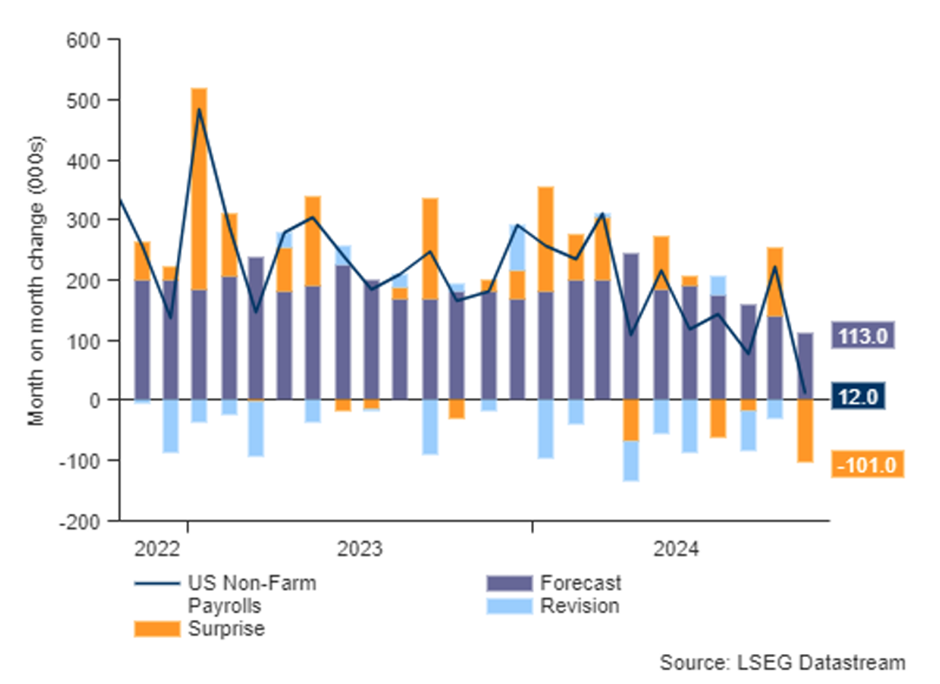
The U.S. economy has been strong over the year but was buffeted by hurricanes and a strike by Boeing staff during October. For that reason, we have a rather confusing U.S. employment report to unpick at the start of November.

Only 12,000 new jobs were added during the month, but the Bureau of Labor Statistics was unable to say how much of this was due to Hurricane Milton. More than 40,000 jobs were missing due to strike action in the transportation industry.

Although it’s difficult to draw conclusions from this report due to events during October, there were reductions to the initial estimates for September and August, such that the most reliable data that can be taken from this temporarily unreliable report suggest it should be considered downbeat. This would fit with a further reduction in job openings, reported in the Job Openings and Labor Turnover Survey (JOLTS) last Tuesday. There are now just under 1.1 job openings per unemployed person.

The trend of weakness in job openings will support the Federal Reserve in cutting interest rates when it meets this week.

Please continue to check our blog content for advice, planning issues and the latest investment market and economic updates from leading investment houses.

Charlotte Clarke

06/11/2024

Team No Comments

EPIC Investment Partners – The Daily Update

Please see the below article from EPIC Investment Partners detailing their discussions on the potential impacts of the US presidential election on markets. Received this morning 05/11/2024.

Today’s US presidential election promises to shape policy across sectors that touch every corner of the market. Yet, while much of the world is fixated on the outcome, a more complex story of market anxieties is unfolding. Despite the distinct policy directions each candidate might pursue—from trade tariffs to fiscal and environmental policies—market concerns seem to converge on one overarching theme: inflation and its impact on interest rates. Recent tariff tensions, especially those involving China, have stirred fears of rising costs that could, in theory, compel the Federal Reserve to tighten rates. However, a closer look suggests these fears may be overstated. Inflation sparked by tariffs is fundamentally different from the kind that typically spurs rate hikes, and this distinction is critical. 

Take trade policy, for example. A second term for Donald Trump could bring escalated tariffs and a shift towards protectionism, raising import costs, particularly for goods from China, and potentially stoking inflation. By contrast, a Kamala Harris administration might pursue a more multilateral approach, reducing trade barriers to ease cost pressures. Yet, whether tariffs rise or fall, the inflation they trigger would primarily be of the “cost-push” variety, where prices rise due to higher import costs rather than increased demand. This distinction matters because the Fed typically addresses demand-driven inflation with rate hikes, not cost-driven price increases that tend to dampen consumer spending.

Markets often fear inflation, associating it with tighter monetary policy. However, tariff-driven inflation could lead to the opposite outcome. Cost-push inflation from higher tariffs functions like a tax, squeezing disposable income and cooling demand. While markets may worry that the Fed will pause rate cuts or even tighten, this reaction seems misplaced. The Fed, aware of the nuances of cost-push inflation, might lean towards easing rates more quickly in response to slower growth and reduced consumer spending power. Tariffs, after all, do not fuel an overheating economy—they act as a burden on it, potentially limiting consumer activity and softening overall economic momentum.

While traders and algorithms may continue to sound the alarm at any sign of inflation, the bigger picture suggests more circumspection. Tariffs and cost-driven inflation do not necessarily signal the need for aggressive rate hikes; instead, they may prompt a restrained approach from a Fed more focused on growth stability than on a temporary inflationary spike. While today’s election will undoubtedly influence policy directions, the potential for tariffs to reduce demand rather than fuel inflation suggests that market fears may be driven more by misinterpretation of economic dynamics than by the candidates’ policy differences themselves.

Please continue to check our blog content for advice, planning issues and the latest investment, market and economic updates from leading investment houses.

Alex Clare

05/11/2024

Team No Comments

Tatton Investment Management – Monday Digest

Please see below, an article from Tatton Investment Management, providing a summary of the key issues currently affecting global investment markets. Received this morning – 04/11/2024

US, not UK, battening down the hatches

The budget dominated headlines, but global investors were again preoccupied with US politics. We said that volatility could spike amid tense markers, and that’s exactly what happened. It could continue until the US election outcome is eventually clear.

Many framed the UK budget as a fundamental change, but ironically the main economic impacts look cyclical rather than structural (according to the OBR). Rachel Reeves painted the budget as a starting point – the medicine before later supply-side reforms. We hope so, but only time will tell. Markets reacted negatively but not horribly: stocks fell and government bond yields rose. At least some of the yield rise was budget-related, but for now debt costs still look manageable.

UK bond yields also reacted to higher US bond yields, which rose because of Trump’s possible tax cuts and fiscal deterioration. Bond traders are getting nervous ahead of election day. We suspect non-US investors are also worried about political stability – judging by the fact higher US yields have not attracted the usual level of demand. Stocks sold off on Thursday, as a reaction to bond moves and underwhelming corporate earnings, but, this says more about short-term investor positioning than overall sentiment. We already know that US growth is improving from a slow summer. Absent a damaging post-election fight, the US is well positioned.

European earnings are worse – and unlike the US, it is not just past earnings but future expectations. Russia’s gains in Ukraine weigh heavily, and what happens there depends on the US election too. On the other hand, Middle East tensions have simmered, after Israel’s relatively tame response (avoiding oil sites) to Iran’s missile barrage. Oil prices fell, which should be a boon for global growth. But again, for positivity to manifest, we need to get the election over with. 

October asset returns review

Global stocks gained a respectable 2% last month in sterling terms, but this was almost entirely down to US markets. Large US stocks rose 3.4% in sterling terms, partly due to an improved economic outlook and partly due to dollar strength. Economic data releases made it clear that the US summer soft patch was just a blip and investors are broadly confident about the future – but volatility spiked at the very end of October. This was mostly about investors rolling back risks ahead of the deeply uncertain presidential election. Bond yields rose on a combination of stronger expected growth, the possibility of Trump’s tax cuts and ensuing fiscal deterioration. 

Some might see higher yields as a ‘risk off’ sign, alongside the stronger dollar and record high gold prices, in light of Middle Eastern conflict. But Israel-Iran risks actually dissipated through the month, lowering oil prices. 

European stocks fell 1.9%, amid a worsening growth outlook. Falling interest rates will help, but European companies face a tough road ahead. UK stocks also finished down, while bond yields went up – but this was less autumn budget related than media commentary would suggest. The yield bump at the end of October was partly due to the budget, but month’s trend was more about higher US yields. Japan’s initial stock market struggles, meanwhile, were about political uncertainty – but stocks actually gained in the end after a snap election surprisingly lost the government its majority.

Last but not least, Chinese stocks bounced up and down depending on how strongly investors approved of Beijing’s economic stimulus announcements. Policymakers announced $1.4 trillion worth of extra debt issuance last week, but on closer inspection this was more a restructuring (moving local government debt to the central government) than new fiscal support. Beijing’s stimulus drive has helped – reflected in China’s outperformance over three months – but we still don’t know by how much. 

Demographics and economics

The ONS reported last week that fertility rates in England and Wales fell to the lowest point on record in 2023. Demographic shifts are never linear, so the birthrate is likely to increase again in the next decade (it looks like we’re at a trough), but the long-term trend is clearly down. People often worry that this could lead to a shrinking, aging population. 

The basic problem with that is it leads to more people depending on economic production than those able to produce, holding back growth. If the economy and worker base isn’t expanding, businesses can’t grow and investment declines, ultimately affecting living standards. This is what happened in Japan’s so-called ‘lost decades’: its population now is the same as in the early 1990s, during which time it has gone from the second-biggest economy in the world to the fourth.

But Britain’s population is actually growing, thanks to immigration. Experts think that, because of declining fertility, the UK will need continued net immigration to sustain a working age population for the rest of this century. In situations like these, immigration becomes one of the driving forces of an economy. US immigration, for example, surged post-pandemic which many have argued boosted growth and solved a shortage of labour supply – bringing down inflation. 

Of course, that immigration surge has resulted in Donald Trump promising to deport millions. It’s easy for economists to think of this as an aggregate supply-demand problem, but distributional effects matter, both economically and for social cohesion. Moreover, on a global scale immigration is by definition zero sum. What will happen to the global economy when the world population stops growing? Optimists suggest technology and automation could be the answer – but that’s often just as socially difficult as immigration. Thankfully, we have a while to work out the answer.

Please continue to check our blog content for the latest advice and planning issues from leading investment management firms.

Alex Kitteringham

4th November 2024

Team No Comments

The Daily Update | Relief in Relief

Please see below article received from EPIC Investment Partners this morning, following the Autumn Budget earlier this week.

Amid the plethora of announcements in the Budget, bringing to an end months of conjecture, it was encouraging to see a more moderate approach than feared to changes in Business property relief on AIM holdings. At present, 100 per cent of the value of an AIM portfolio is exempt from inheritance tax under BPR rules. The new rule means just 50 per cent of the portfolio will be exempt, with the other 50 per cent taxed at 20 per cent – less than the standard IHT rate of 40 per cent.

As managers of an AIM portfolio service, it was helpful to see this reflected in sharp rises in many quality stocks, reversing the losses of last month.

But it does highlight the need for even greater due diligence on positions held, as with tax benefits reduced, investors will need greater visibility on measured returns. AIM will have to compete harder for the allocation of cash.

The AIM market has been under significant pressure for a number of years; from the loss of UK Pension Fund allocations, to increased regulation, and a general nervousness towards UK Small cap stocks. On top of these headwinds, the number of bids, US listings, or companies taken private again has dramatically increased. We have seen this in our portfolio, suffering the loss of some very high quality companies.

As the FT noted, the AIM index has lost half its value between late 2021 and late 2023. Tentative signs of recovery in early 2024 were offset by Labour’s victory and fears over significant tax changes. We hope this week’s announcement will see some sustained relief in both share price behaviour and commitment to a market place that embodies much of the aspirations in supporting small companies, industries and management who can be more dominant influence in the future of innovation, employment and capital allocation.

We apply the same process small cap as we do large cap positions, a focus on debt free, cash generative companies, effective allocators of capital with committed management. While everyone knows about Fevertree, we have found some exceptional opportunities ranging from Renew (specialist engineering services), Cake Box (egg free cake franchise), Craneware (solutions for the hospital and health systems), to Ashtead Technologies ( sub sea equipment rental) and Avingtrans (services to energy, medical and industrial sectors).

We continue to scour the market, believe AIM fits well in broader portfolio construction and can find sufficient exciting opportunities to construct a really differentiated portfolio.

Please check in again with us soon for further relevant content and market news.

Chloe

01/11/2024