Team No Comments

Coronavirus Market Update

One of the investment houses we use, Brewin Dolphin, put this content out on email last night:

With the market’s interpretation of the risks of the coronavirus shifting greatly as at the end of February, our Head of Research, Guy Foster has given the following update. 

The real risk to the economy and therefore the lasting impact on people’s savings is likely to be through the efforts to limit the spread of the virus. These measures will cause short term but potentially quite dramatic curbs on economic activity. 

We are confident the economy will recover and strengthen once these curbs can be removed, but we can’t be as confident about exactly when that will happen. In the last few days central banks have announced policy measures to offset some of the deterioration in outlook. 

Investing, unfortunately, does involve shouldering these and other risks, but with a focus on long-term investing we can ride out temporary disruptions to markets and the economy. 

Brewin Dolphin 02/03/2020 17.24

Comment

The key message from a variety of sources, commentaries and webinars digested over the last week is to remain invested.  This is nothing new.  In times of heightened volatility, the big risk is coming out of your investments.

If you remain invested at some point in the future markets will recover and you will feel the benefit.

It’s slightly different if you are drawing an income from your invested assets, for example in Drawdown from your pension fund in retirement.  The action you would take depends on how you are invested, what the underlying investment funds are, and what your overall position is.

It might be appropriate to stop drawing income from your invested assets for now and switch to drawing income, perhaps at a lower level, from your cash reserves.

If you are not sure please get in touch and ask for advice.  Your likely best response to this volatility is to do nothing with your underlying investments, stay invested as you are and be patient.


Steve Speed                                                                                                                                                              03/03/2020

Team No Comments

State Pensions – What you need to understand well before you retire

When the new State Pension was introduced for those reaching State Pension age on or after 6th April 2016, the intention was to simplify the old system which was a State Pension system with multiple different aspects (i.e. the basic state pension, state earnings-related pension (SERPS), the second state pension (S2P) and the graduated retirement benefit).

The new State Pension is a single benefit paid to individuals who have made (or been credited with) 35 years National Insurance contributions.

Unlike the old system it replaced, the new pension is based solely on the contributions of the individual, with no extra amounts awarded based on contributions made by a spouse or civil partner and no inheriting of rights after the death of a spouse or civil partner.

This loss of the death benefits is just one of the major issues with the new system. Unfortunately, this is not widely known by the general public. Government should publicise this issue.

Apart from the obvious issues regarding longevity and possible legislation changes to the State Pension (including the possible loss of the ‘triple lock’*), one of the biggest issues is incorrect State Pension forecasts.

We wrote about this in a blog back in February 2017, https://www.pandbifa.co.uk/state-pension-forecast-wrong/.

Last year the former pensions minister Steve Webb (in partnership with the ‘This is Money’ website investigated this further and found that in some cases, new forecasts were more than £1,000 a year higher than had previously been expected. These cases were raised with DWP who initially said that these were isolated errors which had now been corrected.

However, there still seems to be issues, particularly around people who were members of Defined Benefit pension schemes that had been contracted out.

Commenting on the findings at the time, Steve Webb (who was also the Director of Policy at Royal London at the time) said: “People are increasingly encouraged to use online services to help plan their retirement, and the new pensions dashboard will rely heavily on such data. It is therefore very worrying that hundreds of thousands of people may have received incorrect state pension forecasts and in some cases will have taken decisions about their retirement plans on the basis of incorrect information. Now that the Government is aware of the scale of the problem, it must put an urgent stop to the issuing of incorrect statements. Individuals need to have confidence that the information they receive from the government is accurate and should not have to live with the uncertainty that a statement they have already received may be seriously incorrect”.

If you haven’t already, please visit https://www.gov.uk/check-state-pension to request a State Pension Forecast or call the Future Pension Centre helpline on 0800 731 0175 and request a paper copy.

We will issue new updates on the future of State Pensions regularly and we take this into account at each of our clients annual reviews.

Comment

In general terms the levelling out of the State Pension in April 2016 was beneficial to a lot of low earners and carers. This is good news.

However, for those of us who have lost significant death benefits from the State Pension, the spouse’s pension element from April 2016, advice should be taken to ensure that our long term partners have enough pension provision (or replacement for it) as soon as possible.

Don’t leave it too late, until just before you draw your State Pension. This could be a mistake that you can’t rectify at this stage.

If you wish to discuss any aspect of the State Pension or retirement planning, please contact us at enquiries@pandbifa.co.uk or call us on 0151 546 1969.

Andrew Lloyd 02/03/2020


*The triple lock is the method under which the State Pension increases each year. This is in line with whichever is the highest of consumer price inflation (CPI), average earnings growth or 2.5%.

Data Source: Royal London Press Release – ‘Minister forced to admit ‘significant’ problems as a third of a million incorrect state pension forecasts issued’ – June 2019

Team No Comments

Good News for Prudential ‘PruFund’ Investors

An announcement released by Prudential yesterday afternoon included the following message for our PruFund Growth investors:

If your plan is invested in PruFund:

  • Your plan is made up of units, and you’ll get an increase to unit prices.
  • We increased your unit price by 0.9% on 26 February 2020. From then, your unit price will continue to move in line with the normal smoothing process of PruFund. You can find out more at pru.co.uk/investments/investment-fund-range/prufund/
  • You need to have been invested in the PruFund funds on 26 February 2020 to get the unit price increase. But any money you have in the holding account at that time won’t get the increase.

Comment

Prudential have more money than they need in their With-Profits Sub Fund, their inherited estate built up over many years.

They have these excess funds in their inherited estate and have decided to share it. This is not a regular occurrence, far from it.

This is great news – as markets drop substantially due to coronavirus (hopefully short term) Prudential add a little value for our ‘smooth’ investors! (pun)


Steve Speed                                                                                                                                                         27/02/2020

Team No Comments

Coronavirus and the reaction of markets to pandemic fears

One of the investment houses we use, Tatton Asset Management, has produced this update on coronavirus today (26/02/2020)  Steve Speed.

Coronavirus and the reaction of markets to pandemic fears

Global equity markets have taken a significant hit this week, as investors started to take news of COVID-19 spreading beyond China to the rest of the world more seriously. We thought it would be a good time to consider the historical impact of previous pandemics on global investment markets, as well as assessing some of the likely outcomes we can expect this time round.

The chart below (from Alpine Macro and Charles Schwab) shows when those episodes occurred in relation to global equity market returns. The data suggests that past epidemics have not resulted in any significant or long-lasting damage to global stock prices. While certain economies and markets have been negatively impacted for short periods, most of these potential worldwide pandemic threats have proven to be just that – potential.


Make no mistake, those threats listed were severe, with some truly pandemic. According to research from the World Health Organisation (WHO), the 2009 H1N1 Mexican Swine Flu affected up to 1.4 billion people (at least one in five people worldwide were infected), and had a death rate of 0.2% and an ultimate fatality count in excess of 160,000.

So what’s different this time?

In comparison to those flu-type outbreaks, the news coverage and the extent of preventative action from governments have been of a different order. Indeed, it is the preventative action that mostly affects economies and financial markets. Global manufacturing supply chains have been affected by much of China’s extended lay-off since the beginning of the year. That said, the clearest global impact of the COVID-19 outbreak so far has been on travel and events. The Six Nations Championship rugby match between Italy and Ireland (due to be played in Dublin on 7 March) is expected to be postponed, while several Serie A football matches in Italy are likely to be played behind closed doors. Conferences a month from now, especially those involving international participation, have been cancelled. There are even questions being asked as to how the Tokyo Olympics in August might be affected.

Companies are revising down expectations, and investors expect policymakers to show their hand

The revenues and profits of many companies will be lower in the coming months. Today, Diageo has warned investors that revenues will be lower than expected for this fiscal year, a decrease of about 1-2%.

Some highly-leveraged companies are particularly vulnerable. The most obvious ones are in the logistics, travel and airlines industries. Energy and resource companies, which were stressed by slow global growth before the outbreak began, are facing even higher financing costs.

However, while bank share prices have fallen slightly more than the overall markets, they are not yet signalling fears of a systemic credit issue. Indeed, government bond yields have experienced a sharp fall, accompanied by a growing expectation of interest rate cuts and monetary intervention from central banks. Institutional investors now see a high likelihood that US rates will be cut by 0.25% within two months.

The probability of policy action to offset economic weakness is likely to support markets in the short-term and potentially provide fuel for a sharp bounce in future activity, most likely in the second half of 2020. That, in turn, should see company earnings expectations return to the levels that were expected a few weeks ago, and perhaps surpass them.

Reasons to remain calm and stay positive

Yes, COVID-19 is worryingly contagious. However, most flu-type viruses are seasonal, dissipating through spring in the northern hemisphere. Despite the widening of the infected area in recent weeks, the rate of infection has slowed overall and the WHO has not changed its view that COVID-19 will follow this path, even if it may yet be classed as a pandemic. Action to prevent its spread will continue, and will be a necessary burden on the global economy. Markets may be both hurt and supported by those actions.

China provides a lot of reasons for optimism, having taken those actions. Activity is rebounding across the country already, while infection rates have declined substantially. This positive news has been overwhelmed by cases from other countries, but does suggest that the impacts can and do pass if robust action is taken.

Summary: we still see a case for positive returns in 2020

This bout of volatility will take some time to pass, and further stock market falls are certainly possible, even likely given the nature of the newsflow. However, there is good medium-to-long-term potential for stocks. Developments may well be positive rather than negative (perhaps the arrival of an effective drug) and trying to time any risk reduction (and increase) threatens to destroy value for investors rather than protect them.

At Tatton, we always aim to keep abreast of current risks but recognise that long-term investment must mean not over-reacting to them. Selling into a panic is never a good strategy. What is certain is that when this crisis is blown over (and we have every reason to assume it will), the world economy will be left with plenty of monetary and fiscal stimulus, and much reduced interest rates. The global economy started this year with expectations of positive growth, and we expect that this will still be the case even if it faces a delay.


Tatton Asset Management



Team No Comments

It’s a confidence thing – potential pension legislation changes

We have heard a lot in the media recently about potential pension legislation changes.  The removal of higher and additional rate income tax relief on pension contributions, lower levels of tax-free cash to be drawn from pensions etc.

Why would any government do this?  To raise income or save spending as much, to reduce or limit state spend.  For short term political gain.  We need long-term cross-party policy on pensions, messing with pensions for a quick political win is a mistake.

Pensions can be funded for 30, 40 or 50 years, we need stable pension legislation for the very long term.  You can’t fund pensions on one basis and then somebody moves the goalposts just before you want to retire or draw your pension benefits.

The state (both major political parties) want us to fund our own pensions to take the onus of State Pension provision.  Auto Enrolment introduced in 2012 was another step in the right direction as far as the State is concerned, trying to get everybody to have a pension.

If you keep changing pension legislation the key issue for me is that you will erode confidence in pensions and this in turn would lead to lower rates of pension funding.  You need a lot more than Auto Enrolment levels of pension funding to get a reasonable level of pension income in retirement.

If you get the opportunity please ask your local MP to leave your pension alone, we need to maintain the status quo, or we will erode confidence in the pension system in the UK – this will probably lead to people falling back on the State.  Our politicians need to understand this.

We need long term plans for pensions with a cross party consensus, they are not a short-term issue or piggy bank to raid.


Steve Speed

24/02/2020

Team No Comments

The Value of Financial Advice

Royal London recently published a report on the value of financial advice, this was based on the findings by the International Longevity Centre, who conducted this research on Royal London’s behalf. The results were quite interesting, and support what we already know and our company’s values.

As we know, in an ageing society its important that people are able to plan for their ‘financial security’ in retirement.

In the UK, there are a number of problems relating to the provision of an adequate income in retirement.

The ageing population means that less people are paying tax and national insurance contributions than the current working population, which adds strain to the provision of State Pensions (meaning the benefits could be reduced and the ages deferred).

This along with the fact that the State Pension is unlikely to provide an adequate income alone, highlights the need for private provision.

Another issue of the ageing population is that people are more likely to need their pension/investment assets to last longer.

The volatile markets are also a key issue and financial advice can help navigate around these issues.

The report published demonstrated that expert advice provided by financial advisers delivers real value in improving peoples financial positions.

There is widespread evidence of people failing to plan and save for retirement, participate in the stock market and to diversify their investments appropriately.

An ongoing relationship with a financial adviser has been demonstrated to help in each of these areas.

Receiving professional financial advice between 2001 and 2006 resulted in an increased wealth of £47,706 in 2014/16 (in pensions and investments).

The evidence suggests that an ongoing service provided by a financial adviser leads to better financial outcomes, and those who receive financial advice have nearly 50% higher average pension assets than those who only received ‘one off’ advice (from data complied in 2001/2006 and again in 2014/2016).

The findings clearly demonstrate that financial advice from professionals is valuable to individuals and there is potential for a wider group of people to benefit from advice than do so currently.

Andrew Lloyd 31/01/2020

Data Source: Royal London/ILC: ‘What its worth, revisiting the value of financial advice’ report, published December 2019. The International Longevity Centre (ILC) is the UK’s specialist think tank on the impact of longevity on society.

Team No Comments

Woodford Equity Income – Fund Update Blog

History

As you may recall, it was announced on the 15th October 2019 that Neil Woodford’s flagship fund, namely the Woodford Equity Income fund is to be wound up with effect from 17/01/2020.

Latest

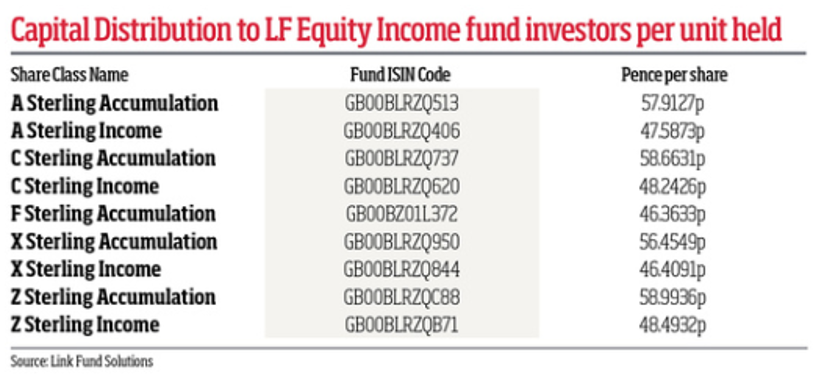
It has today been announced that investors in the LF Equity Income fund (Woodford has been removed from the title), will receive between 0.46p and 0.59p per unit they hold in the fund for the first capital distribution according to Link Fund Solutions (the Fund administrators). Please see the full share class distribution list below:

The payment equates to approximately 70% of the fund’s total value, representing the liquid part of the portfolio that BlackRock Advisers Limited has offloaded already.

Investors will receive confirmation of the total amount they are due by 28/01/2020. The payment will be made “on or around 30 January”, with investors who hold the fund through a platform set to receive theirs “a few days after 30 January due to the time it may take for your platform to process your payment”.

Our Thoughts

This is a good first step for investors in getting some of their capital back. As stated in my original Blog back on the 16th October 2019, the major factor is how will the sale of assets under the less liquid portion of the portfolio be handled. It is important that these assets are not just sold at a lower value to raise capital, as this would impact on the amount of capital investors get back. PJT Partners (UK) Ltd need to take their time in negotiations in order to attempt to get the true worth of the underlying assets held within the portfolio, which they have indicated they will be trying to do.

We will continue to monitor the position and will issue another blog when an announcement is made. As noted previously, our clients are well diversified and are likely to have only a nominal holding in this fund if anything. Diversification helps control the risk.

In the meantime, should you have any queries on this matter, or would like to undertake a financial review of your holdings to better understand how you are invested, please feel free to give us a call on 0151 546 1969.

Carl Mitchell 28/01/2020

Team No Comments

Goodbye 2019 Hello 2020!

If we look back on the last year, we have had an eventful time.  If we expand that time horizon to the last c 4 years who would have believed the following would happen:

  • We vote to leave the EU as a nation
  • Donald Trump becomes the US President
  • Boris Johnson is the Prime Minister of the UK
  • John Bercow as Speaker frustrates democracy with the aid of c 75% of MPs
  • Labour voters turn against Jeremy Corbyn and his policy (lack of policy?) on Brexit

We have had our fair share of political drama in the UK recently, but I think it’s important that we look more globally too.  The biggest issue impacting on markets is the progress (or lack of it) that the US and China are making on their trade deal.

As the US and China move into Phase Two of their trade negotiations they will get immersed in the detail on export and import controls, investment restrictions, and sanctions rather than with tariffs.  The key case to watch will be how the US deal with the global technology business Huawei.  Huawei are a major issue for the US on 5G telecoms technology.  5G will open the door to a wide range of new technologies – a ‘game changer’.

Other technologies such as Quantum Computing and AI/Machine Learning could have a big impact on our lives too.  The investment opportunities are numerous.

There are also plenty of risks. The effects of climate change will continue to be felt globally, and populist politics show no sign of receding. Currently it looks like the barriers to international trade being erected in the US and the UK will be long-term features and may even be added to by other countries. In the 2010s we saw an acceleration of globalisation, the 2020s could well see a reversal. The potential effects of that are unclear.

The slow breaking up of the global trade order would not be good news for China, but it would not stop its rise. It has now reached a size and maturity which allows it – like the US – to rely more and more on domestic demand. Regardless of the global trade picture, we would expect Chinese economic rate of growth to slow from its recent pace over the long term – if only for demographic reasons. The country’s place in the global economic order is entrenched. We expect this to lead to increased confrontation between the US and China, particularly if populism prevails in the former.

The 2020s bring promises and risks, like any new decade. Themes that have been ongoing for decades (globalisation, financialisation, environmental degradation, etc.) could well be set in reverse. Be wary of predictions too, the last few years has shown us all that it’s difficult to predict what will happen next.

In this volatile market the FTSE 100 is not in a bad place and other indices are in a good position too.  With the global political backdrop, the markets look reasonable right now.  But hold onto your hats – it could be a bumpy ride!

If we do experience high volatility, please remember the following:

  • Remain invested in real growth assets
  • Diversification helps, be well diversified
  • Ignore short term volatility if you can
  • Investing is for the long term

Wishing you all a happy, healthy and prosperous New Year!


Steve Speed

30/12/2019


Includes some content from FP & Tatton.

Team No Comments

Post General Election Update 13/12/2019

Whilst exit polls bring about a certain degree of clarity, the moment Blyth Valley went blue just after 11:30pm it was obvious this wasn’t going to be any normal election night. As we sit and digest the full implications of the election result, it is impossible not to conclude that this result is extraordinary no matter your political leanings.

Right now, in the aftermath it is important for us to cut through the rhetoric and political posturing to get to the heart of what matters to investment markets.

A strong majority for the government brings with it clarity, something that markets have been longing for. Investors, both at home and abroad, have largely sat on their hands waiting for the day that the country could move forward with some degree of certainty, which had stymied investment and had put the UK at a significant discount to the majority of its developed market peers.

Initial market euphoria on the morning of the result has been refreshing. Sterling has strengthened substantially and the FTSE 100, that all too often finds itself moving in the opposite direction to the currency due to the prevalence of overseas earners it counts as its constituents, rallied over 1% (nearer 2%). Whereas the FTSE 250, a much more domestically focused index, found itself up over 5% in early trading. The removal of the risk of market unfriendly policies also brings good news for specific sectors, with utilities, property and banks all rallying strongly.

It may be difficult for investors not to get dragged along for the ride, assuming that this election result means that everything is now rosy in the UK. We must, however, remember that this is not the end of the Brexit process, it simply means that the starting pistol has been well and truly fired.


Summary

Volatility is likely to continue as Brexit is negotiated.  We also need to remember that the UK is only a small proportion of global GDP production and economic activity.  In reality, the US/China trade deal is far bigger and the impact on global markets much more significant from this trade deal.

The top geo political risks include major cyber-attacks, rising authoritarianism and trade wars.

However, lets enjoy today as this was the right outcome for markets and the City of London.


Steve Speed

Team No Comments

Investment Update 06/12/2019

I had the benefit of good investment input in a live seminar with Invesco on Tuesday, called ‘Investment Intelligence’ and a couple of webinars from Prudential as they outline their current views for asset class returns in their ‘smoothed’ funds range and celebrate 15 years of investment in PruFund Growth.

Both Fund Managers are substantial in terms of their technical input and capability.  We will take note of their input and views on the markets and consider this alongside other views, JP Morgan for example.

J P Morgan on 05/11/2019 thought that we were finely balanced, and a recession could start in the US and then spread around the world.  It was a 50/50 call.

Thankfully things look like they may have moved on slightly and Invesco have said that the markets have priced in all the good news, we just need to deliver against the good news priced into markets.  Invesco’s view on Monday was the recession risk is decreasing and that we have a 65% chance of not having a recession.

Invesco also stated that an economic downturn is unlikely next year although economic and political uncertainties remain elevated.  However, equities are still more attractive than other investment assets.

Key issues for Invesco are as follows:

Issue Low Risk Medium Risk High Risk
Trade X
Brexit X
Bond Bubble X  
Policy Effectiveness X  
Political Risk X  


The top Geo-Political risks according to Invesco are:

  1. Major cyber attack
  2. Rising authoritarianism
  3. Trade wars

Prudential have a slightly different fund management style as they manage their multi asset fund with ‘smoothing’ but they also stated that a lot of the good news is priced in to markets.  Prudential also re-stated that they expect lower returns for longer.  This has been a theme for quite a while now and not surprising given how low yields have been on fixed interest and cash deposits over the last decade.


Summary

As long-term investors we need to remember the following:

  • Remain invested, it’s about time in the markets not timing the markets
  • Be well diversified
  • Think long term
  • Try to ignore short term volatility, it’s just a function of markets

There is a lot going on in the world and we get bombarded with negative news flow about Brexit and UK politics but don’t be too concerned.  Whatever has happened over the last c 30 years, (man and boy as an adviser – I’m only 21!), the markets have always recovered.

The investment world is far more global today too.  Our key concern now when you invest globally (as most of us do) is for the US and China to do a trade deal.  This would be good for all of us.

Happy Christmas and have a happy, healthy and prosperous New Year from all of us at People and Business IFA!


Steve Speed