Team No Comments

A New World? What Will Happen After The Recovery?

A New World? What Will Happen After The Recovery?

We are living in interesting times now; you couldn’t have made it up. Apparently planning at the highest level in the UK dismissed talking about this global pandemic risk as it was too far-fetched. Things look different now.

I don’t need to describe the current situation as we are all living in it, let’s just say it’s a nightmare. But will any good come of it?

What happens next?

The health crisis will diminish with time and hopefully an anti-virus, ample testing and a vaccine. Globally, economies and markets will recover and life will return to normal or a new version of normal?

Personally, I think it will be the latter. The NHS and other Key Workers are our heroes, Boris owes his life to the skill, professionalism and dedication of the NHS. We will have massive debt as a country. This makes the 2008/2009 global financial crisis look like a stroll in the park!

A few points to consider:
1. We will have to raise taxes to pay for some of the accrued debt. This may not be straight away as the recovery will be fragile. Businesses will have to get back to normal and the consumer will need to start spending and increase spending as the majority of our economy is based on the consumer spend.

2. Some families (consumers) will have debt and very little or no income and will have to find new jobs or ways to generate income.

3. Businesses may have found different ways to do business with technology aiding many of their staff to work from home. Some businesses may decide they don’t need as many staff.

4. On the other hand, entrepreneurs and the technology used may have created new businesses or new sources of business for existing business helping them expand and grow as the UK recovers.

5. The NHS, Social Services and residential care need better funding. We have seen that the NHS has struggled with a lack of essential equipment (PPE) and some other countries appear to have been better resourced and able to cope with the virus with far lower mortality rates, for example Germany.

Societal Change?

Given all of the above are we likely to see a better society; one in which we value our NHS heroes and other Key Workers? I hope so.

Will this mean that we all pay a little more tax for the benefit of everyone? A society that is a little fairer? I don’t mean soft, if you are able to work ideally you should be working and contributing to society.

A society that doesn’t focus too much on money and what you can buy but genuinely values everybody for what they do or what they have done? We may also find it easier to make changes to combat global warming now we understand the damage nature can wreak on us and the power nature still has.

Although what we are dealing with now is pretty awful, hopefully the outcome, the world we live in after this crisis has gone or been controlled sufficiently, will be better for more people.

What do you think?

Steve Speed
20/04/2020
Team No Comments

Market Outlook and Economic Viewpoint

Market outlook and Economic Viewpoint

Market outlook and Economic Viewpoint below from Royal London’s perspective just arrived by email today (20/04/2020).

Market outlook, Trevor Greetham, Head Multi Asset Funds, RLAM

“Sustained recovery in markets will probably have to wait until there is more confidence regarding the coronavirus being under control globally, shuttered parts of the world economy are re-opened and consumer confidence rises from its lows as people are allowed to return to work. We expect our Investment Clock model to reflect this situation by moving quickly from disinflationary Reflation, with weak growth and inflation, and to Recovery as global growth recovers. We intend to make full use of our active tactical asset allocation risk budget to add to equity exposure when we judge the time is right.

Our investment process has weathered difficult markets in the past and we added significant value over the 2007-9 Global Financial Crisis. We believe a disciplined and active approach to both risk control and tactical asset allocation will be crucial in portfolios, as markets respond to the current crisis and policy responses being implemented.”

RLAM Economic Viewpoint

Even while the UK has just extended its lockdown, policymakers in a number of countries elsewhere in Europe are starting to ease social distancing measures or are planning to do so in coming weeks. What that means for their economies isn’t completely straightforward, but – taken at face value – allowing more economic activity to take place boosts GDP and employment. However, while policymakers continue to do their best to limit the damage to businesses and households so that the economy can fire up again, the strength of the recovery will – to a large degree – also depend on how confident people are that the virus (and a second wave of lockdowns) is no longer a threat, as well as depending on what is happening in other countries.

In the meantime, a wealth of recent data is making clear how big the challenge is for economic policymakers and how deep this downturn is. Jobless claims numbers in the US remained awful this week, with another week of initial jobless claims above 5 million. Many data series for March and April have now hit record lows or declined by record amounts. This week, that included the biggest one month fall in US industrial production since 1946 and a record plunge in the broad definition US retail sales measure. In China, data this week showed Q1 GDP fell some 9.8% QoQ, awful by any country’s standards, let alone China’s.

Economists do not expect consumer or business behaviour to instantly jump back to what it was once social distancing substantially eases, especially without an effective treatment and or vaccine for COVID-19. China data shows retail sales, for example, lagging the recovery there. The IMF this week forecast that the global economy will shrink by 3% in 2020, i.e. worse than 2009. However, central bank support for the economy, markets and governments has continued to step up over the last week or two, including an important expansion of Federal Reserve facilities. Fiscal packages continue to be announced, France being one of the latest economies with new expanded budget plans. Such policymaker support is essential for prospects of economic activity returning to pre-crisis levels over a few quarters, rather than several years as was the case during the financial crisis.

You can see from Trevor Greetham’s input he is waiting for opportunities to arise as markets recover and refers to the (useful) experience of 2007 to 2009 Global Financial Crisis.

Royal London run a significant proportion of pension assets and are key in the company pension scheme market in particular. Their default investment proposition is strong.

Steve Speed

20/04/2020

Team No Comments

Prominent Investment Themes


Input from Jupiter’s Fund Manager Amanda Sillars received yesterday (15/04/2020) below as she outlines the four prominent themes in the market today:

Amanda Sillars

Fund Manager, Independent Funds

Quality and technology reign supreme in markets

Four prominent themes have emerged over the last few weeks, said Amanda Sillars, Fund Manager, Independent Funds: reduced dividends, exceptional innovation, and the supremacy of quality and technology stocks.

The first two themes are new. Firstly, it has been reported that over 40% of UK companies so far have ditched their dividends. On a more positive note, the second new theme is the exceptional innovation that is being unleashed in response to the crisis, particularly within the pharmaceutical, medical, monitoring and testing sectors.

The two other themes existed before the coronavirus, but have been supercharged as a result. The supremacy of quality has now gained even more momentum as fund managers unpick the balance sheets of companies they own and stress test for low or no earnings for Q1 and Q2. Many managers have sold weak companies and added to existing quality holdings: companies that are leaders in their fields, with strong balance sheets and long-term, responsible management. Owning quality stocks is seen as essential for survival: the strong companies are getting stronger, seizing new opportunities and investing while their competitors are struggling.

The final supercharged theme is technology, which has been described as the new defensive sector. The shift from physical to digital has accelerated at supersonic speed and is one of the primary outcomes of the global lockdown.

While a return to pre-coronavirus economic activity may well be several years, not several quarters, away Amanda believes that truly active, forensic fund managers can capture the huge opportunities emerging through these extraordinary changes and can identify the best companies, to the benefit of their clients.

For the right Fund Managers, they can see opportunity and select the right kind of stocks not just to survive but that will thrive in the current market.

Carl Mitchell

16/04/2020

Team No Comments

Invesco Investment Intelligence – Weekly Performance Update

Invesco give a good overview of markets in their weekly Performance Update issued today (14/04/2020) below:

With the early stages of a severe winter hitting the global economy, financial markets have decided it’s spring, preferring to focus on the green shoots of further central bank (particularly from the Federal Reserve) and government support (the EU finally came up with a €500bn package), as well as occasional snippets of good news on the coronavirus front. Consequently it was very much risk-on last week with some significant upward moves in both equity and credit markets.

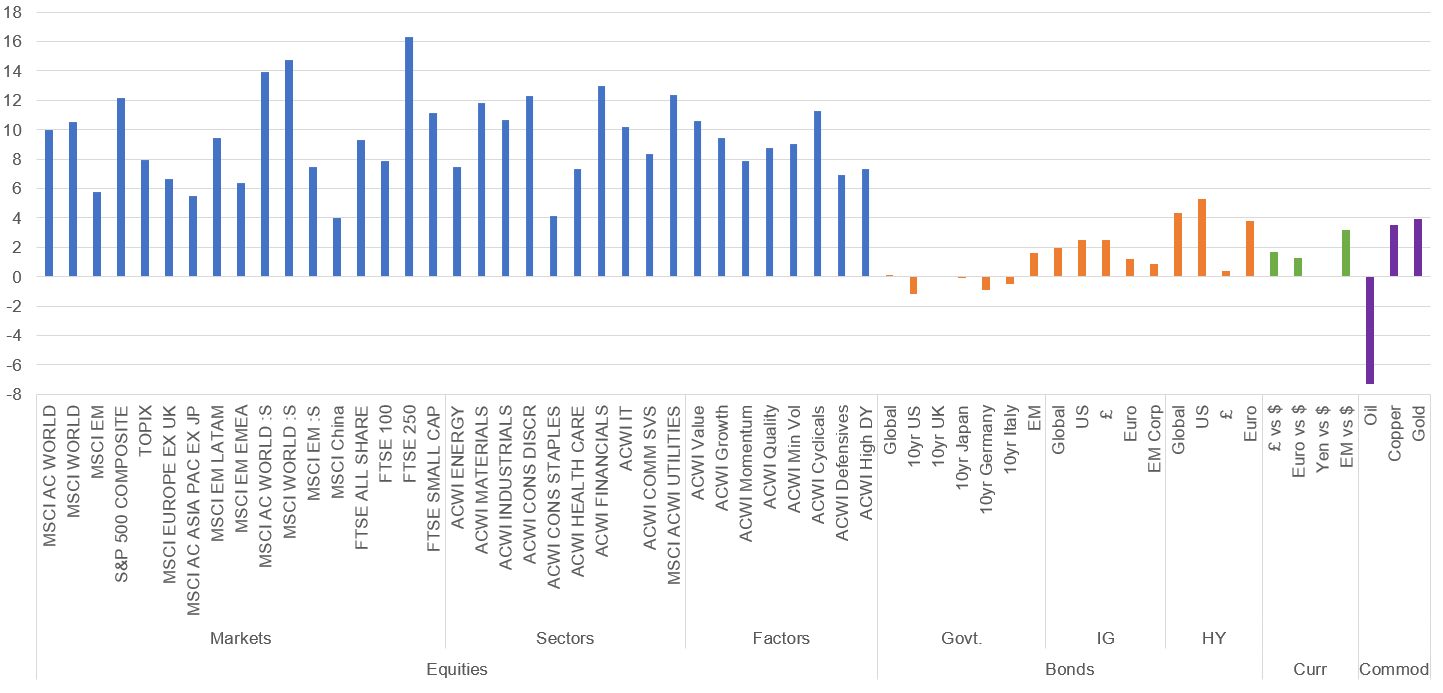
Global equities had their strongest week (+10%) since 2008, but the real standout in Developed Markets was the performance of the FTSE 250 (UK Midcaps), which rose 16.3%, the biggest weekly gain since index data became available (1986). Global small caps had a record week too (+14%). Strong equity markets translated into declining volatility, although the VIX index (1m implied volatility of S&P 500) at 42 still remains at very elevated levels (it was at 14 when the S&P peaked on 19 Feb). In credit markets, HY, and US HY in particular, was boosted by the Federal Reserve expanding its asset purchase to include HY ETFs.

Market performance last week (%)

Past performance is not a guide to future returns. Sources: Datastream as at 13 April 2020. See important information for details of the indices used.1

Key observations on last week’s performance:

  • Global equities rose sharply as highlighted earlier. DM (+10.6%) delivered almost double the return of EM (+5.8%) as US equities were particularly strong (+12.2%). A similar picture was seen in small caps (DM +14.7%, EM +7.5%). UK equities were also robust with the All Share having its best week’s performance since 2008, led by mid and small caps.
  • At a sector level, risk-on invariably means that the more cyclical / value areas of the market outperform and last week was no exception. Financials, Consumer Discretionary and Materials were strong performers, while Consumer Staples and Communication Services were the main laggards. Exceptions to the rule were the defensive Utilities sector on the upside and Energy on the downside, although the latter probably exceeded expectations given the decline in the oil price. At a factor level there was little difference between Growth and Value, with the latter winning out marginally. Momentum and defensives were the weakest sectors.
  • Developed Market government bond returns generally weakened at the margin on the back of a small uptick in yields, with the 10yr UST and Bund both rising 13bp. The 10yr Gilt yield was unchanged at 0.31%. EM sovereign bonds were the best performer, with yields falling 23bp.
  • Global credit markets had a good week, particularly High Yield. Yields and spreads fell across the board, -30bp and -38bp respectively for IG and a more substantial -105bp and -122bp for HY. The lower the credit rating the better, with BBBs the best performer in IG and CCCs and below in HY. US credit outperformed on the back of Federal Reserve support.
  • The risk-on backdrop weighed on the US$ with £, the Euro and EM currencies all appreciating versus the US$.
  • Despite the OPEC+ agreement to cut oil production by 10mbd, along with additional support measures from the G20, making it overall the largest oil supply agreement in history, that was not seen as enough to offset the dramatic collapse in global demand. Consequently Brent fell -7.3% to just below $32. Copper, on the other hand, benefitted from the more optimistic tone in markets and the weaker US$. Gold too was strong, a beneficiary of a weaker US$, and at $1682 is at its highest level since early 2013.

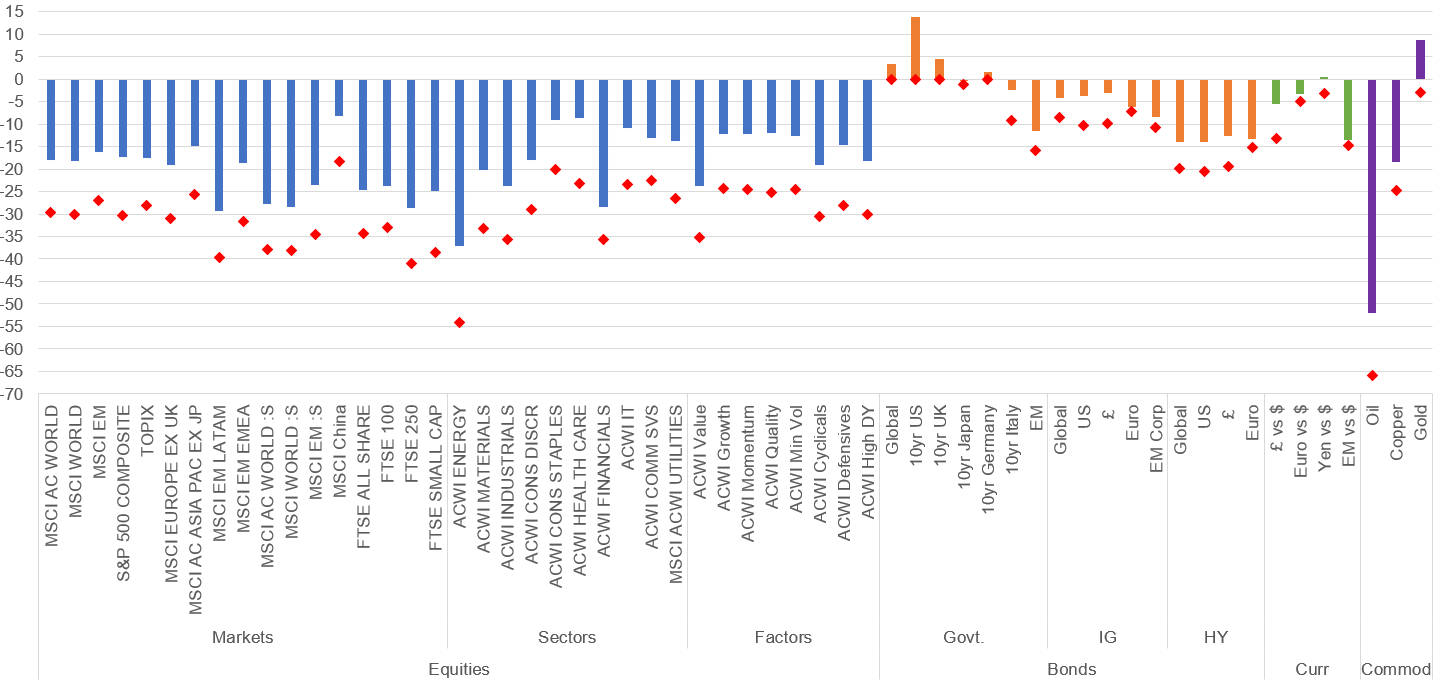
YTD market performance and YTD low (%)

Past performance is not a guide to future returns. Sources: Datastream as at 13 April 2020. See important information for details of the indices used.1

This week you will note that I have shown the maximum YTD drawdown as well. This is from the start of the year, not the peak to trough decline during the year so far.

Key observations on YTD performance:

  • As the chart highlights it’s been a tough start to the year, but almost every asset class is now some way above their YTD lows, which were invariably seen in late March. There have been some significant rallies. The S&P 500 is +24.8% above its lows, the All Share +18.4% and US HY +12.4%.
  • In equities EM (Asia best region) have marginally outperformed DM, with little performance differentiation between regions in the latter other than the UK, where the All Share is still down -24.5%. There has been a 10% performance divergence between large caps relative to small caps, a similar picture for Growth versus Value, while defensive sectors are ahead of cyclical ones by just under 5%.
  • A fairly mixed bag from government bond markets. USTs have been the star performer with the 10yr UST YTM falling 119bp and returning 13.7%. Gilts have also been strong, with the 10yr down 52pts. EZ performance has been mixed. 10yr Bund yields (-15bp) have performed better than EZ peripheral bonds. The 10yr Italian BTP, for example, has seen yields rise +17bp. EM external sovereign yields have risen a massive 172bp, pushing returns down – 11.5% YTD.
  • Despite the recent rally, credit markets remain firmly in negative territory. Global yields and spreads have widened dramatically (Yields IG +53bp HY +311bp, Spreads IG +144bp, HY +459bp). IG has outperformed HY materially. US and £ credit outperformed in IG, £ and Euro in HY. The weaker the credit rating the weaker the relative performance in both IG and HY.
  • £ (-5.4%) and EM currencies (-13.4%) have been the main losers against the US$. Yen remains broadly unchanged, with the Euro slightly weaker.
  • The oil price has halved (-51.8%). Economically sensitive Copper has also been very weak. Meanwhile gold (+8.6%) proves to be a robust safe haven.

Chart of the week: UK GfK consumer confidence survey

Source: Datastream as at 13 April 2020.

  • GfK normally publishes its UK consumer confidence survey index once a month (at month end), having completed the survey during the first two weeks of the month.
  • Last week they published a special flash survey, conducted in the last two weeks of March, to capture the impact of new restrictions on British life. It fell from -9 in the initial March survey to -34. This was not quite as low as the trough in the GFC (-40), but in terms of the economic outlook over the next 12m there was a new record low at -56 (GFC low -52).
  • With unemployment expected to rise sharply, expectations on personal finances also slumped and are just above their GFC low (-17 vs -18).
  • The current headline reading is consistent with household spending falling sharply. Last week’s car registrations give a foretaste of this. They are usually high in March due to the bi-annual plate change system. They fell 44.4%yoy from 458k in March 2019 to 255k in 2020, the lowest March number since the late 1990s.

Key economic data in the week ahead:

  • Another relatively quiet week ahead in terms of economic news flow from the major economies.
  • In the US, focus yet again will be on initial jobless claims (Thursday) after a rise of just under 17m in the past 3 weeks. Another “big” week is expected, with consensus at 5m. On Wednesday March’s retail sales will be published, where a record decline is expected. On that day a close eye will also be kept on the Federal Reserve’s Beige Book, a report published eight times per year ahead of the FOMC meeting (next one is 29 April), which provides anecdotal information on current economic conditions. Expect a material deterioration in the outlook.
  • The highlight in China is the Q1 GDP report due on Friday. Remarkably for the second largest economy in the world, China manages to produce its final number (there are no revisions) well ahead of even provisional numbers for other major economies (the first reading for the US is not until 29 April). Consensus is for a -11.2%qoq decline and -6%yoy, by far and away the worst quarter ever experienced by the Chinese economy, reflecting the coronavirus lockdown shock. This will also impact trade numbers for March due on Tuesday. All a foretaste of what is to come in Europe and the US.
  • A light week for data in the UK. With the BRC Retail Sales number for March (Thursday) we will get a first glimpse of how steep retail sales dropped, while the BoE Credit Condition Surveys on the same day will provide insight into the degree to which banks are ramping up supply of credit, given the expected jump in demand.

As you can see all focus is on the data coming out over the next c two weeks.  We will experience ongoing volatility based on how Covid 19 is progressing/being controlled (how measures are working), the pathway out and the impact on global economies as outlined in the data we receive.

We need to remain invested as we are and be patient.  Ongoing regular monthly contributions into pensions and investments will help over the medium to long term.  Expect heightened volatility.

Steve Speed

14/04/2020

Team No Comments

Brewin Dolphin – Scam Warning Blog

Brewin Dolphin have put this guidance in an article on their website. Unfortunately, criminals see the current crisis as an opportunity. Please take precautions and keep your cash and invested assets safe.

With the entire world focused on coronavirus (Covid-19), fraudsters are taking advantage of the situation to target potential victims.

These scams can take many forms and could be about pensions transfers or high-return investment opportunities.

Scammers are sophisticated, opportunistic and very likely to target the vulnerable. Typically, scammers use fraudulent emails, phone calls, text messages or social media posts to offer help to customers by suggesting their service or product provides a ‘safe haven’ for money, investment opportunities ‘too good to miss’ or even expert medical guidance.

Using coronavirus as a cover story, criminals can also attempt to persuade recipients to disclose personal or financial information or click on links that may contain malware.

To help protect yourself you should:

  • Reject out of the blue offers
  • Beware of adverts on social media channels and paid for/sponsored adverts online
  • Refrain from clicking on links or opening emails from senders you don’t know
  • Avoid being rushed or pressured into making a quick decision
  • Call back existing providers who call you unexpectedly
  • Refuse to give out personal details (bank details, address, existing pensions or investment details) to unexpected callers or online requests

Remember, we, your bank, the FCA or the police will NEVER ask you to transfer money or move it to a safe-haven account.

To be safe, follow the advice of the Government and UK Finance led “Take Five to Stop Fraud” campaign. If you suspect a scam, call Action Fraud straight away on 0300 123 2040.

We endorse the protective measures outlined above by Brewin Dolphin. If you think your invested assets are at risk (lost, stolen or misplaced passwords?) please let us know immediately. We can instruct pension, investment and product providers to increase security measures.

Steve Speed

14/04/2020

Team No Comments

J.P. Morgan – Market Update

J.P. Morgan – Market Update

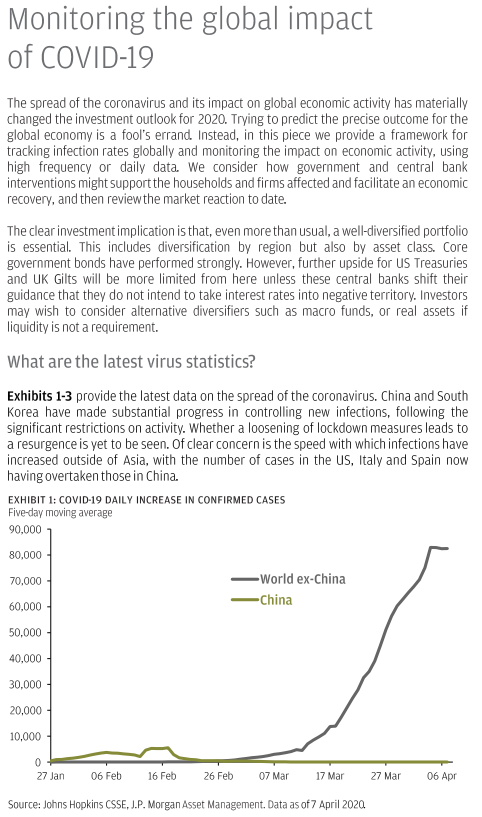
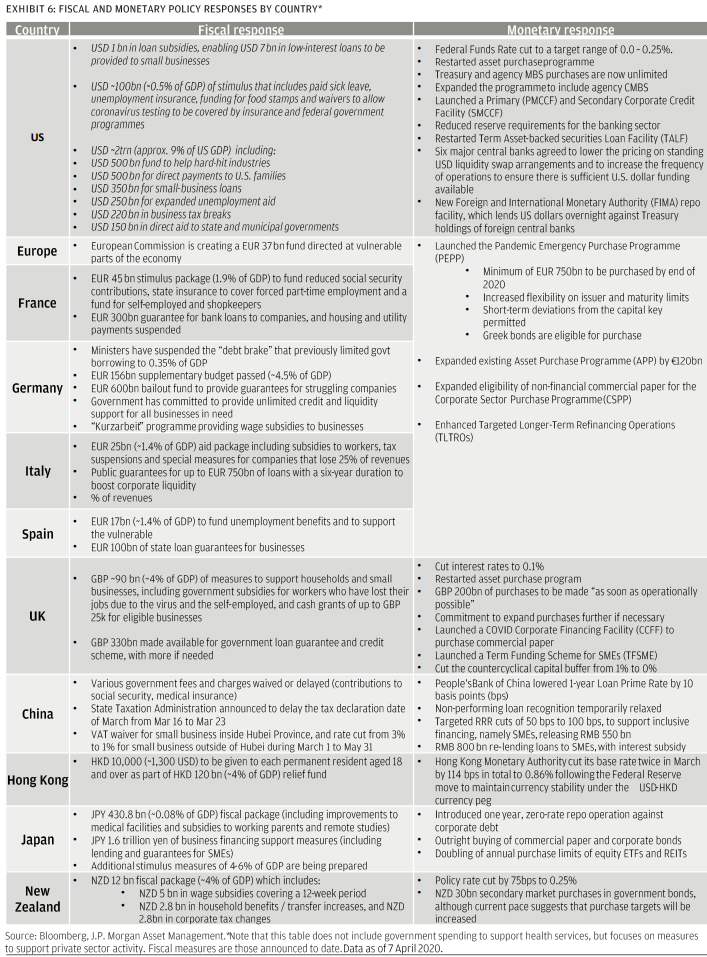
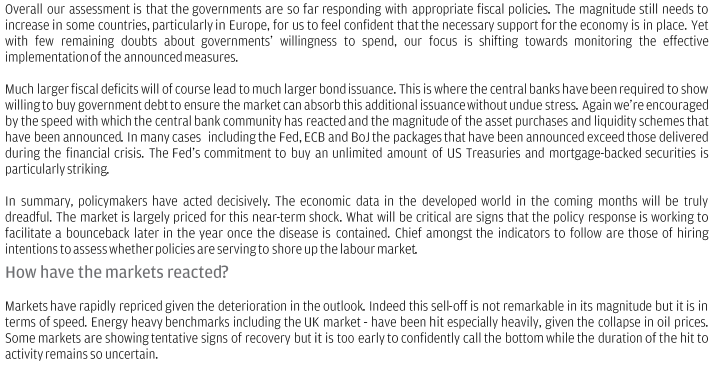
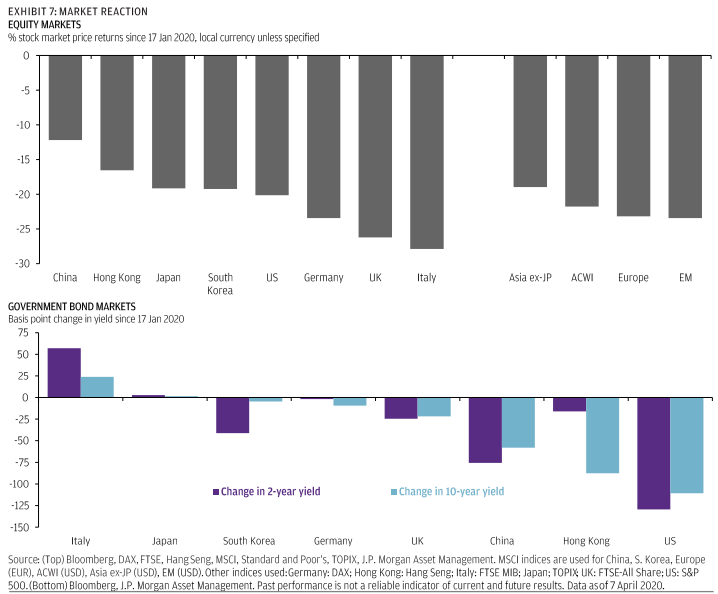
Please see below yesterday’s (08/04/2020) market commentary update from J.P. Morgan Asset Management who have great technical and market resources available to them:

We will continue to deliver market commentary from leading fund managers from around the country.

In the meantime, please keep safe and healthy.


Carl Mitchell – DipPFS

IFA and Paraplanner

9th April 2020

Team No Comments

The Value of Long-Term Investing


Comment from Brewin Dolphin yesterday (06/04/2020) on long term investing:

The value of long-term investing

Investing for the long term gives your money the greatest chance of growing in value. But this means holding your nerve during periods of significant stock market volatility – and remembering that, as history shows, markets will recover.
Here are four reasons why investing over the long term is the wisest strategy.

1. Staying invested

As the old investment adage goes, it’s time in the market – not timing the market – which is key to returns. By delaying, or cashing in your investments, you risk missing out on the best days in the market.

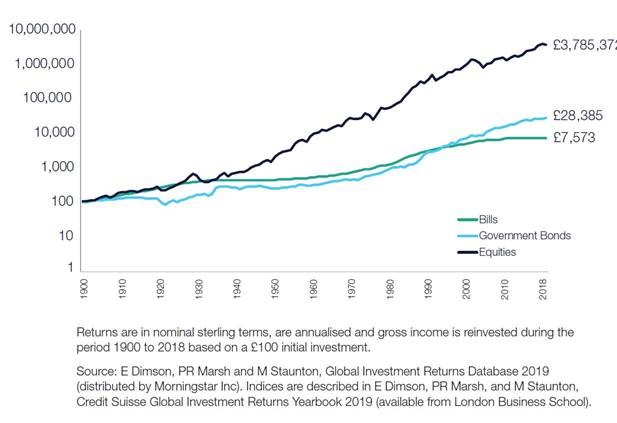
The global economy has endured plenty of adversity over the decades, and yet the stock market has continued to climb, given time.

Brewin Dolphin have the time and expertise to help you make the most of your investments.

2. Compounding – time is everything

Compounding is extremely powerful when it comes to investing. Albert Einstein apparently described it as the eighth wonder of the world. It is, simply, earning returns on your returns.
For example, somebody earning a 5% return in year one would see their investments grow by a compounded return of 63% after 10 years. After 20 years, this rises to 165%, and over 25 years it balloons to 239%. This demonstrates the cumulative effects that compounding has on capital. £

3. Investing typically beats cash

Savings accounts typically struggle to keep pace with inflation, seeing savers lose value in ‘real’ terms. In the graph below, bills are short dated bonds which give an indication of what returns on cash might have been.

If you are prepared to accept the risk that comes with investing, and have time on your side, you give your wealth the greatest chance of growing and beating inflation over the long term.

4. You benefit from diversification

Our portfolios are well diversified. This means that your investments (and risk) is spread across different assets, across the globe – including equities, bonds and cash.

The value of investments and any income from them can fall and you may get back less than you invested.
Past performance is not a guide to future performance.
No investment is suitable in all cases and if you have any doubts as to an investment’s suitability then you should contact us.
The information above is believed to be reliable and accurate, but without further investigation cannot be warranted as to accuracy or completeness.

As long term investors we shouldn’t focus on or worry too much about short term volatility. Time in the markets works, trying to time the markets is virtually impossible.

We need to think as long term investors, not traders.

Steve Speed

07/04/2020

Team No Comments

Royal London Asset Management Economic Viewpoint

Investment input hot off the press from Royal London Asset Management this afternoon (06/04/2020):

RLAM Economic Viewpoint

Although there has been some encouraging news from countries where the growth in new cases has been slowing, it is clear from incoming case numbers that we are still some way off being able to contemplate easing social distancing measures in Europe, let alone the US. In the meantime, therefore, levels of economic activity remain well below pre-crisis norms.

Data has underscored the challenge facing policymakers. Over the week, the latest US weekly initial jobless claims number showed another a record jump of more than 6 million. Benefit claims have risen sharply in the UK too and incoming March survey data reflects a large hit to business activity and confidence in Europe and the US.

Economic activity data in China has improved as social distancing measures have eased and March business surveys show significant improvement. However, business surveys generally ask firms whether activity has increased or decreased, not by much. That is important in the current context where the level of economic activity is likely still significantly below pre-crisis levels. Export-related components of the surveys still signal contraction, consistent with weak global demand now holding back China’s recovery.

Meanwhile reminders that things aren’t normal, and that social easing can’t be unwound in one easy move while there is reinfection risk, came in the shape of some reversals of social easing (e.g. cinemas shutting again and lockdown being re-imposed in Jia county). In the US unemployment numbers this week highlight the scale of the challenge policymakers face in trying to limit the long-term economic damage from this crisis.

The good news is that policymakers globally continue to step up and introduce measures that improve the likelihood of economic activity being able to pick up robustly once social distancing measures ease. Again, we’ve seen measures designed to keep the financial system working (e.g. Fed’s announcement this week of a repo facility for overseas central banks), limit damage to household finances (e.g. the direct wage subsidy scheme announced by Australia at the start of the week) and keep viable businesses afloat. Other highlights included a 50bps rate cut in Canada late last Friday and a policy easing message from Chinese authorities.

Royal London are one of the key Workplace Pension providers in the UK offering innovative strong default investment options with ongoing governance.

Steve Speed

06/04/2020

Team No Comments

Entrepreneurs Relief – The Turning of The Tide

Entrepreneurs Relief – The Turning of The Tide

Over the years, when speaking to some clients and asking them about their existing pension provision, some have responded ‘my business is my pension’. This was always a fairly speculative position to take because there is no guarantee of being able to sell the business for what you believe it to be worth, or there being a demand to buy the business at the time you would like to retire.

Entrepreneurs Relief was certainly a benefit for this approach as the rules allowed business owners of two years or more to pay less Capital Gains Tax (10% rather than 20%), when they sell their business, up to a lifetime limit of £10million. However, in the Chancellor’s budget on 11th March 2020, he announced that he would be reducing the lifetime limit to £1million immediately with limited transitional arrangements.

How Does Entrepreneurs Relief Work?

To summarise, Entrepreneurs Relief results in a tax rate of 10% on the value of the sale of the business. There’s no limit to how many times you can claim, however, from 6th April 2020, you can only claim up to £1 million of relief during your lifetime.

You have to meet other criteria too for Entrepreneurs Relief to apply.

What does this mean?

Prior to the reduction, business owners could have had a primary focus, which was to grow the value of their business as much as possible prior to selling the business for as much as possible, possibly to retire?

Summary

The change in rules effectively means, business owners may now need to reconsider their options and start to take advantage of planning opportunities available to them in order to maximise the value they get out of their business now, prior to the eventual sale. Your options could include the following:

  • Maintain a ‘lifestyle’ business for the long-term;
  • Maximising pension funding;
  • Investing surplus capital; or
  • Paying a higher level of salary or dividends
    • Invest proceeds in a tax efficient manner
  • Using a core business to build a network of ‘family’ satellite businesses

If you are a business owner and you would like to know more about the changes in Entrepreneurs Relief and how this will impact you and your plans, please do not hesitate to contact us.

In the meantime, keep healthy and safe.

Carl Mitchell – DipPFS

IFA and Paraplanner

02/04/2020

Team No Comments

In The Midst of Every Crisis Lies Opportunity

In the midst of every crisis lies opportunity

I’ve cut and pasted this input from an email received from the Jupiter European Growth fund management team yesterday (31/03/2020):

The pandemic has obliged many people to make significant changes to their daily habits. We can even expect an acceleration in some secular growth trends as a consequence of the crisis. We highlight three areas which could benefit over the longer term.

Clinical diagnostics: Expect an acceleration in some secular growth trends as a consequence of the crisis. In the diagnostic testing space, lab equipment companies such as Diasorin, Tecan and bioMerieux are all seeing a short-term increase in demand for their instruments. However, in our view, the real benefit is likely to come in the future as a consequence of their much larger installed base of customers and the greater revenues from the consumable reagents they will be selling to labs, once we get beyond the crisis. Our growth thesis on these companies has hinged on the cost-benefit to national health systems of being able to have faster, more encompassing diagnostic testing services. The coronavirus crisis clearly highlights the need for more investment into this area.

The industrialisation of the food supply chain: Governments will deem it critical to maintain food and farming industries during the worldwide battle against the Covid-19 pandemic. Before the coronavirus, China had already seen African Swine Fever (ASF) wipe out 50% of the country’s pig herd. Here, Genus, the global leader in providing porcine and bovine genetics could be a long-term beneficiary; it receives royalties for each commercial pig weaned. That’s not to say the company hasn’t had short-term problems. In February, owing to transport restrictions within the supply chain, it did not sell a single pig in China. Nevertheless, we have actually become more positive about the outlook for the business. Following the ASF and coronavirus crises we are likely to see a rapid and more professional rebuilding of the highly-fragmented domestic pork supply through the creation of large-scale integrated pork producers. This is a key priority for the Chinese government and should drive significant demand for the company’s products as they will improve productivity in food production.

The Digital World: Following the crisis, we will all migrate back to the physical world. But the current lockdowns are likely to introduce vast swathes of populations to the opportunities in the digital world, such as accelerating the adopting of online shopping, home delivery and other digital produce such as gaming. One of the attractions of Ubisoft Entertainment, a French gaming company, is the growth and superior economics of its digital offering (very low distribution costs, broadband getting even faster) over the sale of physical discs, which are more expensive to produce and distribute. We expect the rate of digitalisation to see a material step up and bring forwards the benefits we had previously anticipated for the business over the next few years.

As the Jupiter European Growth fund management team have outlined above even in the face of this adversity opportunity arises. The fast thinking entrepreneurs of the world will lead, and we could see a new generation of businesses and business leaders coming to the fore.

Steve Speed

01/04/2020