Team No Comments

Brooks Macdonald – Daily Investment Bulletin

Please see the below article from Brooks Macdonald detailing their discussions on US-China relations, Fed chair contenders and markets. Received this morning 28/10/2025.

What has happened?

Yesterday’s wave of optimism propelled the S&P 500 (+1.23%) and Nasdaq Composite (+1.86%) to fresh record highs, marking the S&P’s strongest three-day streak since May. Tech stocks led the charge: Qualcomm surged +11.09% on a new chip challenging Nvidia’s dominance, while Reuters highlighted a $1bn AI partnership between the US Department of Energy and AMD (+2.67%). This boosted the Philadelphia Semiconductor Index and gave the Magnificent Seven (+2.60%) their best day since May. In bonds, the yield curve steepened as short-term Treasuries sold off in the risk-on environment. Gold tumbled -3.18%, slipping below $4,000/oz, now down -8.59% from last week’s peak.

Fed chair contenders emerge

US Treasury Secretary Bessent revealed the final five candidates for Fed Chair: Kevin Hassett, Kevin Warsh, Christopher Waller, Michelle Bowman, and Rick Rieder, with plans to submit the list to President Trump post-Thanksgiving. Trump, however, floated Bessent himself for the role, alongside Marco Rubio for Secretary of State and Jamieson Greer for US Trade Representative, raising questions about the shortlist’s influence. While Trump’s comments might not be serious, investors should approach them cautiously.

Corporate layoffs signal broader labour market softening

Amazon is set to slash up to 30,000 corporate jobs starting Tuesday, aiming to curb costs from pandemic overhiring and affecting nearly 10% of its 350,000 corporate staff. This follows a flurry of layoff announcements last week, including Target (1,800 roles), Applied Materials (~4% of workforce), Rivian (~4%), Charter (~1%), Molson Coors (~9% of North American staff), and Meta (600 AI positions). While these feel company-specific, they align with ongoing signs of a cooling labour market.

What does Brooks Macdonald think?

Optimism is building around President Trump’s upcoming Thursday meeting with President Xi, bolstered by Trump’s comments: ‘I have a lot of respect for Xi. I think we’re going to come away with a deal.’ He also suggested a potential TikTok resolution during talks. That said, trade and macroeconomic outlook remains fluid.

Please continue to check our blog content for advice, planning issues and the latest investment, market and economic updates from leading investment houses.

Alex Clare

28/10/2025

Team No Comments

Tatton Investment Management: Monday Digest

Please see below, an article from Tatton Investment Management, analysing the key factors currently affecting global investment markets. Received this morning – 27/10/2025

Autumn but no fall 

Markets ended last week with all-time highs, but investors remain uneasily positive. We have noticed a disconnect between people’s pessimism and recently strong investment returns. With global inflation coming down business confidence better than expected, the outlook is still strong.

The ‘better-than-it-seems’ narrative is particularly true of the UK: UK stocks and bonds outperformed last week, after lower-than-expected inflation increased the chance of an interest rate cut in December.

The Federal Reserve looks set to cut rates this week – probably 0.25 percentage points (but it could be more, not less). The Fed will be dovish, and this expectation has helped bond yields all over the world, as has a slowing of US economic data (influenced by the government shutdown). Treasury yields falling below 4% has helped balance out the stock market wobble. That’s also why markets aren’t too concerned about credit stress (covered below).

Gold prices fell sharply as traders seemed to take profits from the recent blistering rally. We think there’s an interesting parallel to Chinese tech stocks: they came down after a strong run, and we know Chinese investors are heavily invested in gold. Chinese stocks have been supported by strong liquidity, but that’s tailed off slightly. Recent data showed Beijing’s economic stimulus is working, so the government may now pull back some of its market-support measures.

The Trump administration seems to be preparing for defeat in next month’s Supreme Court tariff ruling, by suggesting alternative sector-specific tariffs. This might not be the boon for markets that some think. Without tariff revenues, US bond yields will be under threat, and sector-specific tariffs could be worse for global supply chains than the current regime. It’s unclear how stocks would respond. Uncertainty is a bigger problem now than over the summer, thanks to tighter liquidity. The recent bout of volatility might not be over. But the global economy is getting a welcome boost to capex, partly in response to tariffs. That strengthens the long-term outlook.

Private markets a concern, not a crisis 

Concerns about private credit are mounting, after the collapse of Tricolor and First Brands. BoE governor Andrew Bailey rang “alarm bells” about private credit standards last week, comparing them to the 2008 Global Financial Crisis (GFC).

Private markets – equity, credit and everything in between – have grown rapidly in recent decades. Private credit firms sell themselves on sell themselves on their bespoke, in-depth credit spreads. But the collapses (and reports of fraud) have worried everyone that those checks aren’t being done. As JPM’s Jamie Dimon quipped, there’s never just one cockroach. Shares in private credit firms and Business Development Corporations (BDCs, somewhere between credit and equity) have been hit hard.

Andrew Bailey’s warning came after similar decrees from the IMF. Private credit now takes up a huge portion of overall lending and its standards are opaque. Many have long speculated that post-GFC regulations have just shifted leverage from public to private markets. And with so many private credit firms running checks, it’s easier for individual firms to copy others’ homework. High fees from individual deals make this problem worse: just like before the GFC, arrangers (themselves lenders) make so much commission from completing the deal they stop worrying about whether borrowers can pay.

That’s not to say another GFC is coming – far from it. We expect problems to be contained, largely because private credit’s expansion hasn’t been driven by private money creation. We do expect a credit crunch, as private lenders get pickier and start running the checks they should have done all along. Private market firms might struggle for investment capital too; we’ve noticed some reaching out to institutional investors like ourselves, rather than relying on traditional sources (families, sovereign wealth and pensions). But unlike in 2008, money will remain in the system. Expect a wobble, not a collapse.

What Britain can learn from Korean markets 

South Korean stocks are up an astonishing 70% since April. That would’ve been unthinkable a year ago, when former president Yoon Suk Yeol attempted to return Korea to a dictatorship. Despite his quick impeachment, it wasn’t until June that Korea had a stable new government. Foreign investors dumped Korean stocks en masse after Donald Trump’s ‘Liberation Day’ tariffs, but it has since become “the leading emerging-market rally”, according to Franklin Templeton. Much of that is focussed on chipmakers like Samsung and SK Hynix, benefitting from the AI theme. Korean tech stocks still have relatively low valuations, though, suggesting the rally could run.

It’s not all about chips; the rally has broadened after an IMF growth upgrade and signs of a US-Korea trade deal. The government’s reform push has helped greatly – including corporate governance (similar to the story that has boosted Japan) and its capital markets framework. Seoul wants to get encourage retail investors into the domestic stock market. This should create a virtuous cycle: the savings pool moves into equity, which improves corporate finances, which in turn makes Korean companies more attractive to global investors.

The UK is trying to do something similar, to address our market’s liquidity problems (which is why so many British companies are listing in New York). Whitehall recently announced a stamp duty holiday for new UK stock listings – though a stamp duty removal (like other nations) would bring more liquidity. The Treasury also floated a cash ISA limit proposal, though that is more stick than carrot. Britain has attractive companies (evidenced by the FTSE 100’s outperformance), we just need reforms to bring more liquidity. Korea’s experience reminds us how beneficial that can be.

Please continue to check our blog content for the latest advice and planning issues from leading investment management firms.

Marcus Blenkinsop

27th October 2025

Team No Comments

EPIC Investment Partners: Official inflation figures can underestimate rises in the cost of living

Please see below, an article from EPIC Investment Partners which analyses the latest inflation figures in the UK. Received today – 24/10/2025

September’s figures show that UK inflation remains stubbornly high at 3.8%, nearly double the Bank of England’s target. Not only does the prospect of further interest rate cuts display wilful disregard of the MPC’s 2% mandate, this inflation number is also understated.

The Consumer Price Index (‘CPI’) is used by governments to set inflation targets and adjust other measures such as state pensions and benefits. It also impacts interest rates, wages and other payments, and is intended to show how inflation affects household budgets. The CPI measures inflation by tracking the average change over time in the prices of a basket of goods and services purchased by a typical household. The Office of National Statistics collects prices for about 700 different items like food, energy, and clothing, to create a “shopping basket”. They then track the price changes of this basket over time to calculate inflation. However, this is a flawed measure of price rises as it excludes housing costs, unlike the more complete Retail Price Index (‘RPI’).

CPI is generally lower than RPI, an older measure that includes owner-occupier housing costs like mortgage interest payments and council tax. But does either measure provide a true reflection of the cost of living? My friend in the US has just sent his Microsoft Excel subscription renewal statement – an increase from $69.99 to $99.99. Those of us unfortunate enough to occasionally grace a supermarket, or fortunate enough to occasionally visit restaurants, can bear witness to exponential price increases that appear divorced from official CPI numbers. And, of course, there is taxation, which apart from excise duties and sales taxes that directly affect prices paid, are excluded from both indices. My American correspondent also points out that their CPI used for index linking excludes both food and energy!

Even compound inflation of 3.8% halves the purchasing power of a currency in 18 years, and a Pound will have lost 75% of its current purchasing power before my newly born grandson reaches the age of thirty-five. Now let’s look at the real erosion of what our currency will buy. Prices including owner occupiers’ housing costs, (CPIH) rose by 4.1% in the 12 months to August 2025, and of course this might not accurately reflect the inflation rate for individuals with different spending habits, such as a retired person with higher healthcare costs, or a family with young children. While necessary for a consistent measure, methods like “substitution bias” (which assumes consumers switch to cheaper alternatives when prices rise) can also lead to an underestimation of the impact of rising prices on specific goods.

As we can see, inflation is a complex topic, and different individuals may feel that their personal experience of rising prices is higher than the official CPI figure, particularly in specific sectors like housing or energy. However, these marginal differences do not seem to explain our individual perceptions of changes in the cost of living. Some basic arithmetic can help: if we focus on the underlying index of prices as opposed to individual annual increases, we might find an answer.

Following Covid, the annual CPI figure rose to high single digit percentages from which it has now fallen back to below 4%. However, this 4% figure is in addition to previous price rises. I will use a basic set of assumptions to make the point. A £100 product price, inflated by 4% rises to £104. However, if preceded by a several years of high levels of compounding inflation, 4% is multiplied by a much larger number. If we use the CPI to measure inflation, just over the past five years, prices as measured by the CPI are now over 28% higher than at the beginning of 2021. 4% inflation this year takes the price index from 128 to nearly 135, and so a further 7%, measured in 2021 prices. This figure sounds closer to what many seem to be experiencing, and by unhappy coincidence reflects some commentators’ estimates of real underlying inflation both here and in America.

Whatever the arithmetic applied, strong signals being given by the commodities markets point towards fears of accelerating FIAT currency debasement. A return to 1970s inflation levels would see the Dollar lose a further 75% of its purchasing power in a decade – this in addition to the 95% erosion of the currency’s value since 1913.

Please continue to check our blog content for the latest advice and planning issues from leading investment management firms.

Alex Kitteringham

24th October 2025

Team No Comments

Brooks Macdonald – Daily Investment Bulletin

Please see below article received from Brooks Macdonald this morning, which provides a global market update for your perusal. 

What has happened?

Yesterday, global markets faced headwinds, with the S&P 500 declining by 0.53% after three consecutive gains. Key pressures included escalating US-China trade tensions, disappointing corporate earnings, and concerns over a prolonged US government shutdown. The S&P 500 fell -0.53% with chip stocks leading the underperformance. The tech sector also faced scrutiny as Tesla kicked off the Mag-7 earnings season. Despite beating revenue expectations, Tesla’s earnings per share fell 31% year-over-year to $0.50, missing estimates due to rising operating expenses. Shares dropped 3.95% in after-hours trading. In Europe, the STOXX 600 fell 0.18%, reflecting a cautious mood. Meanwhile, oil prices surged, with Brent Crude climbing above $64/bbl following new US sanctions on Russia’s largest oil companies, marking a sharper tone in US-Russia relations since President Trump’s return to office.

US-China trade tensions continue

US-China trade concerns dominated market sentiment, driven by reports that the Trump administration is considering export restrictions on goods containing US software in response to China’s limits on rare earth exports. This news hit trade-sensitive sectors hard, with the Philadelphia Semiconductor Index dropping 2.36%. Despite the rhetoric, optimism flickered as Trump hinted at a potential comprehensive deal with China’s President Xi, suggesting negotiations remain fluid ahead of a possible summit.

UK markets shine

In contrast to global unease, UK markets rallied after a surprising drop in inflation. Headline CPI held steady at 3.8% (below the expected 4.0%), while core CPI fell to 3.5% (against forecasts of 3.7%). This fuelled expectations for a Bank of England rate cut, with the probability of a December cut rising from 42% to 72%. Gilts surged, with 2-year yields dropping 8.8bps to their lowest since August 2024, and 10-year yields falling 6.0bps. UK equities also gained, with the FTSE 100 up 0.93% and the FTSE 250 soaring 1.47%, its strongest performance in over six months.

What does Brooks Macdonald think?

The ongoing US government shutdown, now in its 23rd day, continues to cloud the outlook. The record for the longest shutdown was set in 2018-19, and Polymarket odds now indicating a 75% chance of surpassing that record. The lack of a resolution between Republicans and Democrats is stifling the flow of US economic data, leaving investors navigating in the dark. We remain vigilant, preferring opportunities in markets like the UK, where positive inflation data could point to improving outlook.


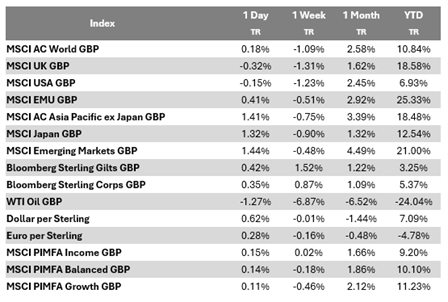
Index   1 Day 1 Week 1 Month YTD
  TR TR TR TR
MSCI AC World GBP   -0.39% 0.70% 1.70% 11.61%
MSCI UK GBP   0.92% 1.01% 3.32% 19.78%
MSCI USA GBP   -0.56% 0.55% 1.03% 7.52%
MSCI EMU GBP   -0.49% 0.70% 3.15% 26.21%
MSCI AC Asia Pacific ex Japan GBP   -0.45% 1.31% 3.54% 20.03%
MSCI Japan GBP   0.40% 2.58% 3.34% 15.45%
MSCI Emerging Markets GBP   -0.24% 1.22% 3.84% 22.47%
Bloomberg Sterling Gilts GBP   0.53% 1.08% 2.76% 4.36%
Bloomberg Sterling Corps GBP   0.41% 0.71% 1.99% 6.11%
WTI Oil GBP   1.19% 0.54% -5.65% -23.63%
Dollar per Sterling   -0.11% -0.35% -1.17% 6.71%
Euro per Sterling   -0.19% -0.03% 0.47% -4.81%
MSCI PIMFA Income GBP   0.19% 0.63% 1.83% 9.89%
MSCI PIMFA Balanced GBP   0.15% 0.64% 1.87% 10.81%
MSCI PIMFA Growth GBP   0.10% 0.68% 1.94% 11.99%
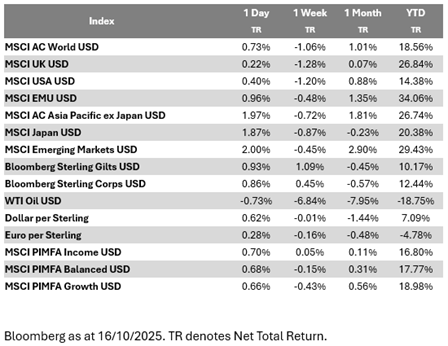
Index   1 Day 1 Week 1 Month YTD
  TR TR TR TR
MSCI AC World USD   -0.41% 0.55% 0.67% 19.21%
MSCI UK USD   0.91% 0.86% 2.28% 27.94%
MSCI USA USD   -0.57% 0.40% 0.00% 14.84%
MSCI EMU USD   -0.50% 0.55% 2.11% 34.80%
MSCI AC Asia Pacific ex Japan USD   -0.47% 1.16% 2.49% 28.20%
MSCI Japan USD   0.39% 2.43% 2.29% 23.30%
MSCI Emerging Markets USD   -0.26% 1.07% 2.79% 30.81%
Bloomberg Sterling Gilts USD   0.39% 1.01% 1.70% 11.29%
Bloomberg Sterling Corps USD   0.27% 0.64% 0.93% 13.16%
WTI Oil USD   1.18% 0.39% -6.61% -18.43%
Dollar per Sterling   -0.11% -0.35% -1.17% 6.71%
Euro per Sterling   -0.19% -0.03% 0.47% -4.81%
MSCI PIMFA Income USD   0.18% 0.48% 0.80% 17.37%
MSCI PIMFA Balanced USD   0.13% 0.49% 0.83% 18.35%
MSCI PIMFA Growth USD   0.09% 0.53% 0.91% 19.61%

Bloomberg as at 23/10/2025. TR denotes Net Total Return.

Please check in with us again soon for further relevant content and market news. 

Chloe 

23/10/2025

Team No Comments

EPIC Investment Partners – The Daily Update | Emerged

Please see below article received from EPIC Investment Partners this morning, which provides an update on emerging markets.

Investors are increasingly questioning whether ‘emerging markets’ should continue to be treated as an asset class. The term was coined by the World Bank back in 1981 as a more polite, or modern, term than The Third World.

From distant memory a country needed a per capita income below $10,000 to be considered emerging. Later frontier markets were identified, defined loosely as ‘generally smaller, less liquid, and less accessible than emerging markets.’

The question is whether it is appropriate to lump, say, Chile with Egypt or the UAE with Thailand or Vietnam with Argentina. The bland traditional definition seems outdated and arguably not fit for purpose. Greece was infamously downgraded to emerging market status in 2013.

Taiwan’s nominal GDP per capita for 2024 was $34,000 while GDP per capita in Purchasing Power Parity (PPP) terms is estimated to be around $82,600. Why is Taiwan still an emerging market? The only reasonable excuse is that foreign investors need to register and obtain a licence to trade local stocks.

The same applies to South Kora where GDP per capital is $36,000 while GDP per capita in PPP terms is estimated to be around $63,000. China remains an emerging market although nominal and PPP GDP per capita income stand at $13,000 and $25,000 respectively. The numbers for India are $2,700 and $12,100.

Local licences are required for all four markets.

The largest five markets in the MSCI Emerging Market Index are as follows: China 31.2%, Taiwan 19.4%, India 15.2%, South Korea 11.0%, and Brazil, 4.3%. Total 81.1%. Only Brazil and India more or less qualify within the traditional GDP per capita definition.

As investors, we are happy to run with the Asia ex Japan asset class which is also dominated by the four markets listed above.

Unfortunately, the markets across ASEAN (The Association of South East Asian Nations) have a tiny index weight – less than 1.5% each (with the notable exception of Singapore). These markets are not uninvestible by any means but passively managed products have little incentive to invest in the region.

Please check in again with us soon for further relevant content and market news.

Chloe

23/10/2025

Team No Comments

Brewin Dolphin – Markets in a Minute

Please see this week’s Markets in a Minute update below from Brewin Dolphin, received yesterday afternoon – 21/10/2025.  

U.S. and China trade negotiations continue

Fresh trade talks between Presidents Trump and Xi were announced last week – how have the markets responded to the news?

Key highlights

  • A pause for reflection: Investors have shifted from chasing the market rally to assessing the risks.
  • Credit “cockroaches”: Isolated loan defaults, such as those at U.S. firms First Brands and Tricolor Holdings, are worth monitoring, but solid bank earnings provide reassurance.
  • The gold rush: Gold prices rallied amid ‘safe haven’ demand and an ongoing ‘debasement trade’

From exuberance to evaluation

After months of relentless gains, global markets took a breather last week.

Investors have shifted from exuberance to evaluation, reassessing whether stretched valuations can hold amid emerging signs of credit stress, renewed trade tensions between the U.S. and China, and concerns over a potential artificial intelligence (AI) bubble.

Stocks took a little breather as gold marches on
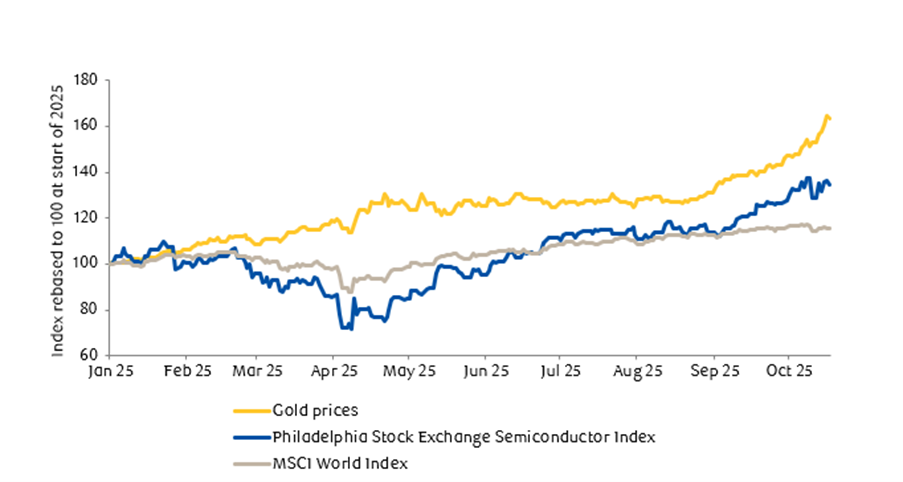
Source: Bloomberg

While caution has crept back in, the broader picture remains constructive, with solid corporate earnings, resilient consumer sentiments, and more Federal Reserve (the Fed) easing on the way.

The change in market tone began with renewed worries about credit quality in U.S. banks. The defaults at First Brands and Tricolor Holdings raised concerns about lax credit standards, potential deterioration in credit quality, and loan loss provisions at financial institutions.

To make things worse, two regional U.S. banks, Zions Bancorp and Western Alliance Bancorp, said they were victims of fraud in relation to loans to funds that invest in distressed commercial mortgages. This revived memories of the regional banking turmoil in 2023, and understandably investors have become nervous. JPMorgan Chase CEO, Jamie Dimon, made a goosebump-inducing analogy, which added to the unease: “When you see one cockroach, there are probably more”.

So far, the credit events feel like unconnected incidents. But when Jamie Dimon talks about cockroaches, it amplifies a long-lingering nervousness about the vast growth of private credit and the need to refinance real estate loans. The fact that the private market is so opaque makes it hard to know how strong credit quality is.

Encouragingly, the early earnings results from U.S. regional banks offered some reassurance. Reports from Truist Financial, Regions Financial, and Fifth Third Bancorp showed lower-than-expected provisions for credit losses. Several lenders also highlighted resilient consumer spending and stable deposit bases. Many regional lenders have also improved capital buffers since 2023.

Beyond the regional lenders, major U.S. banks delivered a strong earnings season, reinforcing the view that the financial system and the U.S. economy remain resilient. The biggest U.S. banks reported healthy net interest income, robust trading revenues and continued loan growth, underpinned by solid consumer spending. There are reasons to believe that the recent credit jitters are idiosyncratic rather than systemic.

Still, recent developments are a reminder that the aftershocks of higher interest rates can reverberate through smaller banks, weaker companies and credit markets. For the Fed, it helps further the argument for easing policy rather than keeping financial conditions too tight for too long.

Trade tensions are meant to escalate, then de-escalate

Renewed tariff exchanges between the U.S. and China added another layer of complexity to investors.

President Donald Trump has threatened additional 100% tariffs on Chinese goods after China tightened export controls on rare-earth materials. Yet, in typical fashion, President Trump struck a softer tone in a Fox Business interview, saying that “tariffs are not sustainable” and expressing confidence that “we’ll be fine with China”.

The markets’ interpretation is that by setting the next tariff increase deadline for 1 November, President Trump is clearly leaving room and time for negotiation. There’s still a chance, and expectation, that he’ll meet President Xi Jinping in South Korea within weeks, which leaves optimism that both sides are ready to de-escalate.

The AI story remains powerful despite talks of a bubble

The AI-driven rally that propelled stocks to record highs has paused for breath. Talk of an AI bubble is front and centre. It’s actually good to see this scepticism when optimism runs high.

Concerns over valuations, concentration and the circular nature of some AI deals have triggered some profit-taking, especially after months of extraordinary gains. Yet, the fundamentals of the AI story remain intact. Earnings from ASML and TSMC reaffirmed that demand for AI-related infrastructure – from semiconductors to equipment makers – remains robust. There’s still clear visibility of and longevity for the tangible capital investments going into AI.

That said, there are pockets and signs of froth (a lesser and milder version of a bubble) – for instance, huge intraday stock price surges from large established companies following AI deal announcements and investors chasing momentum stocks.

AI start-up valuations are also sky high despite many being loss-making at this stage. AI will no doubt be a transformative technology, but there are lingering concerns over whether all the money will generate adequate returns.

With AI capital expenditure (capex) ramping up, and the Fed cutting interest rates again, there are parallels with the late 1990s tech boom. We think the AI-driven rally could well go further and we want to have at least benchmark exposure to that. Stretched valuations keep us from being more bullish on this.

All that glitters… is gold

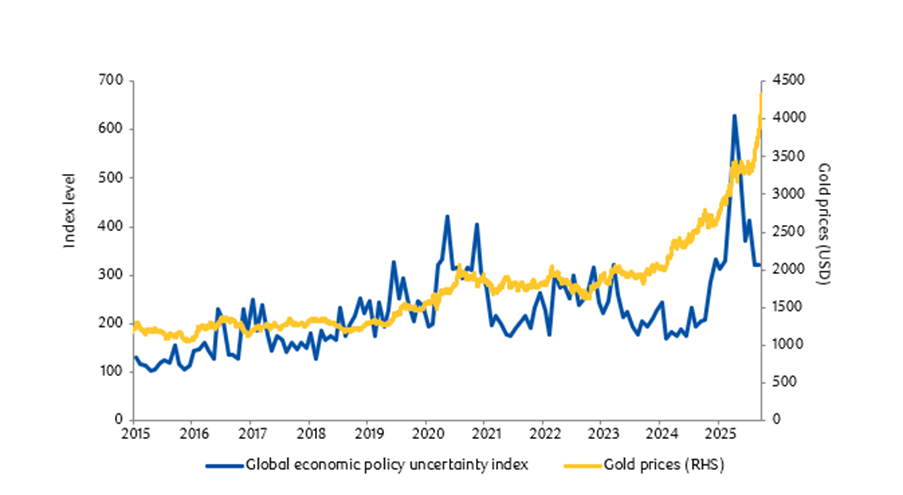
In this climate of cautious sentiment, gold has been the standout performer. The precious metal has surged to US$4,356 per ounce, buoyed by macro uncertainty, institutional distrust, central bank buying and lower U.S. interest rates.

Gold prices made new highs despite the sharp fall in economic policy uncertainty
Source: Bloomberg

Buying gold is described as the ‘debasement trade’, a hedge not only against inflation but also against ballooning fiscal deficits and long-term currency value erosion. Meanwhile, government bonds have found renewed demand as investors price in further Fed easing and weaker growth.

Taken together, the week’s development marked a shift from complacency and euphoria to caution. Valuations are stretched, economic uncertainty persists, and trade tensions remain.

It’s understandable that investors are taking a more measured stance after such a strong run since April, but the broader backdrop is okay. Corporate earnings are still solid, consumers are resilient, and the Fed is likely to continue easing. Markets are doing what they should, which is consolidating after exuberance, digesting new information and recalibrating expectations.

The AI investment cycle continues to provide a structural anchor, while gold and government bonds are fulfilling their roles as hedges in times of uncertainty.

Please continue to check our blog content for advice, planning issues and the latest investment market and economic updates from leading investment houses.

Charlotte Clarke

22/10/2025

 

Team No Comments

EPIC Investment Partners – The Daily Update: Credit Woes Lift the ‘Haven’ Trade

Please see the below article from EPIC Investment Partners detailing their discussions on US Credit Woes. Received this morning 21/10/2025.

Recent instances of credit risk within the US regional banking sector have triggered a decisive flight-to-safety into US Treasury securities. This market reaction intensified last week, sparked by alarming disclosures from several regional lenders, including Zions Bancorp and Western Alliance Bancorp, concerning loan-related write-downs and exposure to alleged fraud. These issues were not isolated; they revived broader market anxieties stemming from the 2023 regional banking turmoil. The events also coincided with high-profile corporate bankruptcies in the private credit market, particularly from lenders like Tricolor, suggesting that a longer period of high interest rates was beginning to expose weakness and potential “hidden” credit quality issues across the financial system.

As fears of banking instability and a potential economic slowdown spread, investors rapidly rotated their capital out of risk-sensitive assets, such as equities and bank stocks, and into perceived safe havens. The US Treasury market, as the global benchmark for risk-free assets, was the primary beneficiary. The surge in demand for Treasuries saw the benchmark 10-year Treasury yield rally through the 4% level, and shorter-term yields witnessed even larger declines.

This rally in sovereign debt was reinforced by the simultaneous adjustment of market expectations regarding monetary policy. The emergence of credit risk, coupled with a protracted US government shutdown and lingering trade tensions, have increased the probability of a deteriorating US economic outlook. Market makers have therefore rapidly increased their bets that the Fed will be forced to accelerate its schedule of interest rate cuts in 2025 to prevent credit tightening from causing a deeper recession. The Treasury rally has been a clear sign that market participants are prioritising liquidity and safety over return, signalling heightened stress in the financial system.

Please continue to check our blog content for advice, planning issues and the latest investment, market and economic updates from leading investment houses.

Alex Clare

21/10/2025

Team No Comments

Tatton Investment Management: Monday Digest

Please see below, an article from Tatton Investment Management, analysing the key factors currently affecting global investment markets. Received this morning – 20/10/2025

Bounce and brace

Global risk assets finally ended with a bounce last week, with portfolios still closer to where they were at the beginning of October than the highs touched before Trump’s 100% tariff threat on China. The pull-back has been healthy, considering how frothy some areas looked.

Trump’s tariff threat came after China’s export restrictions on rare earth minerals. Trump and President Xi will meet face-to-face at the APEC summit starting on October 31st, and we suspect they are getting their barbs in ahead of more constructive negotiations. China goes into the summit in mixed shape, after a pickup in its imports and consumer demand (benefitting European luxury goods). But exports are flat when adjusted for seasonal patterns, while GDP has just been reported as dropping to 4.8% in Q3 -the weakest in a year – and so Beijing still has much to lose. Hopefully, that incentive keeps things stable and civil.

Government bond yields moved down, particularly for the UK. We’ve long argued Britain isn’t as bad as it looks; it’s just odd others are agreeing right before tax rises come in. Corporate credit looks less healthy, amid a spat between JPMorgan’s Jamie Dimon and private credit providers over who has the worse lending standards. Credit in the spotlight means problem areas will be revealed (as with some regional US banks this week) and lending could tighten. It will be difficult for credit spreads and distressed debt to do well in this environment.

Thankfully, the Federal Reserve looks nailed on to cut rates again this week in response, which will help smaller companies (some of the week’s better performers) in particular. The other saving grace was strong quarterly bank earnings – though not enough to support bank share prices. You can’t see credit stress in the reports and earnings everywhere have been resilient.

Without those earnings, markets could have experienced more lasting downdraft. Risk appetite is waning (AI and crypto concerns are covered below) and liquidity is tightening. Lingering anxieties could mean more volatility ahead. But underlying earnings mean investors would do well to stay calm through the turbulence.

AI bubble trouble

According to Bank of America, 54% of fund managers think the AI sector is in bubble territory. AI optimism (and related cloud technologies) has been one of the main market drivers for years, and big US tech companies have poured billions into development. But most businesses struggle to say how generative AI has improved operations. That disconnect fuels bubble talk, especially after a six-month-long global stock rally that many worry is overheating. Just as the dotcom bubble burst in 2000, there are an alarming number of tech companies without any profits. Bubble trouble went into overdrive last month after an OpenAI-Nvidia deal which looks like circular ‘vendor financing’.

We should remember, though, that the ‘Magnificent Seven’ tech stocks that have benefitted the most from the AI theme remain extremely profitable. Their price-to-earnings valuations are much lower than the dotcom-era leaders, and some (Apple and Amazon) aren’t that highly valued at all. You could argue that big tech is overpaying for AI development but many of those companies were accused of underinvestment in the past. Capex is still mostly coming from free cashflow too, rather than leverage.

Bubble talk should therefore be nuanced. It is undeniable that some US tech stocks have stretched valuations, but they’re more likely small and midcap companies. There are worsening profit margins just below the Mag7 (like Oracle and CoreWeave) but those companies are betting on high future computing demand.

Interestingly, the most profitable AI companies benefit from scarcity, but that scarcity pushes up prices and hinders broad AI usage. That’s the opposite of dotcom: the internet was free, which is why companies struggled to make money. AI’s future profits require broad adoption – but its current profits hinder adoption. The biggest names are unlikely to bubble over, but there are concerns below the surface.

Gold benefits from debasement

US instability has pushed people out of the dollar this year, and into old favourites (gold) and new disruptors (cryptocurrencies). Investors call that “the great debasement trade”, but it’s becoming uneven.

Cryptocurrencies sold off sharply after Trump’s 100% China tariff threat a week ago. Bitcoin lost 16% in the aftermath, Dogecoin sank 50% and certain so-called ‘stablecoins’ (which aren’t legally stablecoins, as they’re not backed by risk-free instruments) lost their 1-for-1 dollar pegs. $19bn of leveraged positions were liquidated across futures markets – including a suspiciously large sell order (in profit), that was opened just minutes before Trump’s announcement. Volatility forced leveraged buyers to close crypto positions to cover their margin calls, and exchanges deployed $188mn from an insurance fund to cover market gaps.

Gold, on the other hand, kept soaring ahead. Its years-long rally has amped up recently, going from $3,200 an ounce at the start of August to over $4,200 now. People lump gold and cryptos together in the debasement narrative – but their drivers are different. Central bank purchases have created a momentum trade dynamic for physical gold, following Russia’s SWIFT exit and a desire (mainly from emerging markets) to de-dollarize. Gold prices rallied again despite a stronger dollar, which normally pulls down commodities through pricing effects.

The gold-crypto disparity tells us gold is seen as a currency diversification, while cryptos are risk assets. Indeed, a crypto rally is often taken as a sign of risk appetite. That might sound strange, considering that a gold rally is usually interpreted as a risk-off indicator. The debasement trade reconciles that difference, but the recent coming apart cements gold’s status as the main dollar alternative.

That’s also why we don’t think gold is a viable long-term investment (which long-term returns back up). There’s nothing to stop it rallying further, but it’s a currency diversification play more than a source of growth.

Please continue to check our blog content for the latest advice and planning issues from leading investment management firms.

Marcus Blenkinsop

20th October 2025

Team No Comments

EPIC Investment Partners – Unlocking Value Beyond the Index

Please see below the daily update article from EPIC Investment Partners, received this morning – 17/10/2025:

EPIC Fixed Income philosophy: breaking free from debt-driven returns

The EPIC Fixed Income Strategy is designed to provide investors diversification beyond the confines of a traditional benchmark. Cognisant of the limitations of fixed income indices, which leads to larger exposure to highly indebted nations, the strategy prefers a rigorous, global search for mispriced sovereign and quasi-sovereign debt issued by wealthy nations, as defined by our Net Foreign Analysis (NFA). Our active approach is built on discipline and deep fundamental insight, creating value across the portfolio.

Active management in practice: the Pemex rally

This active approach is exemplified by our position in Petróleos Mexicanos (Pemex) bonds, a primary contributor to our outperformance. Despite persistent operational and financial challenges, Mexican state-owned Pemex has been one of the major outperformers across the strategy.

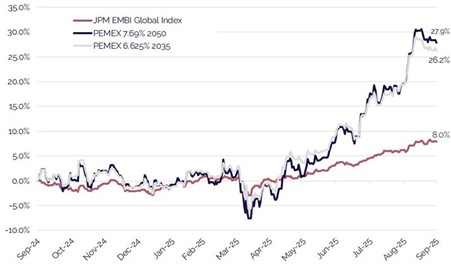
For instance, the 7.69% bond maturing in 2050 has seen a remarkable rally of approximately 28% year-to-date*. The true catalysts were the explicit government backing and undervaluation of the bond. The strategic selection of undervalued bonds enables us to bypass the limitations inherent in an index.

Outperformance versus the JP Morgan EMBI Global Index

* Source Bloomberg LP and EPIC Calculations. As at end September 2025.

The Sheinbaum administration – a new chapter for PEMEX

The election of President Claudia Sheinbaum signalled a decisive shift in approach, committing to addressing the company’s deep-seated financial issues. This renewed government support is the single most important factor for bond investors. The explicit commitment underscores the quasi-sovereign character of Pemex’s debt, effectively positioning the Mexican government’s creditworthiness as the ultimate backstop.

The administration’s proactive steps, which underscore their commitment to stabilise Pemex and other-state owned companies, include:

  • A comprehensive 10-year plan (2025–2035): This strategic roadmap aims to transform Pemex into a more efficient and sustainable entity through debt reduction, production stabilisation, and the revival of key operations.
  • Fiscal relief: A new tax reform is designed to significantly reduce Pemex’s historically high tax burden, freeing up capital for productive investment.
  • Direct financial lifelines: The government has provided, and committed to providing, substantial financial support, including a large investment fund to finance projects and ensure timely payments to suppliers.

The market’s confidence has been formally validated by credit rating agencies. In a matter of weeks:

  • S&P Global Ratings affirmed its BBB rating in September, a benchmark that has remained in place since March 2020. This consistency is key: unlike other agencies whose recent upgrades were a direct reaction to immediate government action, S&P’s investment-grade rating is the clearest reflection of its belief that the Mexican sovereign link is the fundamental driver of value.
  • Moody’s upgraded Pemex by two notches (from B3 to B1) in September, citing a “very high” government support assumption for the company.
  • Fitch Ratings followed suit with a further upgrade to BB+ in October, specifically noting that the successful execution of a large government-funded tender offer indicated an “increased linkage between Pemex and the sovereign.”

This wave of upgrades confirms that the government’s financial strategy, centred on improving stability and sustainability, has dramatically improved the credit profile of the Pemex bonds.

The value of vision

The success of the Pemex position validates our core philosophy. By focusing on fundamental analysis and identifying the true drivers of value, such as explicit government support, we capitalise on opportunities consistently overlooked by passive strategies.

Our unconstrained approach allows us to look past headline risk and conventional metrics, enabling us to target value across three distinct areas:

  • Political and structural catalysts – identifying sovereign actions that fundamentally alter credit risk.
  • Mispriced technical dynamics – exploiting situations where index constraints force others to sell.
  • Deep fundamental dislocation – uncovering value where a market’s negative perception ignores strong underlying economic realities.

Our unconstrained process actively creates value for our clients. We move decisively beyond the limitations inherent in index structures, applying deep insight and rigorous selection to generate performance. Our focus remains squarely on value, discipline, and delivering robust returns for your portfolio.

Please continue to check our blog content for advice, planning issues and the latest investment market and economic updates from leading investment houses.

Andrew Lloyd  

17/10/2025

Team No Comments

Brooks Macdonald Daily Investment Bulletin

Please see below article received from Brooks Macdonald this morning, which provides a global market update for your perusal.

What has happened?

US equities closed mostly higher on Wednesday. The S&P 500 gained +0.40% and Nasdaq gained +0.66%. Banks and semiconductors led as the outperformers, while the big techs were mixed. Treasuries weakened slightly, contributing to some curve steepening. The dollar index dipped -0.3%, gold climbed +0.9% to surpass $4,200 per ounce, and WTI crude oil declined -0.7%. In Europe, markets were slightly positive with the STOXX 600 edging up +0.1%. The FTSE 100 and DAX both gained +0.2%.

Trump continues hawkish tone on trade

US Trade Representative Greer labelled China’s new rare earth export restrictions as a ‘global supply chain power grab’ and a breach of prior agreements. Treasury Secretary Bessent dismissed reports that Beijing is banking on Trump’s stock market focus to force concessions, emphasising that the US won’t negotiate under market pressure. He branded Chinese Vice Commerce Minister Li Chenggang as ‘unhinged,’ accused China of questionable supply chain practices, and announced plans for price floors in various industries to counter market manipulation. However, Bessent offered a glimmer of compromise: a longer pause on high US tariffs if Beijing delays its rare earth limits, potentially negotiable in the coming weeks. Trump has questioned the need for a meeting with Xi at the upcoming Asia-Pacific Economic Cooperation summit in South Korea, but Bessent indicated it’s still likely on.

Fed’s Beige Book reveals stagnant economy

The Federal Reserve’s latest Beige Book reported minimal change in economic activity since the prior period, with three Districts showing slight to modest growth, five unchanged, and four experiencing a slight slowdown. Employment remained stable, but labour demand was subdued, with more firms reporting layoffs. Prices continued to rise, accelerated by higher input costs, which are often linked to tariffs. Wages increased modestly. Consumer spending dipped slightly, especially on retail goods, though electric vehicle sales boosted auto demand. Lower- and middle-income households hunted for discounts, while high-income luxury spending stayed robust. District outlooks varied, blending improved sentiment with persistent uncertainty.

What does Brooks Macdonald think?

US-China trade frictions show no signs of easing. But there were some positive trade developments elsewhere, US-South Korea talks signal headway on a $350 billion investment pledge, while US-India relations warm with Trump’s praise for PM Modi and claims of Delhi halting Russian crude purchase. Closer to home, UK monthly activity expanded marginally in August as expected, though July’s figure was revised to a 0.1% contraction. In France, political drama unfolds with PM Lecornu facing two no-confidence votes—one from the far-right (likely to fail) and one from the left-wing bloc, whose outcome hinges on a few votes despite offered compromises to Socialists.


Please check in again with us soon for further relevant content and market news.

Chloe

16/10/2025