
Team No Comments

Why aren’t you doing something?

Please see Lothar’s input below re Tatton’s thoughts on managing invested assets in this heightened volatility: 

Why aren’t you doing something? 

During times of such unprecedented uncertainty, some of our investors will be asking themselves what active investment management means under the circumstances and what we, as your appointed investment manager, may be doing to manage the impact capital markets are having on portfolio values. So, just as we all want to know what the Government is doing, we would like to answer your questions as to what we are doing. By the way, our operations and investment team remain fully functional with most of the team now working from home. To put our management into context, in times of heightened if not unprecedented levels of uncertainty everybody has a significant urge to ‘do something’ – it is human nature to want to fix something if it goes ‘wrong’. 
 
The toilet paper and now general panic buying, against best advice from the government and the supply chain managers, are testimony to this very human notion. 
 
Investment managers and portfolio managers in particular face the same pressure when markets and asset classes embark on a wild yo-yo-like pattern of daily movements. However,  even if it runs against the human desire to intervene, ‘doing nothing’  is widely accepted as the best approach to a) preserve the volatility reducing characteristics of diversified portfolios vs. direct stock holdings and b) to have portfolios in a position to act at the point when the wild market swings calm and the biggest buying opportunities arise. 
 
This does not mean that Tatton’s investment team has been sitting idle. Nothing could be further from the truth. Every day we review the relative weightings across portfolios and reflect against the market developments whether the portfolios’ individual component parts have drifted to a positioning – driven by differing asset class returns – that we deem adequate and appropriate. 
 
While we continue to monitor the portfolio as a whole, we are constantly reviewing those individual component parts. Ensuring that the underlying funds which make up our portfolios perform as we would expect through the prevailing market environment. We would expect the active managers to be taking advantage of the recent volatility in markets, but we want to ensure they remain committed to the philosophies we selected them for in the first place. 

At the moment, our investment committee made the decision that not rebalancing portfolio weights back to previous target weights is the most suitable investment strategy to deal with the current capital market environment – until current uncertainty levels reduce. 
 
This approach means that equity exposure across all (bar Global Equity) portfolios has drifted to an underweight position versus the risk profile target weight. Given the heightened levels of uncertainty and resulting volatility this seems reasonable to both lower the relative impact of volatility, but also to keep portfolios invested at levels which mean that when the market sentiment turns, they will fully participate to their previous allocation levels. 
 
With a reduction of stock market valuations of over 30% since their February highs, there are arguably buying opportunities appearing in the equity markets. However, we need to understand and accept that uncertainty over the extent and timing of an economic rebound remains exceedingly high and we are only four weeks into this downturn. It is quite likely that we will – even if just temporarily – see lower lows over the coming weeks. 
 
Trying to ‘time- the-market’ and trade on short term swings is the reserve of the very highest risk seekers amongst investors. Those with a capacity for risk to lose significant amounts of their capital or miss any short-sharp recoveries that long-term investors will capture when they misjudge the sudden turns of disorderly markets and guess wrong. As long term investors, we will not be drawn into ‘gambling’ with client savings entrusted to our investment management as we firmly believe that ‘time in the markets’ will once again prevail, just as it has done during all previous ‘apocalyptic’ looking global crises. 

Best wishes 
 
Lothar Mentel 
CEO Tatton Investment Management Limited 
CIO Tatton Asset Management 


This is how Tatton manage their Managed Portfolio Services, in reality it is similar to other Fund Managers.  Once again the key message and way to minimise risk is to remain invested, you can’t time the markets. 


Steve Speed 

18/03/2020 
Team No Comments

Advice in volatile markets

Over the last few weeks volatility has increased quite significantly with the backdrop of the coronavirus pandemic.  Even less volatile investments are now starting to see fund value reductions.

In the circumstances I thought it would be a good idea to outline some basic thoughts about investments:

  • Rule number 1 is you need to remain invested. It is virtually impossible to time markets, so you just remain invested
  • If you are in growth mode and not drawing income, we just wait for the markets to recover. This will happen given time
  • Drawing income from your pension or investment funds is more complicated. My advice in this case is as follows:
  1. If possible, stop drawing income from your investments and draw on your cash deposits – emergency funds. This is what the emergency funds are for
  2. Should you not have any cash assets to draw on reduce your income from your investments or pension funds to the minimum you can manage on. You are trying to protect your invested funds for the long term
  3. When markets recover switch your pension or investment income back on
  4. Replenish your cash deposits (your emergency funds) with capital from your Stocks & Shares or Investment ISAs after the market has fully recovered

This is the ‘three pot’ approach we talk about and advise our clients on all the time.  It might be a while before markets recover, please just be patient and stick with the strategy outlined above.

The key point about this approach is that we are trying to sustain and protect your capital for the long term.  It’s a simple and effective plan.

If you have any questions on your own personal situation, please don’t hesitate to contact me.  In the current environment I’m spending more time in the office.

I know it’s a well-used phrase at the moment, but it really is a time to ‘Keep calm and carry on’.


Steve Speed

17/03/2020


Team No Comments

PruFund Unit Price Adjustments

Prudential have now had to take action on their ‘smoothed’ fund range, please see the following cut and pasted from Prudential’s update: 

PruFund Unit Price Adjustments 

We’ve applied downwards Unit Price Adjustments(UPAs) to the PruFund funds shown below. Please note, the UPAs also apply to the protected version of the funds, where applicable: 

Prudential ISA / Trustee Investment Plan / Flexible Retirement Plan  

• PruFund Growth Pension/ISA Fund: -11.99% 

• Risk Managed PruFund 4: -10.00% Pension/ISA Fund 

• Risk Managed PruFund 5: -11.05% Pension/ISA Fund* 

*Only available on Prudential ISA 


Retirement Account Series D  

• PruFund Growth Fund Series D: -11.99% 

• Risk Managed 4 Pensions Series D Fund : -10.00%   


Retirement Account Series E   

• PruFund Growth Fund Series E: -11.70% 

• Risk Managed 4 Pensions Series E Fund: -11.91%  

• Risk Managed 5 Pensions Series E Fund: -13.13%  

 UPAs have not been applied to any of the other PruFund range of funds. 


 Why have these funds had a downwards UPA movement? 

The difference between the smoothed and unsmoothed prices is checked on a daily basis against Daily Smoothing Limits. A price adjustment is made based on the Daily Smoothing Limits if the unsmoothed price differs from the smoothed price by: 

8% or more, based on the actual unsmoothed price and a 5-day rolling average of the unsmoothed price for our PruFund Cautious, PruFund Risk Managed 1 or PruFund Risk Managed 2 funds. The smoothed price will be adjusted immediately to reduce this difference to 2.0%. 

 Or 

10% or more, based on the actual unsmoothed price and a 5-day rolling average of the unsmoothed price for our PruFund Growth, PruFund Growth & Income, PruFund Risk Managed 3,  PruFund Risk Managed 4 or PruFund Risk Managed 5 funds. The smoothed price will be adjusted immediately to reduce this difference to 2.5%. 

The Daily Smoothing Limit and the Gap After Adjustment will vary for each fund.  


If you are in growth mode please just remain invested, this is short term volatility and you are invested for the medium to long term.  For those of you drawing an income it may be prudent to stop or lower your income now until the market recovers. 

Please get in touch if you have any questions.  Given the current situation I’m becoming more office and home based and able to take calls. 


Steve Speed  17/03/2020 16.40 


Team No Comments

Market update Managed Portolio Service (MPS)

We hit a period of extreme volatility last week but we need to remain calm and invested.  Please see the input below from one of the investment houses that we use, Brewin Dolphin: 

Market update  

Managed Portolio Service (MPS)    

Over the past few weeks, markets have given us a stark reminder of how quickly they can turn. As the impact of the coronavirus in China became apparent and it became clear that the harsh containment measures would not keep the disease within the country’s borders, so the financial markets started trying to price a risk with many unknown factors. As a result, volatility spiked up and markets fell startlingly quickly. Yesterday we saw the biggest one-day move in UK equity markets since 1987.  

Furthermore, Saudi Arabia has declared a price war in the oil market and its timing could not have been more unhelpful. An oil price which was already lower due to concerns about the virus, took a further leg down and fed concerns about the viability of firms that are closely linked to the price of oil. The usual investments that negatively correlate to oil (because it is a major input cost), such as airlines, were having a difficult time for obvious reasons.  

Up until Monday, bonds upheld their role as a risk-off asset and have cushioned lower risk portfolios from the worst of the sell-off. Absolute return funds have also held up reasonably well so far.  

As long-term investors with Brewin Dolphin will know, we are very wary of reacting to market movements or headlines without having a handle on the wider context. It is all-too easy to panic early and lose the benefit of long-term exposure to the markets. It is easy to forget that, not so long ago, newspapers were concerned by the possibility of war in the middle east after the US targeted a senior Iranian general, but fortunately that did not transpire.  

On a personal level it is easy to understand people’s concerns about the virus, but what markets are more concerned about are the effects of the containment and the delaying efforts on the underlying economy.  

Brewin Dolphin has sought opinion from over half a dozen virologists, epidemiologists and public health experts to ascertain the implications. There are a wide range of opinions among the experts but there is a consensus that the focus will need to be on delaying the spread. Our asset allocation committee, which normally meets monthly, has already met twice in February to evaluate the situation. Our base case remains that this represents a sharp, but short-lived hit to global GDP although we recognise that there is a danger the situation could then trigger something more systemic.  

We are fortunate enough to have some extremely experienced and level-headed investment managers on Brewin Dolphin’s MPS Investment Committee. They recently agreed that it was time to sell down two funds that have proved disappointing in recent months. An absolute return fund has been replaced by Muzinich Global Tactical Credit and BNY Mellon Short Dated High Yield. These are two interesting strategies run by exceptionally skilled managers who are cautiously positioned giving themselves opportunities to take advantage. We also removed a European manager whose value strategy we felt could be replaced more cheaply by a blend of active and passive exposure.  

The market movements in February meant that MPS rebalanced a significant amount away from gilts very close to historic highs and bought into equities at lower valuations.  

In the sell-off we are once again seeing quality growth outperform on a relative basis. Lindsell Train has therefore done well in the MI Select Managers UK Equity fund, whilst Investec UK Income has performed the same role in the MI Select Managers UK Equity Income fund.  

Outlook  

The UK equity market produces a healthy dividend currently worth around 5% of current value. Even with the rather tepid growth, if you accept the premise that there will be a return to normality once the impact of the coronavirus fades, then it looks like markets are discounting significant cuts to dividends. In the UK, the convention is to maintain dividends unless your longterm ability to meet them has fundamentally changed, therefore such cuts seems unlikely.  

Underpinning UK dividend yields is a large amount of oil and gas profitability. As time passes oil supply should naturally decline and the market will come back into balance in due course with every chance of current dividends being maintained.  

There can be no question that the coronavirus is very serious, and the headlines in the UK and the US are liable to get worse before they get better, however it is also the case that we believe it will prove to be a temporary phenomenon and as such should only have a modest lasting impact on financial markets. 

As you can see the article suggests that once we are through the coronavirus pandemic the markets should be in a reasonable place with minimal long term impact from coronavirus.  I think it’s important that our blog readers continue to see a variety of views from across a range of different Fund Managers. 

You will see the consistent messages from different sources.  


Steve Speed  16/03/2020 


Article courtesy of Brewin Dolphin on 13/03/2020 

Team No Comments

Forced sellers and other distractions

Further Input from one of our investment houses that we use below, Tatton:

Disorderly divestments create confusing market dynamics

Last week could be characterised as an “orderly” repricing of equity markets to the consequences of COVID-19 disruptions. This week has seen second-order market dynamics, driving valuations down to levels which do not seem particularly rational anymore.

Are we back to a systemic crisis, the return of a global financial system teetering on the brink of collapse as it did back in 2008/2009? The answer is a firm and resounding ‘No!’.

This time the source of the stock market downdraft is not the financial system itself, but an external shock to global economic activity. Given such shocks happen far more frequently than banking crises and the resilience of the financial system is stronger following the financial crisis of 10 years ago, we see far less stress across the financial system overall.

Nevertheless, stock and bond markets are displaying levels of apparent disorientation as they bounce between brutal sell-offs and staggering recoveries, suggesting that distressed sellers are dominating the markets. The double whammy of the oil price collapse adding to the growth downgrades from COVID-19 counter-measures has clearly worsened the situation, but not to the extent that it can explain some of the market action we are currently experiencing.

Instead, it is likely that a number of large investors who entered this rapid sell-off with geared/ leveraged investment positions (to catch the growth rebound that was predicted at the start of 2020), are now scrambling to reduce their positions because their leveraged market exposure has put most of their capital at risk (needless to say that Tatton portfolios do not hold geared investment exposures). To quote Warren Buffet: “Only when the tide goes out, do you discover who has been swimming naked.”

This may provide some explanation why markets are driven down to valuation levels that appear to price in a sustained fall in company earnings – as would result from a lasting recession – even though it is by no means clear that this is the most likely outcome. In other words, we cannot currently gain much insight from market action, except that no-one has more insight than anybody else.

What is very encouraging is the willingness for concerted action between governments (fiscal support) and central banks (monetary intervention). It is easier to agree to protect society as a whole from virus disruptions than bailing out the ‘fat-cats’ of the banking sector as was required 11 years ago. On that note we commend the new chancellor, government and Bank of England on taking the lead amongst the western nations in announcing bold action plans to prevent long lasting economic damage from what increasingly looks like an inevitable but temporary public health crisis.

We read from the UK’s actions, but also some of the extraordinary steps taken by the Italian government to contain the economic fallout at household level, that we may well experience, not only a virus inflicted pause to public live and economic activity, but also a pause to the financial rules and obligations that private households and small businesses normally have to live by. This will feel very uncomfortable for most of us and is likely to confuse markets again, but such action is absolutely what may at some point be required to address this formidable challenge.

In all of this we will not lose sight at Tatton of the fact that such extraordinary times also lead to some extraordinary opportunities in investments, as too much focus on the very short term leads to buying opportunities for those with a longer term perspective. Historical precedent tells us that this virus crisis will pass and lead to a strong recovery, because the recessionary conditions are related to a passing condition, rather than a sustained deterioration in the general direction of travel the global economy was on before the virus crisis struck.


My message remains the same – stay invested, keep calm and carry on. If you have spare cash now is a great time to invest.

Steve Seed

12/03/2020


Article courtesy of Tatton Investment Management

12/03/2020


Team No Comments

Oil price plunge adds to stock markets pressures from Coronavirus

One of the investment houses we use has promptly issued this update at 9.52 this morning:

While most people spent the weekend dealing with the prospect of the COVID-19 epidemic taking hold of UK life, the financial community woke up this morning to another, different – even if slightly more familiar – type of upset: an oil price shock that unfolded over the weekend.

Oil prices have plunged by more than 30% since last week. Together with recent declines, this means that the price of oil has more than halved since the beginning of the year. At the same time, a flight to the perceived safety of government bonds has pushed up bond prices, leading to the lowest yields ever seen on US Treasuries as a result of the inverse relationship between bond prices and their yields.

As a consequence of the double whammy, the already highly nervous stock markets have reacted with what can only be described as panic selling. After falls of around 5% in Asia, European stock markets are opening down by at least as much and in some cases more.

Altogether this news flow will lead many to feel slightly apocalyptic – or at least as anxious as they might have during the darkest days of the financial crisis back in 2008/2009.

But pause for a moment and it becomes clear that this oil price collapse is a total reverse of the most significant oil crisis that took place in the 1970s. This time around, the Saudis decided to push the oil price down, not up, and falling yields take pressures off borrowers, rather than increase it.

This is very different territory compared to previous oil price shocks. So, what is going on?

Following the already significant declines in the oil price since the beginning of the year, there had been widespread expectations that OPEC (plus Russia) would agree to production cuts to stabilise the oil price. It therefore came as a shock to oil traders and their positioning towards rising prices when the opposite outcome occurred over the weekend. Essentially, this means that Saudi Arabia and Russia opted for a resumption of the price war of 2015/2016. Just as now, this strategy was aimed at decimating the competition of US shale oil and gas producers, which require a higher oil price threshold than Saudi and Russia to remain profitable. Just as Trump pursued a strategy of ‘kick ‘em when they are down’ with China last year, it appears the same tactic is now being applied to US oil producers.

Given that the shale producer defaults and the resulting stress in credit markets caused a stock market correction back in Q1 2016, it is not overly surprising that capital markets are following the same script now. Is it likely then that history repeats itself and we are about to witness an even bigger crash than 2016, due to the double whammy of Coronavirus disruptions and oil market upset?

Well, that’s possible in the very short term, but the overall financial, political and economic environment is a different one compared to four years ago. First and foremost, a repeat of the oil price war tactics from back then will no longer carry the same surprise factor. We can expect a much better-informed reaction by the US central bank and government to this renewed onslaught.

Back then, the biggest issue was that mass defaults across the US oil industry would increase the yield costs of corporate credit for all US businesses. Therefore, it is reasonable to expect the Fed will react very quickly to minimise this risk and use its immense quantitative easing (QE) firepower to sell US government and mortgage bond holdings and buy corporate credit to counter any selling pressures. This would also have the effect of easing any ‘flight to safety’ induced supply shortages within government bond markets.

What is more, neither commodity markets nor commodity producers are coming from bubble territory as they did four years ago. This time, there is unlikely to be a similar demand decline from resource industries for manufactured goods, which have already been forced to scale back expansion plans. On the other hand, a halving of the oil price, together with a significant reduction in the cost of borrowing, constitutes a significant stimulus for the global economy and in particular emerging markets, which will additionally benefit from an accompanying fall in the US$.

Our take on this morning’s stock market rout is that faced with this shock surprise action by oil exporters, market participants have become overwhelmed by a doubling up of concerns from the virus disruptions and memories of what happened the last time when oil prices traded at these levels.

We expect some decisive actions from central banks, or at least announcements in this direction. Such actions are unlikely to amount to another round of monetary QE from the Fed, but rather a swapping of government bonds already on its balance sheets with direct purchases of corporate bonds, given that the big falls in government yields from the increased demand in bonds allows them to take supportive action without pushing up yield levels. The Fed has the means to put out this specific fear driven ’fire’, while the economic stimulus effect from the lower cost of energy and of capital should prove to be a very welcome relief over the coming months for the virus disrupted global economy.

At the end of a tumultuous time for stock markets last week, the US stock market rallied hard into the close, leading to a slight weekly gain in those markets overall. This week may well prove similar as there are many more seasoned investors sitting on vast amounts of uninvested cash following years of overextended prices for risk assets.

Perhaps it is worth mentioning that due to unattractively high valuation levels, Warren Buffet’s Berkshire Hathaway fund was at the beginning of the year sitting on uninvested cash of around £130billion. As Warren Buffett is fond of saying: “Price is what you pay; value is what you get. Whether we’re talking about socks or stocks, I like buying quality merchandise when it is marked down.”

As you can see volatility is extreme, you need to remain invested as you are until the volatility subsides. It is also a buying opportunity for anybody sitting on cash.


Steve Speed

09/03/2020


Article courtesy of Tatton Investment Management Ltd.

Team No Comments

Transition into Retirement

One of the key areas we advise on is retirement planning, preparing for retirement, retiring and living your retirement.  As we could now live for 30 years or more in retirement it’s important to get it right.

There’s a good quote that says ‘Retirement is about waking up with enough purpose and going to sleep with enough money’.

For the transition into retirement to be successful you need to have both ‘the emotional capacity to retire and the financial capacity’.

A good transition into retirement for many is to semi-retire for a few years first.  This allows you the time to build up other interests outside of work and perhaps a new network of friends.

You need to have not just the wealth to retire but also the capacity to handle the emotional or psychological impact of leaving the world of work.

In general, people need to start thinking earlier about what comes next.  It’s useful to have these discussions years before you retire.  Understanding what you might do in retirement should help you to plan to have the means to retire (to do what you want).

Be flexible with your retirement, it’s very likely that you will change direction and you will have to adapt your original plans and keep adapting them.  Your retirement plan has to be pliable.

Quite often people either carry on working or return to work after a few months off.  This can be a retirement option for those that have the means to fully retire.  I have also had clients who have been pretty much full time voluntary workers.  The most important outcome is that you are happy with your retirement.

Summary

Think about your retirement, what do you want to do?  How will you spend your time?  Have you factored in what your partner and family want or what you’d like to do for them in retirement?

What will it cost to live the life you want to live?

Will your new life be engaging and intellectually stimulating?  Plan with your partner if you have one.

As mentioned earlier you need both the financial and emotional capacity to retire.


Steve Speed

09/03/2020


Thought provocation from Nucleus Illuminate 06/03/2020

Team No Comments

Coronavirus Market Update

One of the investment houses we use, Brewin Dolphin, put this content out on email last night:

With the market’s interpretation of the risks of the coronavirus shifting greatly as at the end of February, our Head of Research, Guy Foster has given the following update. 

The real risk to the economy and therefore the lasting impact on people’s savings is likely to be through the efforts to limit the spread of the virus. These measures will cause short term but potentially quite dramatic curbs on economic activity. 

We are confident the economy will recover and strengthen once these curbs can be removed, but we can’t be as confident about exactly when that will happen. In the last few days central banks have announced policy measures to offset some of the deterioration in outlook. 

Investing, unfortunately, does involve shouldering these and other risks, but with a focus on long-term investing we can ride out temporary disruptions to markets and the economy. 

Brewin Dolphin 02/03/2020 17.24

Comment

The key message from a variety of sources, commentaries and webinars digested over the last week is to remain invested.  This is nothing new.  In times of heightened volatility, the big risk is coming out of your investments.

If you remain invested at some point in the future markets will recover and you will feel the benefit.

It’s slightly different if you are drawing an income from your invested assets, for example in Drawdown from your pension fund in retirement.  The action you would take depends on how you are invested, what the underlying investment funds are, and what your overall position is.

It might be appropriate to stop drawing income from your invested assets for now and switch to drawing income, perhaps at a lower level, from your cash reserves.

If you are not sure please get in touch and ask for advice.  Your likely best response to this volatility is to do nothing with your underlying investments, stay invested as you are and be patient.


Steve Speed                                                                                                                                                              03/03/2020

Team No Comments

Good News for Prudential ‘PruFund’ Investors

An announcement released by Prudential yesterday afternoon included the following message for our PruFund Growth investors:

If your plan is invested in PruFund:

  • Your plan is made up of units, and you’ll get an increase to unit prices.
  • We increased your unit price by 0.9% on 26 February 2020. From then, your unit price will continue to move in line with the normal smoothing process of PruFund. You can find out more at pru.co.uk/investments/investment-fund-range/prufund/
  • You need to have been invested in the PruFund funds on 26 February 2020 to get the unit price increase. But any money you have in the holding account at that time won’t get the increase.

Comment

Prudential have more money than they need in their With-Profits Sub Fund, their inherited estate built up over many years.

They have these excess funds in their inherited estate and have decided to share it. This is not a regular occurrence, far from it.

This is great news – as markets drop substantially due to coronavirus (hopefully short term) Prudential add a little value for our ‘smooth’ investors! (pun)


Steve Speed                                                                                                                                                         27/02/2020

Team No Comments

Woodford Equity Income – Fund Update Blog

History

As you may recall, it was announced on the 15th October 2019 that Neil Woodford’s flagship fund, namely the Woodford Equity Income fund is to be wound up with effect from 17/01/2020.

Latest

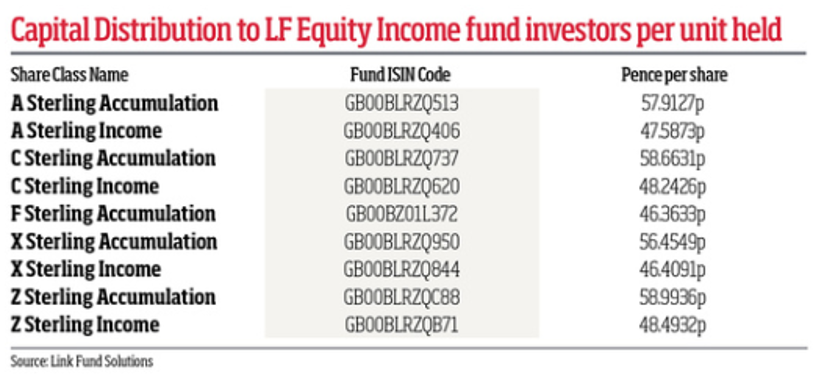
It has today been announced that investors in the LF Equity Income fund (Woodford has been removed from the title), will receive between 0.46p and 0.59p per unit they hold in the fund for the first capital distribution according to Link Fund Solutions (the Fund administrators). Please see the full share class distribution list below:

The payment equates to approximately 70% of the fund’s total value, representing the liquid part of the portfolio that BlackRock Advisers Limited has offloaded already.

Investors will receive confirmation of the total amount they are due by 28/01/2020. The payment will be made “on or around 30 January”, with investors who hold the fund through a platform set to receive theirs “a few days after 30 January due to the time it may take for your platform to process your payment”.

Our Thoughts

This is a good first step for investors in getting some of their capital back. As stated in my original Blog back on the 16th October 2019, the major factor is how will the sale of assets under the less liquid portion of the portfolio be handled. It is important that these assets are not just sold at a lower value to raise capital, as this would impact on the amount of capital investors get back. PJT Partners (UK) Ltd need to take their time in negotiations in order to attempt to get the true worth of the underlying assets held within the portfolio, which they have indicated they will be trying to do.

We will continue to monitor the position and will issue another blog when an announcement is made. As noted previously, our clients are well diversified and are likely to have only a nominal holding in this fund if anything. Diversification helps control the risk.

In the meantime, should you have any queries on this matter, or would like to undertake a financial review of your holdings to better understand how you are invested, please feel free to give us a call on 0151 546 1969.

Carl Mitchell 28/01/2020