
Team No Comments

Brewin Dolphin – Markets in a Minute

Please see below an article from Brewin Dolphin detailing their views on recent market data and events which was published yesterday (09/07/2024) and received this morning:

Janet Mui, Head of Market Analysis, discusses how markets digested the news of Labour’s landslide election win, France’s hung parliament, and the latest U.S. economic data.

It was politics that occupied the news headlines last week. And while it’s had some impact on markets, the UK general election was met with market apathy given that the result had been expected – that’s despite a historic seat gain for Sir Keir Starmer’s Labour Party.

This result is popular with the markets, as Labour is seen as a more functional governing party compared to the years of infighting, division and leadership contests under the Conservative Party.

A strong majority for Labour means an endorsement of the party’s leader and policy agenda. In Labour’s case, its commitment to avoid a repeat of Liz Truss’s infamous brush with fiscal mortality means a likely period of economic orthodoxy is welcome.

In France, by contrast, a majority for Marine Le Pen’s National Rally Party over the weekend would’ve been a concern for markets because her policy agenda seems fiscally cavalier. However, last week, it seemed increasingly likely that National Rally wouldn’t achieve a majority, causing French assets to perform relatively well. Indeed, National Rally came third in the second round of voting on Sunday. Left-wing alliance New Popular Front won 188 seats while President Emmanuel Macron’s liberal coalition Ensemble came in second with 161 seats.

The strength of Labour’s performance stands in contrast to a general tide of increased preference for more socially conservative policies. UK voters don’t necessarily have a different perspective on what’s important, but they do have a different political system, and this victory for Labour had more to do with the fracturing of the rightwing vote than a triumph of the left.

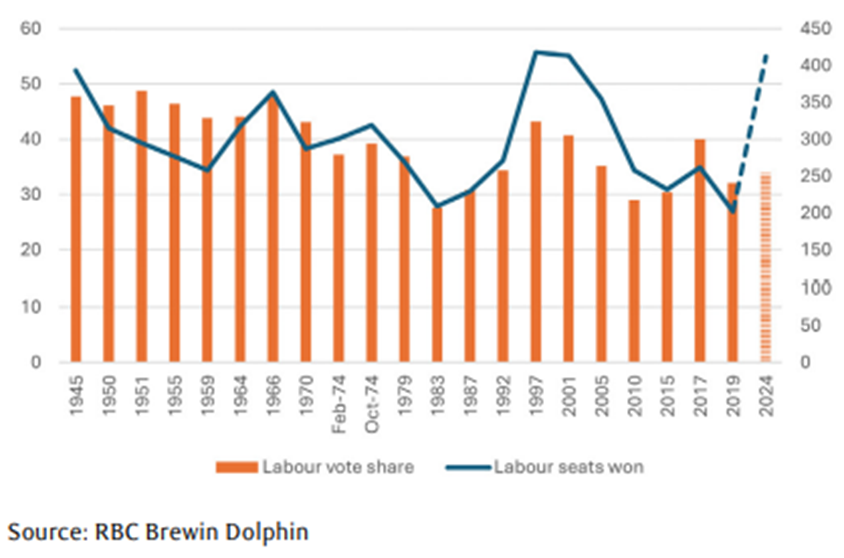
This was Labour’s third highest seat haul, but its sixth lowest share of the popular vote, since 1945. Its vote share was up less than 2% on the 2019 election, in which Jeremy Corbyn’s Labour was trounced by Boris Johnson.

The splitting of the right-wing vote across the Conservatives and Reform UK was instrumental in delivering huge seat gains for Labour and the Liberal Democrats. Also contributing towards Labour’s success was the decline in the Scottish National Party’s vote share.
With a Labour majority always seeming the most likely result, the market was apathetic, with no discernible movement in bonds or currency markets.

Within the FTSE 100, the housebuilders were amongst the leaders. They are perceived to benefit from Labour’s plan for a blitz of planning reform, which will enable more housebuilding. The policy will doubtless be unpopular with many existing constituents, but a large majority helps quell any stirrings of rebellion.

Is a change on the cards for the Democrats?

The biggest political headlines were drawn by U.S. President Joe Biden, as he has been fighting to retain his position as the presumptive Democratic nominee to contest the presidential election this November.

A few Democrats have finally started to break cover and call for Biden to stand down. By convention, a sitting president is not challenged when seeking re-election, but Biden’s advanced years have caused many to question the wisdom of him standing.

The issue has been that nobody else has been seen to stand a better chance of beating Trump than Biden, but that seems to be changing with head-to-head polling suggesting that Vice President Kamala Harris may have a better chance than Biden. She would be the easiest replacement candidate for the party as she was already Biden’s stated running mate. Prediction markets and betting odds seem to suggest that Harris may even be considered more likely to face the voters.

Bond markets would likely look fondly on a change in Democratic candidate now that Biden’s chances have diminished so much. They perceive Trump as a malign inflationary influence.

However, in reality, the economic consequences of a Trump presidency are more complex than that, depending on whether his party would also control the Senate and House of Representatives (all of which are quite possible).

Is economic momentum slowing?

It’s easy to get distracted by the politics but, of course, the more tangible factor affecting markets is economics. Last week’s business surveys from across the globe painted an ambiguous picture of the economic outlook.

Manufacturing activity remains muted although the low level of inventories should reassure us that downside is limited. Services sector activity continues to expand but does so at a slower rate than in May. There were confusing irregularities in the data, making it difficult to see a distinct trend.

In general, the economy looks to have lost some momentum compared to the first quarter. What’s consistent is evidence that price growth is slowing.
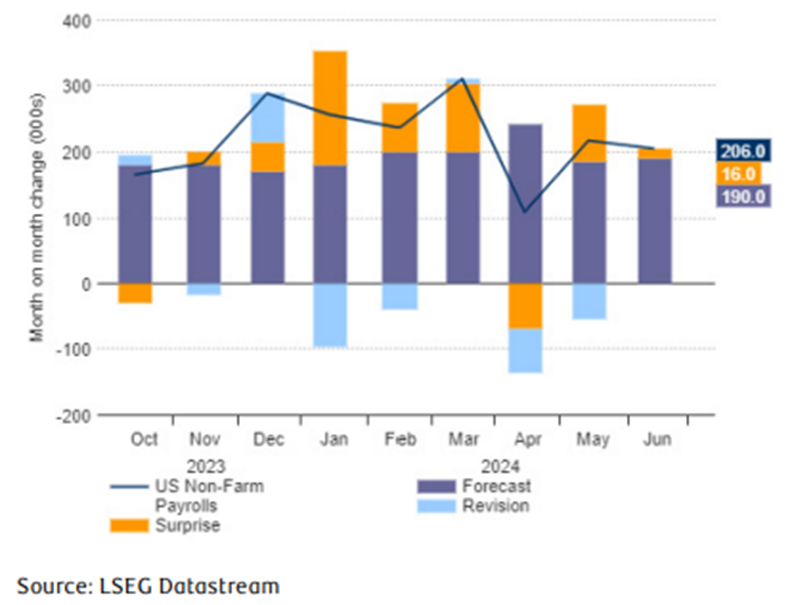
The book end to last week was Friday’s U.S. employment report. Headline employment growth was slightly ahead of expectations, but there were plenty of caveats to threaten the positive headline.

The unexpected jobs growth came from government hiring, with the private sector slower than expected. The unemployment rate ticked up and this has been moving higher in a way that could be consistent with a recession. However, the moves have been about increasing labour supply, rather than job losses or a slowdown in hiring. April and May’s jobs growth was also revised down to a more modest pace.

Finally, wage growth slowed on an annual basis. Taken as a whole, this was a labour market report that will help the Federal Reserve to build the case for rate cuts. If services sector inflation (excluding housing) is reasonable in June, the case for a September rate cut will have become very compelling.

Please continue to check our blog content for advice, planning issues and the latest investment, market and economic updates from leading investment houses.

Carl Mitchell – DipPFS

10/07/2024

Team No Comments

What does the election mean for UK markets?

Please see below article received from Jupiter Asset Management this morning, which provides their market predictions following the Labour Party’s victory in the UK General Election. 

As the nation wakes up after polling day, the public, press and markets will be digesting news of the result. To give an investment perspective on what it means for markets, we asked some of our experts for their immediate reaction.

Matthew Beesley, CEO

“The UK market has very healthy underlying fundamentals and is trading at near all-time high levels. Yet frustratingly at the same time, the valuations of UK stocks are also at record low levels because of the political uncertainty of the last few years. There is every reason to hope that the new government will usher in a period of political stability, prioritise the Edinburgh reforms and hold themselves accountable to a clear industrial growth strategy that will cement the UK’s recovery and turn it back into a key focus for international investors.”

Adrian Gosden and Chris Morrison, Investment Managers, UK Equity Income

“This election was decided without major policy announcements from either of the main parties, and we are hopeful that a stable political backdrop will prove to be good for the economy and for market sentiment. UK equities have enjoyed solid performance this year to date, and we are looking for a sustained rebound in the market, helped by supportive factors such as weakening inflation, a potential Bank of England rate cut, attractive valuations for UK equities and good earnings performance from UK companies.”

Tim Service, Investment Manager, UK Small & Mid Cap Equities

“After nearly a decade of political shocks in the UK, today’s election result feels unusual for a Labour win having been so predictable. I expect this to be good news for the UK equity market over the medium-term, if for no other reason that markets and companies alike crave certainty. A government with a clear mandate will give companies confidence to hire people and invest in the future, while markets can better discount future company profits accurately.

However, ‘certainty’ is a still a relative concept given Labour’s campaign rhetoric to deliver change – so it’s important for investors to consider how new legislation, tax and spending plans might affect individual companies. We hope that Labour can start addressing productivity issues through planning reform and infrastructure investment, while also reenergising the UK’s capital markets. We are encouraged that Labour seems to recognise the problems, but would stress the urgency with which the remedies are required.”

Mark Nash, Huw Davies and James Novotny, Investment Managers, Fixed Income – Absolute Return

“Relative to the high level of uncertainty seen in the aftermath of international elections over the last few weeks (South Africa, India, Mexico, EU, France) and the concerns around President Biden’s performance at the first US presidential debate, the UK election has been something of a non-event. Labour’s victory means that we have now entered a period of relative stability in UK politics which is in stark contrast to the possibility of continued volatility elsewhere, especially in the run up to the US presidential elections in November. The UK could well look like a haven of political stability, a very different landscape to the years since the Brexit referendum.

The new government has to contend with the perilous scale of the UK’s twin deficits, with the adverse market reaction to Liz Truss’s mini budget almost two years ago still vivid in our memories. Labour will need to convince the market, and also the electorate, that they are fiscally prudent while still improving the shoddy state of UK public services and anaemic productivity and growth profile, none of which will be easy.

Growth will be their get-out-of-Jail free card, easier said but hard to deliver. They look likely to rest their hopes on a better trade deal with the EU to try and reduce friction at the border with the EU, and also by liberalising the UK planning laws. If they can succeed in this endeavour, then there may be some renewed hope for better UK growth along with less inflationary pressure within the UK. Despite the UK’s fiscal position, we believe Gilt yields look cheap compared to other countries that have a weak fiscal position (e.g. France) so there may well be some flows towards Gilts from other challenged sovereign bond markets that continue to have political problems now our election is done and dusted.”

Please check in with us again soon for further relevant content and market news.

Chloe

05/07/2024

Team No Comments

Tatton Monday Digest

Please see the ‘Monday Digest’ article below, received from Tatton Investment Management this morning. 

Tatton Monday Digest Politics, where policy takes a back seat

Last Friday marked the end of the second quarter, culminating in the day after the first 2024 US Presidential debate, widely seen as disastrous for Biden, yet financial markets have remained relatively steady. Institutional investors are currently engaged in their scheduled portfolio rebalancing, however, this time it is causing minimal disruption across asset classes. 

Thursday’s debate was anticipated to scrutinise presidential fitness rather than policy details. Biden’s disastrous performance raised concerns even among loyal Democrats, potentially jeopardising his electoral viability with any loss of voter support being very damaging.

We think betting markets show a more unbiased indicator than polls, reflecting a notable shift post-debate. Trump’s odds improved to 54.8%, a 4% gain, while Biden’s plummeted below 25%, a decline exceeding 15%. Betfair Exchange Politics indicates a 60% likelihood of Republican victory, signalling diminished prospects for Democrats if Biden remains their nominee.

Amidst debate fallout, California Governor Gavin Newsom emerged as a prominent alternative in market discussions should Democrats opt for a candidate change. The viability of such a shift hinges on internal polling and strategic calculations within the Democratic Party, which may in flux at the moment.  

Market reactions following the debate were almost blasé. US stock futures saw modest gains, contrasting with a decline in US Treasury bond prices (indicative of rising yields). The dollar also rose. International stocks were a little weaker. This implies that investors are currently expecting a slight near-term benefit for US growth should Trump win, but that it may also mean a worse budget deficit.

Looking beyond the US, global elections share common themes: aspirational manifestos mean that most important policies will not be clear until well after the elections are finished amidst heightened voter polarisation. In France the right wing did well in the first round of voting, but outright victory may be hampered in the second round by tactical voting simply to prevent the Le Pen from winning. In the UK, Labour’s centrist manifesto seems less alarming to markets, yet clarity on actual policies also remains vague.

Compared to the start of the year, global economic data remains mixed with a slight positive bias, bolstered by upward revisions in world growth forecasts. The Chinese economic policy push to bolster economic activity has driven down goods inflation, but this signals weakening domestic demand. The US shows a loss of growth momentum with slew of profit warnings from consumer-facing companies ahead of Q2 results. Consumer caution over inflation has tempered spending, impacting sectors like housing and consumer goods.

Gentle economic slowing that allows the Fed to cut rates, should lead to rebounding growth amid an otherwise stable dynamic characterised by tight labour supply driving business investment into productivity enhancing technology advancements. Europe is in a similar position although admittedly with softer underlying growth.

Looking ahead, companies broadly remain on a positive path, but market risk will continue to emanate from policy volatility uncertainties. We’ll know a bit more next week after the UK elections and possibly a lot more after the second round of the French election 

Basel III banking regulation – the Unending Endgame

Last week marked the 50th anniversary of the Herstatt Crisis, a pivotal event that triggered the establishment of the Basel Committee on Banking Supervision by the G-10 nations. In 1974, Herstatt Bank’s collapse during currency trading left a $620 million loss ($400bn today) on the global banking sector, prompting G-10 nations to form the Basel Committee on Banking Supervision to mitigate such risks.

Initially overseen by the Bank for International Settlements in Basel, Switzerland, the committee aimed to regulate an increasingly interconnected global financial system. It took 14 years, until 1988 for Basel I, which introduced international banking regulations focusing on capital adequacy, classifying assets into risk categories and requiring banks to maintain capital equal to at least 8% of their risk-weighted assets.

It was hoped Basel I would prevent bank failures spilling into the global financial system, but it failed. The Barings Bank collapse in 1995 and the Long Term Capital Management debacle in 1998 underscored its limitations and led to Basel II. Introduced in 2004, it aimed to enhance risk management and transparency by assessing asset risks more accurately, however it also failed spectacularly to prevent the 2008 financial crisis. This led to the development of Basel III, implementation of which began in 2010 and continues, albeit slowly, with the final phase known as the “Basel III Endgame.”

Basel III extended Basel II’s focus on risk management – increasing minimum capital requirements, raising common equity levels from 2% to 4.5% of risk-weighted assets. It introduces capital buffers to absorb losses during economic stress, mandates liquidity ratios to ensure banks maintain high-quality liquid assets and imposes stricter requirements on globally significant banks.

However, Basel III places greater weight on banking regulation but not on other financial institutions such as private equity and credit firms, which are now seeing stronger equity returns. Last week US bank shares rose when the US Federal Reserve Recent announced revision to moderate the impact on large banks with sizable trading operations reducing the increases in capital adequacy to about 5% from a potential 16% rise.

In Europe, implementation has been delayed pending alignment with potential US revisions. Politics may disrupt the final outcomes as well. It is worth remembering, that Trump removed some of the regulations for US regional banks in his first term and he may seek to allow US banks more latitude.

Perhaps more likely is that the non-bank players, especially the private equity and credit firms, will seek to prevent similar regulation being applied to them, as highlighted by the Bank of England last week when it reenforced the need for international co-ordination for private equity  cross jurisdictions.

So, for the banks, “Endgame” might be applied to this Basel episode. For private equity firms, their episode will probably be called “Opening Gambit”.

The rise and fall of Ocado

Ocado, known for its distinctive green and white delivery vans and association with M&S, began in 2000 as a pioneering online grocery service in the UK. Initially praised for its innovative technology and logistics, including automated Customer Fulfilment Centres (CFCs), Ocado quickly gained market traction. Its 2010 stock market debut saw shares rise from an initial 180p to nearly 600p, buoyed by efficient operations and a partnership with Waitrose, which bolstered its IPO.

A turning point for Ocado was licensing its Smart Platform technology globally, securing deals with major retailers like Morrisons, Kroger, Casino, and Aeon. This expansion underscored Ocado’s tech prowess and potential for substantial revenue growth, reflected in its share price peak of around 2886p in 2020.


However, the grocery sector’s fierce competition and narrow margins strained Ocado, despite its technological edge. High costs associated with building and maintaining CFCs, alongside increasing competition from Amazon Fresh and traditional grocers going digital, pressured Ocado to continually innovate.

The COVID-19 pandemic briefly boosted Ocado as online grocery demand surged. However, the temporary spike strained operations and inflated costs, raising concerns about long-term sustainability post-pandemic. Analysts, including Morgan Stanley, now project prolonged cash flow challenges and debt accumulation.

Morgan Stanley’s cautious forecasts include fewer CFC deployments and heightened debt levels, signalling ongoing operational and financial hurdles for Ocado. This shift in sentiment has driven a significant decline in Ocado’s share price from its peak to just 281p last week, underscoring investor scepticism about its ability to manage these challenges effectively.

Looking ahead, Ocado must focus on cost management, margin improvement, and expanding its technological services to new markets to regain investor confidence. While its innovative approach sets it apart, navigating the competitive and cost-sensitive grocery sector remains a formidable task.

Ocado’s journey serves as a cautionary tale in the tech industry, highlighting the complexities of sustaining growth amid operational pressures and competitive forces. Its evolution underscores the volatile nature of high-growth enterprises reliant on borrowed potential, where minor shifts in profitability drivers can lead to significant market reactions.

Please check in again with us soon for further relevant content and market news.

Chloe

01/07/2024

Team No Comments

EPIC Investment Partners: Daily Update – Economic Challenges Loom as 2024 Unfolds

Please see below, EPIC Investment Partners daily market summary which covers their views on global markets and economies and was received yesterday (26/06/2024):

As we near the second half of 2024, the global economy finds itself at a crossroads, balancing optimism for a soft landing with persistent challenges. The World Bank’s upgrade to its global growth forecast to 2.6% for 2024 reflects a cautiously optimistic outlook, with the United States remaining a key driver of global economic resilience. 

However, the US economy is showing signs of deceleration. Real GDP growth is projected to slow to 1.5% in 2024, down from 3.1% in 2023. Consumer spending, which has been a cornerstone of economic strength, is weakening as households deplete savings and face rising loan delinquencies. The labour market is also expected to soften, with unemployment potentially rising to 4.5% by year-end. 

Inflation remains a central concern. The Fed anticipates core PCE inflation at ~2.8% for 2024, above its 2% target. This persistent inflation has led to a more hawkish stance, with the central bank projecting a higher funds rate of 5.1% for 2024. Despite this, markets still expect two 25bps rate cuts in 2024, priced in from September. 

The political landscape adds another layer of complexity. The upcoming US election in November could significantly impact trade, tax, defence, and immigration policies. With the US government already spending as if the nation is in deep depression (clearly underpinning inflation), the US is facing a severe debt crisis as national debt nears USD 35tn and is increasing rapidly. Interest payments alone now consume around USD 1tn annually, surpassing many crucial programme budgets. Despite acknowledgment from past and present politicians, effective action remains absent. The only viable path forward is to curb government spending, limiting increases to below average economic growth. However, political will for such measures is lacking, risking severe future economic consequences. 

Financial markets appear to be pricing in a near-perfect scenario. The S&P500 has reached multiple new highs in 2024, and volatility remains low. The 10-year US Treasury yield, while fluctuating, appears to be stabilising given reduced expectations for Fed rate cuts. The US dollar maintains its strength, underpinned by the Fed’s cautious approach and its safe-haven status. 

However, risks loom on the horizon. The full impact of previous interest rate hikes may still be unfolding. The persistence of above-target inflation continues to challenge policymakers. Market volatility could increase as the US election approaches, with potential implications for global trade and economic policies. 

As we move through the latter half of 2024, the global economy walks a tightrope. Central banks’ abilities to navigate the delicate balance between stabilising inflation and supporting economic growth will be crucial. While a global soft landing remains possible, the path forward is fraught with uncertainties. Policymakers, businesses, and investors will therefore need to remain vigilant, adapting to a rapidly evolving economic landscape. As always, flexibility and careful risk management will be key to navigating these uncertain economic waters. 

Please continue to check our blog content for advice, planning issues and the latest investment, market and economic updates from leading investment houses.

Carl Mitchell – DipPFS

Independent Financial Adviser

27/06/2024

Team No Comments

The Daily Update | From Central Banks to NFA Predictions

Please see below ‘Daily Update’ article received from EPIC Investment Partners earlier this afternoon, which provides global economic analysis.

The Bank of England (BoE) maintained interest rates at 5.25%, as widely anticipated, despite headline inflation reaching the 2% target in May. Governor Bailey said: “It’s good news that inflation has returned to our 2% target. We need to be sure that inflation will stay low and that’s why we’ve decided to hold rates at 5.25% for now.” 

The BoE’s primary concern, mirroring its US counterpart, is persistent service inflation, which only marginally decreased to 5.7% from 5.9% in April. The central bank attributed part of these increases to regulated prices and volatile components, rather than underlying inflationary pressures. 

As in the previous meeting, seven Monetary Policy Committee (MPC) members favoured maintaining rates, while two advocated for a 25bps cut. However, this decision was described as “finely balanced,” suggesting a more nuanced discussion around potential rate cuts. 

The MPC meeting minutes revealed stronger-than-expected economic growth, the BOE forecast 0.5% GDP growth in Q2 2024, up from the 0.2% projected in May. This growth, partly driven by increased government spending, marks a clear recovery from last year’s recession. However, MPC members expressed concerns about persistent wage growth potentially leading to further price increases, and the risk of rising energy prices in autumn contributing to higher inflation. 

The MPC’s subtle shift in guidance, focusing more on the August forecast round rather than immediate data releases, indicates a more forward-looking approach. This change suggests the committee may be becoming less reactive to short-term data fluctuations and more focused on broader trends. 

Barring significant surprises in June’s inflation data, the BoE could commence its easing cycle in August. Markets are currently pricing in a ~70% chance of a cut in August, up from ~30% ahead of the BoE announcement.  

The upcoming change in MPC personnel, with Broadbent’s departure and the more hawkish Clare Lombardelli’s arrival, introduces an element of uncertainty that could influence the timing of the first cut. 

In other news, the Swiss National Bank (SNB) reduced rates by 25bps to 1.25%, marking its second cut this cycle. Unlike many Western countries, Switzerland’s inflation has fallen below 2%, stagnating at 1.4% in May. Of note, the SNB expressed willingness to intervene in the foreign exchange market, given the recent surge in the franc amid European political uncertainty. 

Remember our Net Foreign Asset (NFA) model that we use to predict Euro success? Well, it’s been a mixed bag. While the wealthy nations have largely triumphed, a few upsets have left our Fixed Income team scratching their heads. Belgium (6 star NFA) fumbled against Slovakia (2 star), but they’ve got another shot at glory against Romania (2 star) this weekend. Meanwhile, our model suggests the Netherlands (7 star) should outshine France (3 star) tonight, despite the latter being one of the tournament favourites. Will the Dutch make it rain Oranje, or will the French prove that football prowess is not about wealth? 

Please check in with us again soon for further relevant content and market news.

Chloe

21/06/2024

Team No Comments

Evelyn Partners on the 2024 General Election

Please see below article received from IFA Magazine and Evelyn Partners earlier this afternoon, which highlights the pension and tax questions that savers are asking.

Much is up in the air across many facets of pensions and tax policy, and until a few weeks ago the main political parties had most of the rest of the year to make clear some intentions. 

However, campaigning is now well underway with limited clarity as the country looks towards a 4 July poll. 

Gary Smith, Partner in Financial Planning at wealth management firm Evelyn Partners, says: 

‘We haven’t seen the manifestos yet, and even when we do they might not contain much concrete detail on pensions, inheritance tax or the taxation of investments. So we are left in a world of probabilities, possibilities and suspicions around upcoming changes to the financial landscape that savers might have to navigate.  

‘The fact that we are looking at a very probable change of government come 5 July throws up some urgent questions around what’s in store for pensions both state and private, or for families planning how pass on their wealth – but campaign rhetoric doesn’t provide many answers. We do know that change for savers is closer at hand than it was a fortnight ago.  

‘We’ve had the surprise “triple-lock plus” gambit from Rishi Sunak, and while he might not get the chance to put it into practice, it does reignite the state pension debate, as well as disquiet over frozen allowances for everyone. Unless Labour moves to match it, which seems unlikely, it opens up some clear water on policy. 

‘One elephant in the room is the prospect that a new Government might look to the taxation of pensions, or other wealth assets, to escape the fiscal restraints the main parties have imposed on themselves.’ 

The Institute for Fiscal Studies and the International Monetary Fund have warned that both parties’ public finance projections indicate a significant funding gap, of up to £30billion, unless unscheduled spending cuts are enforced. A recent poll revealed that 56 per cent of British voters expect taxes to go up after the UK general election if Labour win, and 52 per cent if the Tories remain in power. 

Labour has now promised not to hike VAT, which means both parties have pledged not to raise any of the three biggest levies – income tax and national insurance being the other two – that account for the lion’s share of Treasury revenues. Labour has also vowed not to raise the headline rate of corporation tax, the fourth biggest fundraiser. 

Smith says: ‘A new government might look at the tax treatment of pensions or certain IHT reliefs to bridge a funding gap that seems bound to open up even if public sector spending is severely restricted. Savers, however, should be very wary of acting on such possibilities and it is highly unlikely any changes to the tax system would be enacted before April 2025.’ 

State pension triple lock (plus?) 

Smith says, ‘The affordability of the triple-locked state pension is a can that keeps getting kicked down the road and an election is not the time that either main party is likely to break that pattern. 

‘In fact, the Conservatives have doubled down with their £2.4billion “triple lock plus” pledge. Mr Sunak has said he would create an “age-related” tax-free personal allowance in the income tax system, which would rise to keep it above the rate of the state pension. This would mean two different personal allowances: one for working-age people that will be frozen until 2028 and another higher one for retirees that would change annually.  

‘There are issues with this, apart from affordability and the potential to be generationally divisive. It’s not clear what sort of personal allowance would apply to those who continued to work after state pension age – and 1.37million people aged 65 and over were still in work last year. It would also add another level of complexity to the UK tax system. 

‘It’s questionable whether the Conservatives would have tabled this policy if they had a good chance of remaining in power, but it does at least shine a light on how frozen thresholds are raising the tax burden by stealth. Promises from both parties not to raise headline tax rates offer little comfort when we all know we’re going to be paying more tax anyway due to fiscal drag. 

‘One favour today’s workers can do for themselves is to assume the triple lock might not be sustainable for more than a decade, and that they need to save more than they think to make up for that.’ 

The pensions lifetime allowance 

Smith says, ‘While Jeremy Hunt’s abolition of the pensions lifetime allowance was widely welcomed, some of the details in the implementation have caused lingering uncertainty and confusion – as has Labour’s undertaking to reinstate it. 

‘We hope Labour will soon offer some more clarity on how and when it plans to reintroduce the LTA. If an LTA is reintroduced, the key questions will be at what level, and will there be some sort of carve-out for highly-paid NHS clinicians? It seems very unlikely a new LTA would be set back at its most recent £1.073 million – a level that landed doctors and surgeons with unwelcome tax charges, exacerbated staffing shortages in the NHS and led to Hunt’s decision to abolish the threshold. 

‘Under the last Labour government, the LTA ended up at £1.8 million, which would now be worth over £2.5 million adjusted for inflation since. It wouldn’t be surprising if the LTA was reintroduced at something like the £2 million mark. 

‘Either away, it is important to understand that the LTA has been removed from the statute book and so a future Government wishing to reintroduce it could not just switch it back on the day after the election but would have to pass new legislation which would likely take the form of a Finance Bill on the back of a Budget – and Shadow Chancellor Rachel Reeves has ruled out a summer Budget.  

‘The legislative process takes time and therefore is unlikely that a new LTA could be in place until April 2025. Applying a new LTA retrospectively would be highly contentious, open to challenge, and therefore unlikely. There is also strong precedent, from the original introduction of the LTA and previous reductions in the threshold, that those impacted would able to take out protection, typically by ceasing further funding.  

‘Given all this, for some savers who may have previously ceased pension funding because of the LTA and are very keen to restart with regular or lump sum contributions, the current window of opportunity might be worth taking advantage of, after taking some advice.  

‘But making drastic changes to one’s financial plans in what is a fluid situation is probably inadvisable, particularly for those who are about to access their pots. For instance, if some savers are thinking of rushing to access their 25 per cent tax-free lump sum because of fears over what Labour might do – as some reports have suggested – they should take advice before any hasty action.’ 

Could there be other changes to pension taxation? 

The Conservatives have affirmed that they would not introduce any new taxes on pensions or increase existing ones for the whole of the next Parliament. They would maintain the 25 per cent tax-free lump sum and tax relief on pension contributions at the marginal rate of income tax. National Insurance would not be extended to employer pension contributions. 

Smith says: ‘We have no indication of any such plans from Labour but no such assurances either. In spite or because of this, the taxation of pensions is inevitably drawing some speculation, not just over the reintroduction of the LTA, but other areas where a future government could look to raise revenue. 

‘Labour objected to Jeremy Hunt’s pension taxation reforms at the 2023 Budget as “a tax gift to the wealthy”, so the increase of the annual allowance from £40,000 to £60,000 cannot be considered untouchable. The annual allowance is arguably an easier and more efficient way to cap the amount spent on pension tax relief than the LTA, so some sort of reversal of the AA increase is not unthinkable, whether it comes alongside or instead of a new LTA. 

‘Another way to limit the Treasury spend on pension tax benefits would be to reduce or do away with the 25 per cent pension commencement lump sum, or to limit tax relief on pension contributions. Either measure would be controversial, and the latter would be an administrative challenge, so they are perhaps unlikely, at least early on in a new government’s parliament. 

‘But as pension contributions are an effective way to pay less tax as thresholds remain frozen, it’s understandable if suspicions that a new government might look to cap or reduce tax relief in some way are leading some savers to stash cash into their pensions now. 

‘One final tax-preferential treatment of pensions that could come under scrutiny is the exemption of defined contribution pension pots from inheritance tax.’ 

The questions around inheritance tax exemptions 

Smith says: ‘Labour have made it clear they think some inheritance tax exemptions and allowances are too generous, so it’s possible some sort of measures will be taken to reduce them if they gain power. 

‘While the IHT-exempt status of defined contribution (or money purchase) pension pots has not been mentioned by Labour, it has been highlighted more than once by think-tanks as an anomaly, so it might well be on Rachel Reeves’ radar. 

‘If some steps were taken to levy IHT on the transfer of pension assets, this would probably lead to a widespread draining of drawdown pots, and a lurch towards other assets and tactics that mitigate against IHT, which at 40% is quite significant. 

‘The other major talking point on IHT is around business and agricultural property reliefs, with a think-tank this week highlighting how they help some large estates shelter assets from IHT, and questioning the potential eligibility of most AIM shares for Business Relief.

‘There are legitimate reasons behind business and agricultural IHT reliefs, which help family and rural business to remain intact and going concerns on the death of owner, thereby savings jobs and assets of community value. Objections to the inclusion of AIM shares miss this point, and even a drive to remove AIM shares from Business Relief must take into account that it’s there to encourage private investment in small British firms that is sadly in short supply in the UK economy at the moment.’ 

Please check in again with us soon for further relevant content and market news.

Chloe

14/06/2024

Team No Comments

Does the outcome of the General Election impact on current pension legislation?

It looks like Labour are likely to win the General Election – it is theirs to lose.  Will Labour getting into power impact on existing pension legislation?  It’s difficult to answer this question.  Typically, 50% of what is outlined before an election never gets changed after the election.  That won’t be a surprise to anyone.

In any case, we have certainty about the legislation in place today. If you do think that legislation could change in future, it may be beneficial to act now if you are able to do so.

Areas of concern:

The Lifetime Allowance.  This was abolished on 06/04/2024 and we no longer have a cap at £1,073,100.00 for total pension benefits.  In press coverage today, it looks like Labour may not re-introduce the Lifetime Allowance.  This would be complex and send the wrong message to pension funders, impacting on senior staff in the NHS and Education etc.

Best left alone for all.

Pension Contributions

On 06/04/2023, the maximum annual pension contribution was increased to £60,000.00 gross per annum from £40,000.00 gross per annum.  We also have the ability to carry forward any unused allowances for the previous three tax years.

Labour could limit pension contributions, but again this would impact on senior staff in the NHS and Education etc.

Tax Relief

It has been suggested that Labour will remove marginal rate tax relief for personal pension contributions at 20%, 40% and 45%, to replace it with a tax relief on personal pension contributions of 30% for all (subject to standard contribution rules).

If you are funding your pension personally and you are a higher or additional rate taxpayer, this would not be good news.

Comment

Tinkering with pension legislation all the time is not good news.  As it can impact on our long-term planning, we need to have stable pension legislation, legislation that we can trust.  This is one area of politics that should have cross party agreement and a long-term plan.

The State would like us to fund our own pensions and not be wholly reliant on the State Pension.

What can we do?  We have certainty over the rules we have in place today.  If we are not sure what the rules will be under Labour, and you want to utilise the rules we have now and have the capacity to do so, you could take action now by making a large pension contribution for example.

Please take advice from an IFA before making any decisions.  Personally, I’m still hoping that pension legislation won’t change again – we will see.

Steve Speed

10/06/2024

Team No Comments

Tatton Monday Digest

Please see below article received from Tatton Investment Management this morning, which provides a positive global market update and economic predictions for the months ahead.

ECB’s Lagarde makes rate cut history

Rate cuts at last. The ECB delivered a 25 basis point cut last week, as expected, and markets got excited about easier monetary policy again. ECB president Lagarde spoke about “dialling back” now that inflation is closer to the official 2% target. Nobody expects a full-blown easing cycle (bets on a September cut were dialled back too) but markets are confident that rates will fall globally – especially weaker-than-expected US employment data seemed to confirm an autumn cut from the US Fed.

And yet, no one expects the US or Europe to reach the official 2% inflation target anytime soon. It begs the question of whether central banks have moved to an unofficial 3% target – which would arguably be justified by structural economic changes. Growth and inflation have consistently beaten expectations in the US, for example, but markets expect the Fed to push ahead with cuts this year and next.

That is pushing bond yields sharply down, which is supporting equity valuations. Does this challenge our assessment last week that profits, rather than rates, are driving stock markets? Not exactly. Rates were key this week, but markets are still laser focused on expected profit growth. Nvidia’s incredible performance encapsulates both points: falling rate expectations pushed it to the brink of a $3 trillion market cap last week, but underlying that valuation is an astounding track record for growing profits (up 600% year-on-year last quarter). This is the ‘goldilocks’ environment that markets long for. Rates fall and growth moderates, but not enough to truly hurt profits.

Lastly, a note about elections. Recent stock market swings in Mexico, India and South Africa, following unexpected election results, has some worried about whether the UK election might upset things. This is unlikely, since the near-term impacts of the main parties’ economic policies are unlikely to substantially differ. But even when markets do get spooked by politics, it tends to be short-lived, and in fact most of the time represents a good buying opportunity. It would take a lot to really upset markets at the moment.

May 2024 asset returns review

May was decent for global investors, global stocks gaining 2.3% in sterling terms. This was underlined by strong corporate profits and firmer rate cut expectations. Inflation slowed again but unevenly, sending global bond prices up 0.9%. The US was in line with expectations but Britain and Europe surprised to the upside. This was not enough to deter the ECB from cutting rates at the start of June, however, and US data seemed to confirm an autumn cut from the Fed.

US tech was again the standout, jumping 5.2%, but this was less about rate cut optimism and more about stellar Q1 profits. AI champion Nvidia reported the afore mentioned 600% year-on-year jump for the first three months of this year, and its stock price has been duly rewarded.

US Companies that didn’t live up to the hype were punished – showing that markets are laser focused on fundamentals – a far cry from the ‘valuation vertigo’ fears earlier in the year. Growth is less strong in the UK and Europe, but stock markets still rallied 2.1% and 3.5% respectively, as lower rates are expected.
 
Emerging markets were down 1.1% through May, despite mildly positive returns (up 0.8%) in China. Currency troubles hurt several EMs – as well as Japan, whose currency is among the worst performing this year. Commodity prices fell too, led by a 7.6% swing down for crude oil. Weaker oil demand is a sign of slowing global growth, but it will undoubtedly be a positive in terms of removing a key price pressure.

May was encouraging overall. Not only did markets recover April losses, but we saw the emergence of a healthy system of market checks and balances: where rates look set to stay higher for longer, profits look strong enough to account for it. And where profits don’t look as good, rate cuts should accommodate.

Will currency volatility return?

Currency markets are having an interesting time. The Japanese yen has lost nearly 10% of its value against the dollar year-to-date, and China’s renminbi is under pressure too – consistently trading at the top of its official exchange rate band. Historically, big currency swings can upset capital markets but, for years now, foreign exchange markets have had little impact on wider markets. That could be about to change.

There are two key reasons why: monetary policy divergence and deglobalisation. Japan is the clearest example of the first (Japanese interest rates are practically zero and US rates are 5.5%) but there is growing divergence between the US and Europe too – with cuts coming sooner in the latter. China is the clearest example of the second – with former president Donald Trump explicitly arguing that the dollar is too expensive relative to the renminbi.

Ironically, trade wars have strengthened the dollar, since threats to the global economy push people toward the world’s reserve currency. Central banks are increasing their dollar allocations too – reversing a long-term trend of higher renminbi allocations.

This impacts how we think about currency moves. A strong dollar is usually seen as a cyclical headwind to growth, but if there is a structural push for a stronger dollar we might have to re-evaluate. For example, the renminbi is historically weak against the dollar, but China’s trade with the US is now smaller than its trade with Asia. The renminbi looks overvalued relative to Asian currencies which would suggest it needs to depreciate.

That would mean financial and geopolitical headwinds – especially if Trump becomes president again. The pattern could play out in the UK and Europe too, considering growth is relatively weaker than in the US. The more economies become misaligned, the more we need to include currency movements as an additional factor in our investment outlook.

Please check in again with us shortly for further relevant content and market news.

Chloe

10/06/2024

Team No Comments

EPIC Partners: Daily Update – Going Weekly

Please see below an article from EPIC Partners providing their daily round-up on markets, which was received this morning (07/06/2024):

No, don’t worry, at least not about us.  

In a move that has left many Londoners nostalgic, the Evening Standard, a staple of the city’s daily commute since 1827, is set to transition from a daily to a weekly print edition. This shift underscores the challenges faced by traditional news outlets in an era where financial sustainability is increasingly arduous. 

The newspaper has reported significant financial losses, totalling £84.5 million over the past six years, contributing to a decline in circulation from 850,000 to approximately 250,000. Factors such as reduced commuting, increased remote work, and Wi-Fi availability on the Tube have all played a role. 

Changing news consumption patterns are affecting the industry globally. These shifts have allowed opportunistic players like Alden Global Capital, often considered a stereotypical “vulture fund,” to acquire numerous newspapers in the US and implement severe cost-cutting measures. 

There are other models, however. Reuters, for instance, has capitalised on early knowledge of significant developments to make trades before releasing the news to the market. Hunterbrook Capital, a hedge fund, is copying that model and has raised $100 million to trade based on scoops from its affiliated newsroom, Hunterbrook Media. Unlike firms that take short positions before publishing their research, such as Hindenburg Research and Muddy Waters, Hunterbrook has established Chinese walls between its trading and journalistic arms. Whether this will suffice to fend off regulators and lawyers remains an open question. 

The situation with the Evening Standard is a stark reminder of a critical issue: who pays for high-quality, fact-based journalism? Free content with ads doesn’t seem to cover costs, micropayments haven’t gained traction, and many only skim headlines rather than reading full articles. This funding gap is something that opportunistic investors have been keen to exploit, threatening the future of long-form investigative journalism. 

High-quality journalism is crucial not only for democracy but also for efficient markets and vital for uncovering malfeasance, from corporate fraud to government corruption, playing a key role in maintaining public trust and informed decision-making. This is also essential for our investments to ensure risk-awareness and appropriate management. 

As the Evening Standard’s daily edition sails off into the sunset, rest assured that we will continue to deliver our daily dispatches. We continue to see it, say it. Sorted. 

Have a good weekend. 

Please continue to check our blog content for advice, planning issues and the latest investment, market and economic updates from leading investment houses.

Carl Mitchell – DipPFS

Independent Financial Adviser

07/06/2024

Team No Comments

How UK equities have responded to past general elections

Please see below article received from AJ Bell yesterday morning, with our thoughts added at the end for your perusal.

Given the rate at which prime ministers (and chancellors) seem to come and go, investors may be rightly inclined to avoid second-guessing the result of the next general election, which is now set for Thursday 4 July.

The lack of available cash in the government’s kitty, the Conservatives’ occasionally frayed relationship with ‘business’ and the likelihood that Labour took on board Trussonomics’ lesson that unfunded promises could prompt chaos may all mean that investors could be in the mood to take Sir Keir Starmer’s big lead in the polls, and any eventual victory, in their stride, even if the FTSE All-Share’s record shows it seems to prefer a Tory government, on average.

The prospect of a government spearheaded by Sir Keir and Rachel Reeves is unlikely to spark the sort of fear that would have been inspired by an administration whose driving forces were Jeremy Corbyn and John McDonnell. Moreover, the current Conservative government, whose tenure effectively dates back to 2010 and covers a flurry of five prime ministers, could be seen as having taken an increasingly interventionist approach to the economy, given such initiatives as sugar taxes, Help to Buy, energy price caps, windfall taxes on North Sea oil producers, 2021’s National Security and Investment Act and proposals for changes to the 2005 Gambling Act under the recent review. 

Increasingly vocal and forceful regulators, such as the Financial Conduct Authority, Ofcom, Ofgem, Ofwat and the Competition and Markets Authority, appear to be responding to public pressure for greater action, and perhaps the hardest part for investors going forward will be spotting which industry or sectors will come under scrutiny next, in the wake of such recent examples as betting, funeral services and veterinary services.

The headline data suggests that a Labour government, and a change in the identity of the incumbent in 10 Downing Street, need not be seen as an inherently bad thing.

A study of all sixteen of the general elections since the inception of the FTSE All-Share in 1962 shows that the UK stock market is by no means frightened of a change in government and it may even welcome it. On average, the FTSE All-Share has recorded a double-digit percentage gain in the first year after an election which sees one prime minister ejected from office and another, new one ushered into it. There are also greater average gains when a government changes relative to when it remains the same.

Source: LSEG Datastream data. *1964/66 to 1970 Wilson governments and 1974/74 to 1979 Wilson/Callaghan governments counted as one term. 2019 Conservative government to 22 May 2024 

Labour governments can also point to healthy average stock market gains during the terms of their five prime ministers during the 42-year era of the FTSE All-Share.

That said, the UK equity market has done better since 1962, on average, when the Conservatives have triumphed at the ballot box.

Source: LSEG Datastream data. *1964/66 to 1970 Wilson governments and 1974/74 to 1979 Wilson/Callaghan governments counted as one term. 2019 Conservative government to 22 May 2024.  **Adjusted for retail price index (RPI).

Some investors could therefore be forgiven for wishing for a Conservative government, on financial grounds, irrespective of their personal political preferences, especially as the average real, post-inflation return from the FTSE All-Share is markedly superior under Conservative governments than it is Labour ones.

The size of a government’s majority seems to be matter of indifference to stock market investors, even if any incumbent in 10 Downing Street will be looking for a thumping advantage in the House of Commons, so they can get on with the business of governing the country and formulating policy, rather than having to constantly curry favour with their own MPs first.

Margaret Thatcher’s crushing 1983 general election win helped to set the tone for her second term and that period yielded the best nominal (and real, post-inflation) returns from the FTSE All-Share from any post-1962 administration. However, Tony Blair’s second-term majority was even bigger, and that period yielded negative returns for investors in UK equities, using the FTSE All-Share as a benchmark.

Source: LSEG Datastream data. *Wilson initially PM with a minority of 33 after February 1974 and then with a majority of 3 after October 1974. Wilson stepped down in April 1976. **Wilson initially won a majority of 3 in 1964 which was increased to 96 in 1966. ***Blair stepped down in June 2007. ****Cameron stepped down in July 2016. *****Johnson resigned in July 2022. Liz Truss took over in September 2022 and was replaced by Rishi Sunak in October 2022. ******May’s initial working majority was based on a deal with the DUP. *******Performance under current government as of 22 May 2024

Again, the role of inflation is important here. The 1974-79 Labour administration that began under Harold Wilson and ended under James Callaghan started off with a tiny majority but on paper generated healthy returns for the FTSE All-Share, which rocketed. However, once those returns take a spiral in the RPI measure of inflation into account (and RPI is used as it offers a longer history than CPI), then investors actually lost out in real terms, in what was a difficult decade for shareholders, owing to the ravages of inflation.

Source: LSEG Datastream data. *Wilson initially PM with a minority of 33 after February 1974 and then with a majority of 3 after October 1974. Wilson stepped down in April 1976. **Wilson initially won a majority of 3 in 1964 which was increased to 96 in 1966. ***Blair stepped down in June 2007. ****Cameron’s majority relied on a coalition with the Liberal Democrats. He stepped down in July 2016. *****Johnson resigned in July 2022. Liz Truss took over in September 2022 and was replaced by Rishi Sunak in October 2022. ******May’s initial working majority was based on a deal with the DUP. *******Performance under current government as of 22 May 2024

Inflation also sorts out the real winners and losers, from the markets’ perspective, when it comes to individual prime ministers. Of the 13 prime ministers since 1964, four of the best five from the very narrow perspective of stock market perspective were Conservatives, once FTSE All-Share returns are measured in nominal terms.

But the shake-out comes in real, post-inflation terms, when four of the five best premierships for investors came under the Conservatives and the three worst under Labour.

This is not to make an economic point, rather than a political one. As former US president Bill Clinton’s strategist, James Carville, argued ahead of the then Arkansas governor’s 1992 election win, ‘It’s the economy, stupid.’ If the voters feel flush, they are more likely to vote for the incumbent government and less so if not, and inflation is a key part of that. 

The galloping inflation of the 1970s, and subsequent labour unrest, did for both Ted Heath in 1974 and James Callaghan in 1979. In the latter case, public appetite for a change of tack was particularly strong and ushered into power the nation’s first female prime minister.

Gordon Brown had little or no chance, having had the bad luck to preside over the Great Financial Crisis of 2007-09 and Tony Blair’s second term coincided with the bursting of the technology, media and telecoms bubble, the blame for which could not be laid at Downing Street’s door under any circumstances.

What will be interesting this time around is the degree to which inflation and the economy shape public thinking once more. The Brexit vote dealt Theresa May a difficult hand and the pandemic gave Boris Johnson a dud one, but the public will remember inflation and the cost-of-living crisis. Regardless of whether they blame that on the Bank of England’s monetary experimentation, supply chain dislocations caused by the pandemic, the oil price spike that followed Russia’s invasion of Ukraine, or just stick it on the government may be a crucial factor in how the general election plays out.

For all that Rishi Sunak now feels able to claim the credit for a deceleration in the annual rate of inflation back to 2.3%, prices are still rising and not shrinking. Since Boris Johnson defeated Jeremy Corbyn in December 2019, the retail price index is up by 31.9% and the consumer price index by 23%, so the cumulative impact of inflation upon consumers’ spending power is damaging indeed.”

Source: Office for National Statistics

Comment

Markets appear to have priced in a Labour win and we don’t anticipate much volatility around the time of the UK General Election. It is interesting to note how events impact on the performance of markets for Governments.

The Tories have a far better outcome overall. But does this Labour Party look more Tory than Labour? And what will happen when elected?

Steve

03/06/2024