Team No Comments

Invesco Quarter 4 2023 – The big headlines

Please see below article received from Invesco this morning, which summarises the market-moving events from Q4 2023.

Oil slick

SF: “After a yearlong decline, oil prices enjoyed an impressive recovery from June 2023, to reach highs for the year in September at low to mid $90s for both WTI and Brent. Subsequently, however, and despite the terrifying developments in the Middle East, sentiment turned relatively bearish through the end of December. Though there are many important variables driving the oil price, our analysis informs that price weakness likely stemmed from the market’s reassessment of US supply strength, coinciding with seemingly slowing demand growth.

“Perhaps more positive for US geopolitical clout, yet evidently a headwind for global oil prices, was the upward revisions to US second half 2023 supply, driven by improved drilling efficiencies and oil well productivity in shale. Indeed, according to the International Energy Agency December 2023 Oil Market Report, the US will have been accountable for 2/3rds of the non-OPEC (Organization of the Petroleum Exporting Countries) expansion (Canada, China, Brazil and Russia are other notable names). Simultaneously, OPEC’s output is expected to decline, reducing its global market share to 51% in 2023 – the lowest since the bloc’s creation in 2016.

“A subdued macro outlook heading into 2024 is driving downward revision to global oil consumption forecasts. This will likely be seen most acutely in Europe, whose economy is looking relatively weaker as the old continent suffers the strain of a broad industrial and manufacturing slump.

“Overall, the first three quarters of 2023 saw relative strength for oil as the Russia/Ukraine conflict continued into its second year, delivering ongoing disruption to the supply status quo. However, given the impressive supply response from the US, along with the apparent slowing in demand, the oil price has fallen back.

Moving forward, we would conclude that bold oil price forecasts have a tendency to take reputations to an early grave, so better to take hedges in either direction. To the upside UK equities and their preponderance of oil majors look a sound option. To the downside we would expect the disinflationary narrative to grow more certain, leaving bonds well placed to perform.”

Interest rates reach a summit

DA: “Our central case is that most monetary policymakers have reached the end of their tightening cycles, with the next step likely to be easing across major developed market economies. However, we are mindful that the path towards lower rates will likely be a choppy one. While the recent re-assessment of the market’s rate cut expectations will drive short term volatility, a peak in rates environment has generally been a good one for investors provided that a recession is avoided.

“In terms of what this means for asset allocation, we believe 2024 will be a good year for bonds. While painful, the string of aggressive rate hikes from central banks over the last two years have put the “income” back in “fixed income”. At these levels, it makes sense for investors to increase the maturity of their portfolios to lock in the current high-income levels. Absent a recession, equity markets have also generally done well in the run-up to, and after, the first rate cut. With this said, keeping a close eye on fundamentals and being selective about geographical and sectoral exposures will be key. The BoJ is the exception. We expect a gradual normalising of policy here and yields in Japan to edge higher in 2024.”

Recession fears fade

DA: “Given the more supportive inflation/interest rate backdrop in Q4, fears of recession have faded among market participants, providing another tailwind for financial market performance.

“In our view, any economic slowdown is more likely to be relatively brief and shallow (as opposed to pronounced and prolonged) as inflation continues to moderate and monetary policy tightening eases. Households and corporates are, in aggregate, in good shape having strong balance sheets and are less rate sensitive than they have been in the past. The US will likely continue to engage in fiscal spending as the election approaches further supporting growth. There will continue to be some economic damage, with some sectors and firms feeling the pain of higher rates as they refinance this year. However, we stress that different markets and sectors are at different points in the cycle and will have varying degrees of weaker or stronger activity. An official recession therefore may not occur in most regions, but some sectors and countries will go through technical recessions.”

Return of the Magnificent 7

DA: “The final quarter of 2023 delivered a welcome Christmas present for investors with exposures to Alphabet, Amazon, Apple, Meta, Microsoft, Nvidia and Tesla – the so-called ‘Magnificent 7’. They accounted for c. 80% of the gains of the S&P 500 index in 2023. Excluding these names, the remaining S&P 493 was up only c. 7%, struggling with sharp interest rate rises, cost inflation and weakening economies. In contrast, the Magnificent 7 were up 96% (total returns in GBP). Although these moves were certainly extreme, they need to be viewed in context. In many ways, the Magnificent 7’s stellar performance is a rebound from the large declines of 2022, when they were collectively down c. 40%. They accounted for almost as much of the S&P 500’s decline in 2022 as they did the gains in 2023.

“While returns have been strong, the sheer size of the Magnificent 7 demands special consideration. Collectively, these tech stocks make up almost 30% of the S&P 500 index, the highest index concentration level in years. Apple and Microsoft alone, boast market valuations greater than the entire UK stock market. To evaluate the sustainability of their performance, investors should eschew reliance on charts of share price performance and focus instead on business fundamentals and valuations. While not unassailable these companies have large moats, very strong balance sheets, and many have revenue streams that are far less cyclical than tech companies of the past. They are however trading at lofty valuations which increases risk.”

UK – don’t call it a comeback

BG: “Whether it was the release of a stunning new Beatles’ track, David Tennant’s reprisal of The Doctor, or David Cameron’s return to cabinet, it’s fair to say the final quarter was brimming with UK comeback stories. Though less culturally significant, it was a similar story for investors, as after a tricky late summer selloff, and an equally weak October, UK stocks enjoyed a smart recovery, rounding out a rewarding year for the UK bourse. Despite delivering cash beating returns, however, those close to investment markets will know it has been another year of relative disappointment for the UK stock market. Unfortunately, for our domestic bourse, performance woe stems from a dual narrative, relating just as much to what is ‘not’ in the index, as to what is.

“As is well understood, a key determinant of global market strength this year has been the outsized returns of the mega cap US Technology names (known as the Magnificent 7), particularly given their association with the Artificial Intelligence growth engine. For the UK, however, at first blush there is very little Technology to get excited about, which seems to have contributed to a general disinterest from asset allocators. But beyond a headline categorisation level, such analysis looks a little misguided. Just a modest research effort would reveal several domestic businesses utilising A.I. technology extremely successfully within their businesses, improving the client offering and experience along with. Specific areas of success include high profile names within online retail, online education, and retail financial services. Antipathy towards the UK as ‘Non-Tech Player’ looks misplaced, therefore, rendering the valuation mismatch a little too stretched and representing an opportunity for the patient investor.”

Please check in again with us soon for further relevant content and market news.

Chloe

26/01/2024
Team No Comments

Brewin Dolphin Markets in a Minute

Please see below article received from Brewin Dolphin, which discusses global market performance following the S&P 500 surpassing its previous all-time high.

Last week was a tumultuous week for investors but it ended on a bright note. Markets saw a slight pickup in volatility and a mixed performance over the week. There was plenty of news flow, enough that you might ordinarily have expected a more adverse reaction. Investor sentiment is a complex beast. There are gauges which suggest bullish sentiment amongst some shorter-term investors, but in general, institutions are gradually overcoming their risk aversion. Often when markets climb, we describe them as climbing the wall of worry, rising as investors anxiety dissipates.

One of the longstanding risks for the market is that of China invading Taiwan. The stakes would be high due to China’s 13% share of world trade, but the chances are low. The challenges faced by Russia when invading Ukraine, with which it shares a land border, would pale in comparison to an amphibious assault across the Taiwan strait, landing on largely mountainous terrain with only a handful of viable landing sites. There are more challenges too. Russia’s military was exposed as being underprepared despite having seen action over recent years. China’s military has grown but remains untested, and is perceived to be riddled with corruption and vested interests which are symptomatic of the party-controlled state. Recent months have seen evidence of a purge of the Chinese military as president Xi Jinping has found it to be unfit for purpose despite billions having been spent on modernisation.

The restructuring is believed to push back the potential date of any viable intervention in Taiwan.

Last week also marked China’s failure to make progress on the diplomatic front, with Taiwan’s incumbent president strolling to re-election, albeit with a plurality that was well down on the majority achieved by his predecessor. The Democratic Progressive Party (DPP) is a Taiwanese nationalist and anti-communist party that is opposed to stronger links with China. This year’s election was seen as an opportunity to break the DPP’s rule, but infighting amongst the opposition allowed the DPP a relatively clear path to re-election.

Chinese economy

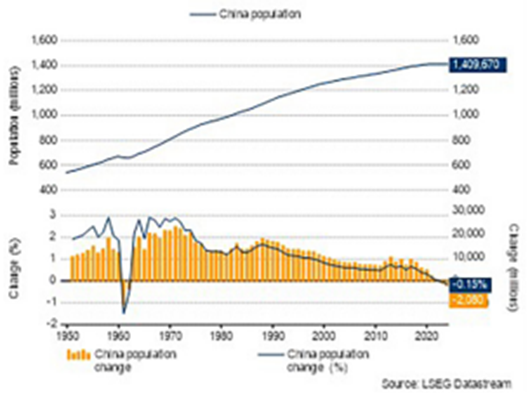
It was an inauspicious start to last week, which contained little cheer for China. Internationally traded Chinese stocks underperformed. A release of Chinese economic data provided mixed news. An eye-catching headline was the decline in the population growth rate. This was broadly expected and simply a continuation of a trend of slowing, and now reversing, population growth, which has been in place for a decade and was accelerated by COVID. The Chinese population contracted by two million people (or just 0.15%) last year. That contraction will accelerate over the coming years.

The more timely measures of Chinese activity were reasonable, but property prices declined for the seventh straight month, and with most Chinese wealth tied up in property assets, declines in property prices have a big impact on consumer balance sheets.

The likely result is that China will step up economic stimulus after a year in which it took many piecemeal measures that failed to address weak demand. Leaks from policymakers’ deliberations suggest that China is expecting to increase the budget deficit to try and recover growth momentum.

Inflation

For the rest of the world, the very well-ingrained hopes are for monetary stimulus during 2024. But the start of the year has suggested that it might be premature to expect rate cuts. Inflation has generally been higher than forecast in December (as seen in numbers released in January).

There are explanations of course; in the UK, many forecasters failed to account for an increase in tobacco duties. We find it useful to look at a measure of the median price level, looking further than the normal weighted average price level. On this basis, UK inflation has been between 0.2% and 0.3% each month for the last seven months. That’s much more stable than the official core inflation metric, although still slightly higher than the Bank of England (BoE) would want it.

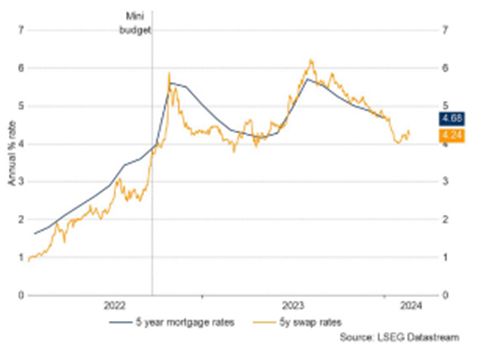
So, inflation is a little too high and the housing market showed signs of life. Rightmove’s house prices improved nationally, and the RICS (Royal Institution of Chartered Surveyors) house price balance also ticked higher. House prices will reflect the declines in expected interest rates, which have dragged five-year swap rates down and led to lower rates on mortgages. The fly in the ointment for the UK is the labour market, where the latest payrolls numbers suggest a net decline in employment. These data are volatile and subject to revision, so should be treated sceptically, but wouldn’t seem out of place with the longer trend of declining UK employment growth.

It provides a dilemma for the BoE’s Monetary Policy Committee (MPC), which is replicated around the world. If inflation is currently still too high, can it respond to tentative signs of a slowing economy?

The Red Sea

It is particularly hard to do so when inflationary pressures are rising. Shipping costs continue to rise as the Yemeni Houthi rebels attack freights navigating the Red Sea. Conflict has intensified but remains a series of proxy wars rather than a hot Middle Eastern war, which might disrupt oil supply. But there seems a reduced path of free navigation of the Suez Canal now that the US and UK launched airstrikes against the Houthis. Far from discouraging them, the rebels now see US shipping as legitimate targets. Freight rates continue to rise.

Houthis activity is facilitated by Iranian weapons supplies. The Iranians themselves launched attacks on militants in Iran and Pakistan, as well as what they claimed was a Mossad facility in Syria.

With the prospect of ongoing Houthi disruption, and a complex web of proxy conflicts taking place within the Middle East, foreign policy is likely to become a topic of the upcoming US election.

Interest rates

Around most of the world, expected interest rate cuts have been pushed back with economic news still seeming to be reasonably upbeat and inflation slightly higher than expected. A couple of weeks ago, we referenced JP Morgan CEO Jamie Dimon’s comments, which he had just made when delivering the company’s Q4 results. He said, “The US economy continues to be resilient, with consumers still spending, and markets currently expect a soft landing. It is important to note that the economy is being fuelled by large amounts of government spending and past stimulus. There is also an ongoing need for increased spending due to the green economy, the restructuring of global supply chains, higher military spending and rising healthcare costs.”

These factors would suggest that inflation and real interest rates should be higher than they have been previously, as we have discussed in the past.

Earnings season

Finally, we can check in on the US earnings season. Although only 45 companies have reported at the time of writing, the earnings season has already settled into a ratio of 80% positive earnings surprises. Regular readers will know that this is normal and not as bullish as it might seem. With the banks sounding upbeat on economic activity, it will take another view to be able to draw more meaningful conclusions from a good spread of non-bank companies.

Please check in again with us soon for more relevant content and market news.

Chloe

24/01/2024

Team No Comments

Tatton Investment Management – Monday Digest

Please see the below Tatton Investment Management Monday Digest article received this morning – 22/01/2024:

Overview: ‘Lower, slower’ replaces ‘Higher for longer’

Positive sentiment, driven by expectations of an imminent and significant onset of rate cuts, began to wane last week, and global capital markets resumed their volatile path of last year. The combination of a distinct slowing in the downward trajectory of inflation, paired with increasing confirmation that economic conditions are more on the up than down (at least in the US), have made it even less probable that rates will be cut soon and fast. As a result, some investors are facing up to the very distinct possibility that rates may only begin to be cut later and then more slowly. In other words ‘lower, slower’ seems to be replacing last October’s ‘higher for longer’ narrative. 

Consequentially, bond yields rose again last week, led by more rises in the US Treasury market. In the US, mega-caps were notable performers and the Nasdaq Composite regained the 15,000 level. However, equities overall generally drifted downwards with smaller caps under pressure. Non-US markets also declined.

Global companies are reporting lacklustre results for the last quarter of 2023 and giving similarly tepid forward guidance. It’s still the early stages of the reporting cycle, with just 6% of S&P 500, companies having reported, mostly banks, consumer and industrials. Bank results have been mixed, while consumer names are seeing less US spending power as households’ cash savings decrease. Revenue ‘beats’ may be not as positive as hoped, but broadly speaking, expectations for US companies’ earnings growth are still strong, driven mostly by US domestic demand.

Last week’s return of seemingly indecisive markets suggests a creeping realisation that the inherent impatience of markets has once again led to unrealistic expectations over the potential rates ‘reward’ on falling inflation. Does that mean market sentiment has reversed and investors are no longer optimistic? No, not at all from what we can see. A dose of realism into how long it may actually take for economic and market fortunes to be sustainably positive again may well offer up some short term investment opportunities, particularly while markets have re-entered range-bound terrain.

Just how sustainable are European and US deficits? 

At the moment, fiscal deficits are high by historical standards and rising over the long-term. This is not the short-term funding gap we saw in the pandemic, but a sustained push toward looser fiscal policy, and it is happening across virtually all major economies. With bonds currently in limbo, understanding countries’ fiscal positions – and whether they might lead to instability – is key. Even though rising deficits can be seen across the world, the outlook varies by region – most consequentially between the US and Europe.

In the US, deficit spending has continued and grown under President Biden. Some of this is a hangover from pandemic-era policies, but even after those have faded there has been a substantial increase in the gap between federal tax receipts and spending. The US government is running a cumulative deficit of $509 billion for the 2024 fiscal year so far, $94 billion more than in the same period in the prior fiscal year. Tax receipts are growing, thanks to the enduring strength of the underlying economy, but outlays are growing faster. Sustained fiscal expansion is one of the main reasons why US growth remained surprisingly strong last year. It is almost inevitable that this impetus will reverse but a sharp change in outlays could make things extremely difficult. Some analysts have argued on this basis that the US economy will struggle in 2024. The flipside of this, though, is that the Federal Reserve (Fed) has made clear its intention to cut rates, bringing down short-term yields and lowering immediate borrowing costs. That would constitute a substantial relief in terms of interest expense for the Treasury, since it has done a lot of its borrowing through short-term markets.

Heading into election season, the fiscal deficit will likely be an avenue of attack against Biden. This will probably happen regardless of which Republican candidate ends up on the ballot, even though Trump’s own fiscal record is clearly questionable. Fiscally conservative rhetoric will be heard – even perhaps from the more centrist Democrats – but that does not guarantee fiscally conservative policy.

Please continue to check our Blog content for advice and planning issues and the latest investment, markets and economic updates from leading investment houses.

Carl Mitchell – Dip PFS

Independent Financial Adviser

22/01/2024

Team No Comments

Weekly market commentary: US equity market at near all-time-high amid rate cut hopes

Please see below article received from Brooks Macdonald this morning, which provides a global market update with reference to political and economical developments in the US. 

Despite an upside beat to US CPI last week, US bond markets became more confident that the Federal Reserve would cut interest rates in Q1 2024. Against this backdrop the US equity market rose almost 2%, with the index now less than half a percentage point away from its all-time high. Today will see a slow start to the new week with the US on holiday for Martin Luther King Day.

Despite US markets being closed, there will be some US headlines later today after the Iowa Caucus which will be a test of Republican appetite for a Trump nomination. Recent polls have pointed to a significant lead for Trump however commentators will be waiting to see if he can achieve 50% of the vote which would lock out any contenders regardless of vote switching as rivals drop out. Taiwanese politics will also be in focus after the presidential election which saw the incumbent Democratic Progressive Party (DPP) win with just over 40% of the vote. The DPP’s leader, William Lai Ching-te has previously been labelled a separatist by Beijing therefore markets are wary of any escalatory rhetoric in the aftermath of this win. So far neither Beijing nor the DPP have said anything to stir tensions, but this remains one to watch.

Alongside a busy week for the US earnings season, we will receive the latest US retail sales numbers for December. Given the importance of the month for sales, this will give an insight into consumer momentum as we continue through 2024. Housing data and the latest University of Michigan consumer survey will also be worth noting. In the UK, we have a large set of important data points including labour market measures on Tuesday and retail sales on Friday. The most important release will be the UK CPI report, on Wednesday, with the Bank of England hoping for continued signs of disinflation.

The Bank of England is eager to tilt towards a more balanced, or even accommodative, monetary policy. UK economic data has broadly flatlined in recent quarters, suggesting a stagnating economy. The Bank of England faces a very different backdrop to the US where economic momentum continues to feed the demand side of the inflation story. If UK CPI continues to come down the market could find the UK central bank changing its tune quite rapidly.

Please check in again with us soon for further relevant content and market news.

Chloe

16/01/2024

Team No Comments

Brewin Dolphin – Markets in a Minute

Please see below the latest ‘Markets in Minute’ update from Brewin Dolphin, which covers their views on recent events in markets and was received late yesterday (09/01/2024) afternoon:

At the end of 2023, everything rallied – and at the start of 2024, everything has sold off. This has not been an enormous shock. The fabled Santa Rally means that the S&P500 has risen in 15 out of the last 20 years. The flipside of this is that only ten of the last 20 Januarys have provided gains. When taking into account the currency exposure a UK investor suffers, this drops to eight out of the last 20 Januarys. The UK equity market is even more stark. 17 of the last 20 Decembers have seen gains, and only seven of the last 20 Januarys.

Seasonal trends do not form the bedrock of a reliable investment strategy. On average, January has been the worst month for the UK equity market but last January, stocks jumped 4.4%. As the influential investor Howard Marks remarked, “Never forget the six-foot tall man who drowned crossing the stream that was five feet deep on average.”

So, while the odds are generally slightly more favourable for December than January, this particular December saw a rally so strong and so broad that it pushed a number of stocks into overbought territory (when companies have rallied particularly sharply, they are overbought and often need to slow down or even reverse their gains).

Markets also seemed to suffer from a form of selective blindness, in which they took great cheer from the dovish central bank and were less concerned by signs of inflation persevering.

All of this meant that the early days of January were likely to see profit taking, as seems to have been the case

Middle Eastern escalation

Another issue the markets have been comfortable overlooking is the rise of geopolitical risk. The 7 October attacks on Israel saw a sharp rise in the oil price, reflecting the risk that the attacks could begin a cycle of escalation that might eventually disrupt energy supply. In the final months of the year, though, this risk was overwhelmed by the greater risk that the Organization of the Petroleum Exporting Countries (OPEC) might be oversupplying energy to the global economy, and that it might struggle to restrict supply in the face of price falls. During 2023, Saudi Arabia restricted its own supply to support prices for OPEC as a whole, but continuing to do so indefinitely would undermine the point of the OPEC operating as a cartel.

So, oil was weak at the end of last year, contributing to the increasing hopes of a soft landing for the global economy. But it picked up over the last week as the threat of escalation in the Middle East has returned. Prior to last week, we already understood that Houthi rebels, who have been fighting a civil war in Yemen for the last decade, had begun harassing shipping navigating the Red Sea through missile and drone attacks and attempted boardings. Over the New Year’s weekend, the US Navy intervened to defend shipping, was fired upon, and ended up sinking Houthi vessels. However, this action has not deterred Houthi attacks.

As discussed, the risk to oil is that a broader Middle Eastern conflict emerges from the current proxy wars involving Iranian-backed groups operating throughout the region. Over the course of last week, aside from activity in Yemen, the US struck Iran-backed militia in Baghdad with a drone strike and two bombs were detonated in Iran.

Fretting over freight rates

There are, however, more direct consequences of the Houthi harassment of shipping. The Red Sea is the gateway to the Suez Canal, which forms a well-travelled shipping artery between Asia and Europe. 12% of global trade travels this route each year and disruptions (as occurred when the vessel Ever Given blocked the canal in 2021) have serious repercussions for supply chains. It can mean that shipping either has to travel a further ten days around the southern cape of Africa, or for urgent transit, shippers will redemand higher transit fees to compensate them for the heightened risk of navigating the Red Sea.

Freight rates have risen sharply, despite the good fortune that these attacks began as the peak season was drawing to a close. Demand will, however, pick up, particularly ahead of Chinese New Year in mid-February. Unfortunately, they also come at a time when the water level in the Panama Canal is unusually low, restricting its use for pan-American transit. Anecdotal reports have suggested that freight rates have risen to multiples of the rates being charged a few weeks ago.

Should this trend continue, those costs will be reflected in consumer goods prices. Consumer goods have been an important source of disinflation over the last few months despite services costs seeming to remain persistently high. As a rule, goods prices in developed economies will likely reflect some combination raw material, transport and currency costs (recent weakness of the dollar will push up imported goods costs). Beyond this, goods may be over or under supplied, and after the surge of pandemic demand, consumer goods production outstripped demand, leading to a need for destocking, a process which seems to be coming to an end.

By contrast, a lot of services prices reflect wages. These have moderated in some regions (the US) more than others (the UK and Europe). But services prices have been slower to decline.

January’s jobs report

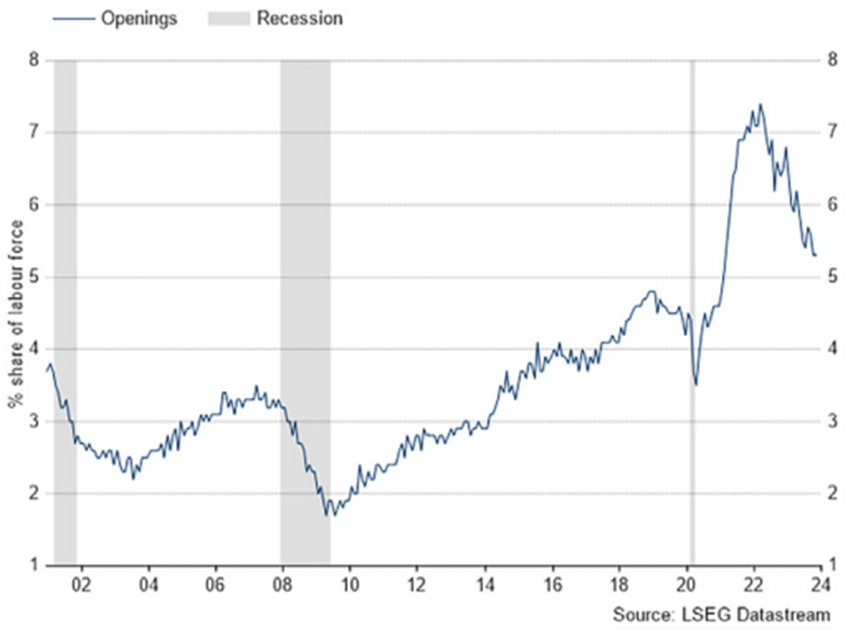
The US labour market was the main source of economic news last week. An ideal scenario would be one in which the inflationary pressures (slowing wage inflation) ease whilst employment levels remain high enough to keep the economy going. Early last week, we learnt that the number of job openings continued to decrease (albeit marginally), consistent with the idea of a loosening jobs market and a gradual decline in wage pressures. Last Thursday’s jobless claims data suggested that very few people were losing their jobs. This was all in keeping with the case for soft economic landing.

Friday saw more employment data which muddied the waters a little. Jobs growth was strong and should be good for growth, as long as it isn’t inflationary. But in December, wages did rise faster than expected and the unemployment rate stayed low at 3.7%. The labour force participation rate fell to its lowest in almost a year. These data will give the Federal Reserve some reason to fret over how fast inflation will decline in the future.

So, it has been a rough start to the New Year, but that would be expected given the strong finish to last year. Looking ahead, investors will be looking for evidence that tensions de-escalate in the Middle East. At home, they will want reassurance that the US labour market is not too hot to drive to prompt inflation, whilst also not being too cold so it provokes a recession.

Please continue to check our Blog content for advice and planning issues and the latest investment, markets and economic updates from leading investment houses.

Carl Mitchell – Dip PFS

Independent Financial Adviser

10/01/2024

Team No Comments

Brewin Dolphin – Markets in a Minute

Please see below article received from Brewin Dolphin yesterday evening, which discusses the markets’ strong end to 2023.

The Santa rally continued broadly last week, albeit at a more moderate pace, after an ascent of over 15% on the MSCI World Index since late October.

The last trading day of the year was uneventful. The S&P 500 index fell 0.3% on the day, though miniscule compared to the +24.2% gain in 2023 and after nine consecutive weeks of gains. The Nasdaq 100 index had its best year since 1999 and the global bond market experienced its biggest twomonth gain on record.

It is a reminder that market volatility is normal, and that staying invested and strategically adding to investments during periods of market weakness can benefit portfolios over the long term.

To the markets. And as you can imagine, the festive period and the last trading week of the year is usually a quiet one. However, while western markets saw dull trading sessions, the Chinese stock market experienced some hefty moves in the positive direction.

Unpredictability continues in China

You may recall in our last Weekly Round-up, we wrote about how Chinese authorities were imposing strict regulations on the gaming industry that could challenge companies’ revenue models. This stance has since softened, which may have something to do with the $80 billion market rout led by Chinese tech companies like Tencent and Netease. Chinese authorities have now said they will listen to feedback from both companies and players on how to improve the new rules. But that wasn’t all. In what was seen as a further boost for the gaming industry, China also approved 105 domestic games.

Chinese stocks surged on the back of the change of tone. There was also a boost for investors hunting for bargains, as the mainland’s stock market is set for an unprecedented third consecutive year of declines.

So, are Chinese stocks sustainable in 2024?

We cannot rule out that Chinese stocks may go higher in the near term due to momentum and a reversal of extreme pessimism. And for those of us who are superstitious, 2024 is the year of the dragon, which is perceived to be a powerful and positive zodiac animal.

However, for long-term investors, the challenges that come with investing in China haven’t changed. Yes, the Chinese authorities may have sounded a bit more forgiving with the gaming sector, but that just shows the extreme and unpredictable nature of the policy setting. Policy risks and politics are making China borderline un-investible, with significant market volatility and high risk becoming the norm. The property market also remains a source of concern – especially the risk of a financial contagion.

China is not the only place sending mixed signals to investors though.

Japan – land of the rising rates?

Seen as the laggard of developed market central banks in terms of policy normalisation, the Bank of Japan (BOJ) has kept traders guessing on when it will exit the world’s last negative interest rates. It has been moving towards policy normalisation, notably with the near abandonment of yield curve control. With inflation in Japan at 2.8% and the official interest rate at -0.1%, higher rates seem justifiable; the BOJ just wants to be sure inflation is persistent.

The annual wage negotiations in spring will be crucial for the BOJ to gauge the inflation outlook, with speculation it will consider policy changes following the event. However, the BOJ’s governor, Kazuo Ueda, said this week they may not need to wait for the full results of the wage data, raising expectations that the BOJ may move before April. That said, the latest BOJ board minutes indicate that some members see no rush to exit its ultra-loose policy. The Japanese yen has reacted on these noises and Japanese stocks have displayed their usual negative correlation with the yen.

It is unlikely the BOJ will pre-commit or provide clearer guidance like the US Federal Reserve (the Fed). As a result, markets will have to live with confusing signals from the BOJ for the time being. For those of us choosing to ignore the more immediate market noises, the BOJ exiting negative interest rates is a matter of when, not if.

The Japanese bond markets have priced in a more than 50% chance of a rate hike by April 2024. If that happens, the BOJ will be tightening policy while other major central banks are cutting interest rates – potentially a key macro theme of policy divergence. This will have significant implications and present opportunities to market participants such as macro traders and asset allocators. One market dynamic will be via the yen and Japanese assets’ sensitivity to it. Another dynamic will be the cross-asset implications of higher Japanese government bond yields.

We watch Japanese policy developments closely because Japan is not only part of our regional exposure, but it has the potential to impact global markets. We have been paying particular attention to the possible knock-on impact of higher Japanese government bond yields on global bond yields. So far – and to our relief – the impact has been more on its currency rather global bond yields. This suggests the removal of the last anchor of low interest rates in Japan may not be an obstacle to the sustainability of a rally in global bonds in 2024.

2024 – the year of the soft landing?

At the end of the day, the elephant in the room for global assets remains the Fed. Like us, the Fed is watching the incoming data closely to decide on its next steps. In a week of limited economic data releases, we saw US data continue to broadly lean towards a soft landing. One notable data release was the personal consumption expenditure price indices, which are the Fed’s preferred measures of inflation. Both headline and core measures of the inflation gauge came in lower than expected in November. Notably, the headline Personal Consumption Expenditures Price Index has contracted by 0.1% month-on-month.

Meanwhile, US personal spending adjusted for inflation rose by 0.3% on the month, suggesting US consumers remain in spending mode going into the holiday season. US consumers have been supported by excess savings, resilient job market conditions and falling gasoline prices. For the labour market, the latest release of initial jobless claims figures hovered around the low 200,000s; a pace consistent with the low and stable unemployment rates seen in recent times. In summary, it is no surprise markets are feeling buoyant as we wave goodbye to sharp interest rate hikes (well, maybe not in Japan), expectations rise of the Fed pivoting to easier monetary policy in 2024, and US data points to a higher chance of a soft landing.

Please check in again with us soon for further relevant content and news.

Chloe

04/01/2024

Team No Comments

Brooks Macdonald – Outlook for 2024

Please see below an article published by Brooks Macdonald which was received yesterday afternoon and outlines their outlook for markets in 2024:

Glass half empty or full? Outlook 2024

As we near the end of 2023, we are at a crossroads for both economies and investments. During 2023 sentiment has oscillated between two different investment scenarios, the glass-half-full camp, and the glass-half-empty camp. The challenge is to construct portfolios while recognising that either scenario could occur. Given the uncertainty which prevails, we believe that maintaining a balance is key.

2023 has been a year in which investment markets have encountered cross winds. On the positive side, equity markets have benefited from a new age in technology, driven by generative artificial intelligence (AI). At the same time, geopolitical risks have heightened with Russia’s ongoing invasion of Ukraine alongside the conflict in the Middle East between Israel and Hamas. Furthermore, China-US relations remain fraught, despite recent efforts to improve them.

Inflation is the key focus for policy makers and with interest rates clearly in restrictive territory, the glass-half-empty camp is waiting for the full impact of higher interest rates on consumers and companies. At the same time, any worsening of the situation in the Middle East or tightening of supply by the OPEC+ members would lead to a rise in the oil price, causing further upward pressure on inflation.

The glass-half-full camp believe that given labour markets remain tight, wage growth will be robust. In the US, many consumers still have post-pandemic savings to spend and unlike in the UK, for example, have 30-year fixed rate mortgages meaning they are insulated from the recent rate rises.

The key question for both camps is whether consumers and companies will remain solvent while policy makers wait for inflation to fall back to the Central Banks’ targets.

How did we get here?

After a tough 2022 when both equities and bonds posted negative returns, 2023 has seen a recovery, at least in equity markets. At the time of writing, government bonds are still in negative territory, despite the fall in yields (and corresponding rise in prices) seen since the peak of mid-October. The MSCI All Country World Index is up 10.4% in total return, sterling terms. However, the same index adjusted on an equal-weight basis (where each stock has an equivalent weight in the index, removing the dominance of so-called ‘mega-cap’ stocks), is down -1.4%. This difference highlights the impressive performance of a small number of technology-related names which are perceived to be beneficiaries of AI.

The age of Generative AI

The new age of AI started with the launch of Chat GPT in November 2022. Chat GPT is what is known as a large language model-based chatbot developed by Open AI, enabling users to generate media (be it text, code, pictures and more). By January 2023 it had over 100 million users per month and was the fastest growing consumer software application in history. Investor attention turned to companies believed to be the enablers of AI, particularly those focused on designing the necessary

The picture in Euro Area and the UK is less robust, with the IMF forecasting growth of less than 1% in 2023 and an only modest recovery in 2024.

semiconductors: Nvidia, the US chip designer, has risen by comfortably more than 200% year to date. The key question is the size of the productivity gains across the broader economy. The US National Bureau of Economic Research looked at a staggered introduction of a generative AI-based conversational assistant using data from over five thousand customer support agents and found that access to the tool increased productivity, as measured by issues resolved per hour, by 14% on average. Clearly gains of this magnitude will help mitigate the effects of higher interest rates and wage costs.

Corporate earnings growth remains robust

After the boost from the post pandemic recovery, corporate earnings growth expectations are lower but still in positive territory. Data from Factset indicates that companies are delivering better than expected earnings-per-share numbers at an historically high rate. Looking ahead to 2024, current consensus estimates point to an expected annual US company earnings growth rate of over 11%. The operating environment is also becoming more favourable: post pandemic supply chain disruptions have ceased and trade volume growth of 3.3% in 2024 is expected, compared to 0.8% in 2023*.

Economic growth picture still mixed

Central Banks continue to face the challenge of bringing down inflation while avoiding a recession. They also must ensure financial stability and avoid a situation such as the failure of regional US banks in Q1 2023. The three main regional drivers of growth are the US, Europe (including UK) and China. The US reported annual real GDP growth of 4.9% in Q3 2023, well ahead of the Fed’s own estimate of long-term real GDP growth of 1.8%. Growth in China remains healthy, with the IMF forecasting China’s real GDP growth in 2024 of 4.6%.

However, the picture in Euro Area and the UK is less robust, with the IMF forecasting growth of less than 1% in 2023 and an only modest recovery in 2024. These differences illustrate the importance of using an asset allocation framework that can adjust for regional settings.

Investors face three outcomes for economic growth. First, a hard landing, which is a contraction in economic activity, sharply rising unemployment, and a collapse in consumer spending. Second, a soft landing, with a gradual slowing of growth, a recession avoided and a moderate rise in unemployment. Third, no landing, with economic growth continuing at the current rate. The first outcome would imply we should reduce equities and add to longer duration bonds, given the likelihood that interest rates would then be cut significantly. If the third were to materialise, we should add to equities and reduce more defensive assets such as fixed income. Over the course of the year, the soft landing outcome has become more likely but far from certain, so we aim to maintain a balance within portfolios for investors.

Bonds: income is back

Over the course of the past two years, the rise in bond yields has meant that bonds can once again provide a counterbalance to other asset classes within portfolios. This increase in yields available from longer dated bonds gave us the opportunity to increase slightly the duration within the bond portfolios, thereby locking in higher yields. We believe it is too soon to increase duration significantly though, given the risk that inflation may persist for longer. Within corporate bonds we continue to prefer higher quality investment grade bonds over the more speculative high yield, as we believe the additional yield available does not adequately compensate us for the additional risk of the latter.

The equity barbell remains in place

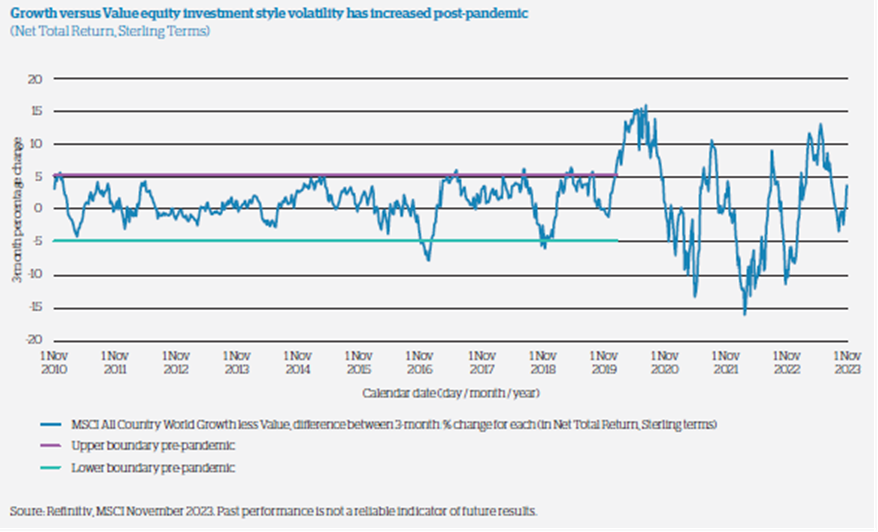
The graph below shows how, since the pandemic, the style leadership of the equity market has changed more frequently and become more pronounced. For this reason, we have implemented a barbell approach in the equity portfolios, whereby we aim to achieve an equal weighting of both value and growth investment styles. Given the range of possible economic scenarios together with current heightened geo-political risks, the barbell approach remains. Despite this balance, we continue to take conviction views on a geographical basis, emphasising the different investment styles through our core equity and thematic exposures.

Conclusion

As we weigh up the investment outlook, the challenge for asset allocators is how to take a calculated position to keep exposure to more than one economic scenario materialising. There is currently insufficient visibility for us to back a single sustained outcome. Instead, staying invested but keeping balance continues to be our goal.

Please continue to check our Blog content for advice and planning issues and the latest investment, markets and economic updates from leading investment houses.

Carl Mitchell – Dip PFS

Independent Financial Adviser

22/12/2023

Team No Comments

Evelyn Partners Update – UK November CPI inflation

Please see below article received from Evelyn Partners this afternoon, which provides an economic update as we approach Christmas and the end of 2023.

What happened?

UK November annual headline CPI inflation was reported at 3.9% (consensus: 4.4%), its lowest pace in over two years, versus 4.6% in October. In monthly terms, CPI fell 0.2% (consensus: +0.1%), compared to remaining flat at 0% in October.

November annual core CPI (excluding food, energy, alcohol and tobacco) was 5.1% (consensus: 5.6%), versus 5.7% in October. In monthly terms, core CPI was -0.3% (consensus: +0.2%), versus 0.3% in October.

What does it mean?

Today’s encouraging inflation print confirms the continuation of the downward trend in inflation. Just over a year on from headline CPI peaking at 11.1% in October 2022, it has since decelerated by over 7% points, with much of that deceleration in the headline rate coming from lower energy prices in the transport (i.e. fuel) and housing and household services (i.e. gas and electricity) categories. What was even more promising was the downward movement in core inflation, which has decelerated to its lowest rate since January 2022.

As it stands, Brent crude oil prices are now down roughly 4% for the year despite heightened geopolitical risk in the Middle East and OPEC+ output cuts. This reduces the risk of upside in retail petrol and diesel fuel prices. This weakness in oil prices has been reflected in the CPI basket for transport which decelerated by 1.7% in November. On an annual basis this segment of the economy is now exhibiting deflation, with the 12-month inflation rate turning negative.

Looking elsewhere in the divisional breakdown, goods inflation has now decelerated to 2.0% on an annual basis. While services, although slowing, remains more resilient at 6.3% for the last 12 months.

Food and non-alcoholic beverages continue to put pressure on the wallets of households, with this segment exhibiting the highest monthly inflation rate for any category at 0.3% for November. On an annual basis, prices in this segment have risen by 9.2%.

Bottom Line

With both headline and core CPI inflation slowing at a faster rate than expected in November, this should reassure policy setters at the Bank of England that high interest rates are having the desired effect of materially decelerating inflation. The Monetary Policy Committee should now be able to focus on when to cut rates, rather than if additional tightening is required. Money markets are currently expecting these interest rate cuts to materialise in the second quarter of 2024.

Please check in again with us soon for further relevant content and market news.

Chloe

20/12/2023

Team No Comments

Brewin Dolphin Markets in a Minute

Please see below article received from Brewin Dolphin yesterday afternoon, which comments on US inflation figures, interest rate decisions from the Federal Reserve and Bank of England, and Chinese economic data.

The glass is very much half full for the investment world at the moment, with good news being taken as such and bad news being shrugged off.

Continuing the theme of the last two months, gains have come from the anticipation of a more benign inflationary outlook. European inflation numbers have seemed to endorse that view, dropping quite sharply over the last few months. US inflation has been more nuanced; data released last week were broadly in line with expectations, but the underlying composition of inflation could give cause for concern.

US core inflation picked up during November to a pace that would be inconsistent with the Federal Reserve meeting its inflation target. It is well understood that core inflation is heavily influenced by shelter, and shelter inflation will reflect rents and changes in house prices with a lag, representing the time it takes for tenancy agreements to be renewed. That means there should be some disinflation to come from the housing slowdown that has already occurred. More recently, the impact of housing on the consumer price index (CPI) has become clouded. Demand for new housing seems depressed but house prices have been rising for the last few months. The recent sharp decline in bond yields means that US mortgage rates have been declining, which ought to offer further support for house prices and have some knock-on effect for shelter CPI.

Moreover, the Fed looks beyond core CPI these days to try and gauge underlying price pressures. While core inflation strips out volatile food and energy prices, so-called ‘supercore’ inflation comprises services inflation excluding energy and housing. This measure should reflect the general level of inflationary pressure driven by the balance of the labour market. It accelerated slightly this month and has been running ahead of the Fed’s implied inflation target for the last four months.

Interest rates

With this backdrop, the Federal Reserve announced its latest changes to monetary policy. Broadly, policy was left unchanged, as had been universally expected, but the press conference and statement surprised the market by being more dovish than anticipated. The Fed cut its inflation expectations and raised its growth expectations for what is left of 2023. More meaningfully, it also lowered the expected interest rate at the end of 2024 to a level that implies three interest rate cuts will take place over the year. This comes at a time when the Fed is also expecting inflation to remain above target (albeit only modestly). It is surprising the Fed would endorse rate cuts whilst seeming to tolerate above target inflation. For context, market-based interest rate expectations moved lower and now imply nearly six interest rate cuts over the next twelve months.

Labour markets are the key determinant of the inflationary environment but are often observed to be lagging indicators. By the time the unemployment rate has started rising, it has often developed a momentum that makes it difficult to stop. The fear of this, at a time when Fed chairman Jerome Powell believes policy is “well into restrictive territory”, will be the motivation for this dovish tilt.

One factor that has been helpful in curtailing inflation in the US is the relatively benign performance of wages. Wage growth peaked around the turn of last year in America but has not yet done so definitively in the UK or eurozone.

Europe

That discrepancy probably motivated the Bank of England (BoE) in its more hawkish tone. Three Monetary Policy Committee (MPC) members voted to raise interest rates again, believing there was evidence of persistent inflationary pressure. They were outvoted and policy was left on hold.

The MPC decision came after the release of quite weak monthly gross domestic product (GDP) data on Wednesday, on top of Tuesday’s relatively poor labour market data. BoE governor Andrew Bailey took a more predictable line, emphasising the battle to contain inflation was not yet won and the Bank would “take the decisions necessary to get inflation all the way back to 2%”.

All central banks become heavily motivated by the latest economic data at potential turning points in interest rate cycles. The data for the UK does seem quite weak, whereas there are tentative signs of the European economy recovering some momentum. This morning saw a slight setback in the purchasing managers indices for Germany and France. This was mirrored by the UK’s ailing manufacturing sector but bucked by the UK services sector, which expanded faster for a fourth consecutive month.

Meanwhile, in the east…

A lot of data was released last week detailing the Chinese economy. There are some signs of recovery, with annual growth numbers like the 10% expansion in retail sales seeming quite healthy. This is somewhat illusory though, as China was in lockdown this time last year. The thorn in the side of the Chinese economy remains the property market. Data released today showed the continued decline in new home prices. It comes after the conclusion of the Central Economic Work Conference (CEWC). The post-meeting communique signalled some measures would come in to try to bring relief to the Chinese economy. But the promise was vague and modest, suggesting perhaps a couple of interest rate cuts and a further easing of required reserves at banks (which would enable them to lend more to the economy).

China maintained its growth target of around 5%, which sounds ambitious given the weakness of the economy. But, again, this reflects the fact that last year, China was in lockdown, and so growing 5% from that depressed level should be neither taxing nor impressive.

Please check in with us again soon for further relevant content and market news.

Chloe

20/12/2023

Team No Comments

Brewin Dolphin – Markets in a Minute

Please see below the latest ‘Markets in Minute’ update from Brewin Dolphin, which covers their views on recent events in markets and was received late yesterday (12/12/2023) afternoon:

Please continue to check our Blog content for advice and planning issues and the latest investment, markets and economic updates from leading investment houses.

Carl Mitchell – Dip PFS

Independent Financial Adviser

13/12/2023