
Please see this week’s Markets in a Minute update below from Brewin Dolphin, received yesterday afternoon – 10/11/2026
Will AI stocks weather the political storm?
With U.S. midterm results reshaping the regulatory outlook, we look at whether the AI sell-off is justified.
Key highlights
- U.S. midterm results reshape the outlook: The Democrats’ sweeping victory raises concerns over tougher AI regulation, though President Trump’s veto could mean policy gridlock.
- AI stocks faced a sharp correction: Concerns over regulation, spending and valuations have triggered widespread selling, despite strong underlying demand.
- The Bank of England raises rates: Interest rates increased to 4%, but falling oil prices could ease inflation pressures and limit further tightening.
Political uncertainty meets a fragile AI trade
The Democrats’ decisive victory in the U.S. midterm elections was not entirely unexpected, but the scale of the party’s success surprised markets. Taking control of both chambers of Congress – the Senate and the House of Representatives – raises the prospect of greater scrutiny of businesses, particularly AI and data centre development.
Markets initially welcomed the removal of election uncertainty, but relief quickly gave way to renewed selling of technology shares. Investors are concerned that tougher regulation could slow the extraordinary expansion of AI infrastructure.
However, President Trump retains veto power, making sweeping legislative changes difficult without bipartisan support. The result could be policy gridlock, with both sides struggling to advance their agendas.
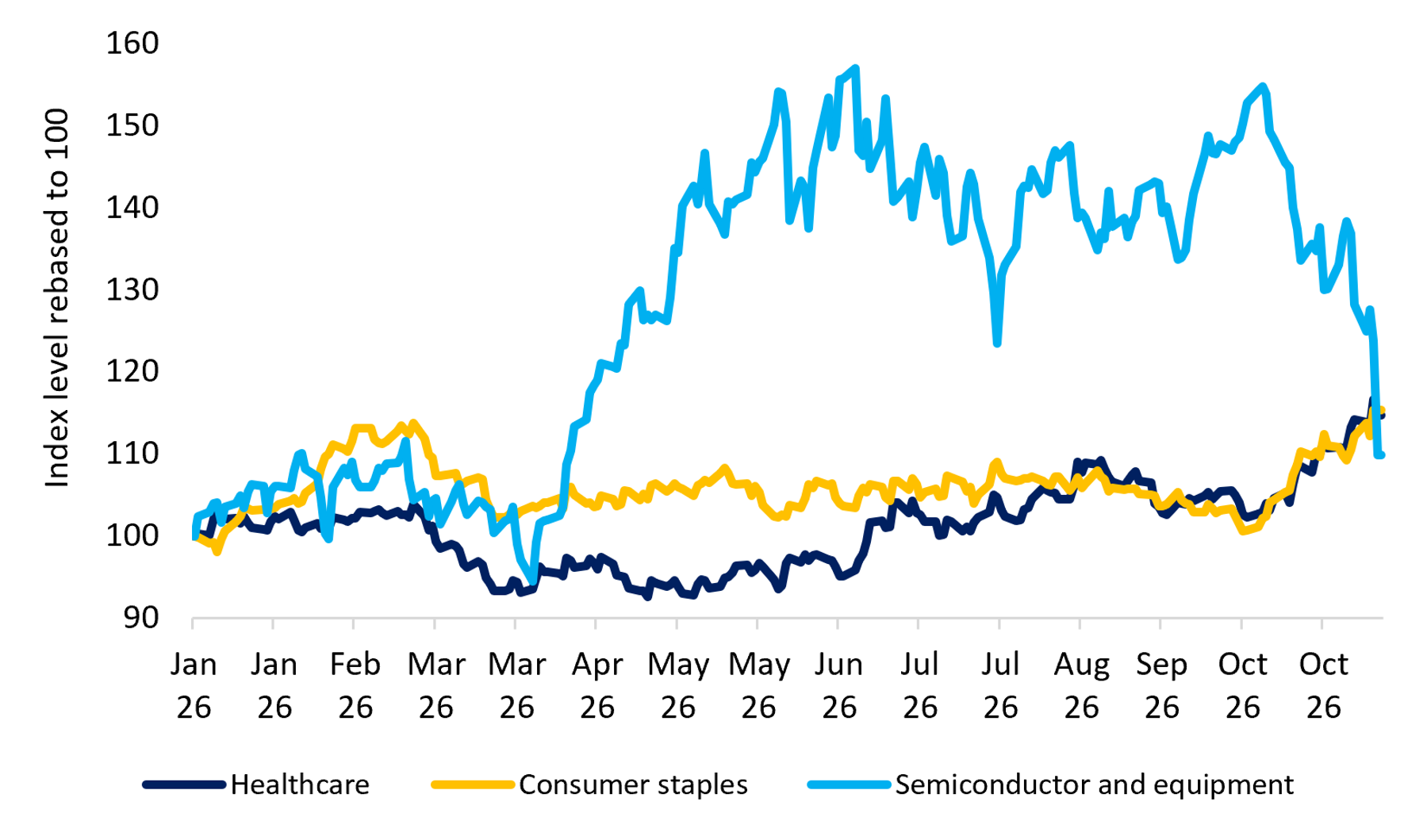
Technology shares had already been under pressure amid concerns about elevated valuations and the returns on AI spending. The subsequent sell-off spread across semiconductor manufacturers, memory suppliers and other companies supporting AI infrastructure.
MSCI World Price Index performance by sector
Source: Bloomberg
We believe the scale of selling reflects more than deteriorating fundamentals. Investors had built substantial exposure to the AI trade, and hedge funds have been reducing crowded positions. Such selling can become self-reinforcing, pushing share prices further than the underlying news might justify.
This creates considerable near-term uncertainty but does not necessarily signal the end of the AI investment cycle.
AI: Strong demand, but tougher questions
Underlying demand for AI computing power remains impressive.
Global cloud infrastructure spending reached $168 billion in the third quarter, growing 55% annually. Major providers’ order backlogs exceed $2 trillion according to contracted future revenue estimates released alongside earnings results.
The largest technology companies regard AI investment as strategically essential, and their strong balance sheets provide considerable financial flexibility.
Nevertheless, investors are increasingly questioning the returns on this extraordinary spending.
Five major technology companies have doubled their combined capital expenditure to more than $550 billion. In the first nine months of this year, they returned just 9.3% of operating cashflow to shareholders, the lowest proportion in at least 15 years.
The longer-term arithmetic is challenging. Research and advisory firm Gartner estimates cumulative AI infrastructure spending will hit $7 trillion by 2030. Generating an adequate return could require around $8.5 trillion in revenue, considerably above current forecasts.
Our assessment remains balanced. We retain a modest overweight in global equities, supported by resilient corporate earnings and strong AI demand. However, the investment environment has become more fragile, and further volatility is possible.
History suggests that positioning-driven sell-offs can overshoot. Some of the strongest market recoveries occur close to periods of greatest pessimism, making it difficult to time an exit and re-entry.
We therefore favour staying invested while making deliberate adjustments rather than reacting to every market swing. Our exposure to European equities, cash and government bonds provides valuable diversification against technology-related volatility.
Government bonds find support amid uncertainty
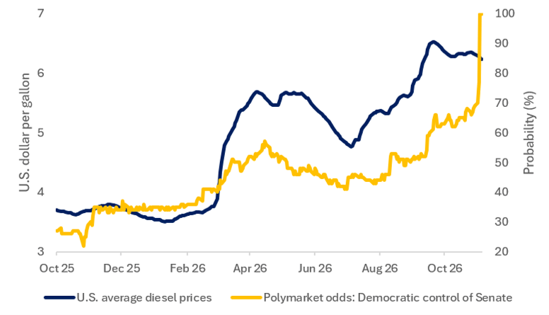
Government bonds have benefited from safe-haven demand amid equity market volatility, falling oil prices and expectations that a Democrat-controlled Congress could constrain further fiscal expansion.
Democrats’ chances have surged with the price of diesel
Source: Bloomberg
The 10-year U.S. Treasury yield has retreated from around 5.3% a few weeks ago to approximately 4.85%, supporting bond prices. Gold has also recovered to above $4,100 an ounce, helped by a weaker dollar and defensive demand.
However, political uncertainty remains. While Congress may constrain President Trump’s domestic legislative agenda, he retains substantial authority over foreign policy, particularly regarding Iran.
Diplomatic efforts continue, but the conflict remains unresolved and the risk of renewed escalation persists.
Oil prices have fallen further from their recent peak of above $117 per barrel to below $100, reflecting hopes of diplomatic progress. This offers welcome relief for inflation expectations and borrowing costs.
Nevertheless, the trajectory of energy prices remains crucial. A sustained decline would improve the inflation outlook, while renewed escalation could quickly reverse recent gains.
Central banks face a delicate balancing act
Last week, the Bank of England (BoE) raised interest rates by 25 basis points to 4%, the first increase in more than three years.
Governor Andrew Bailey explicitly linked the outlook for further tightening to the Iran conflict and energy prices. The BoE expects inflation to peak close to 5% next year, although the recent decline in oil offers some encouragement.
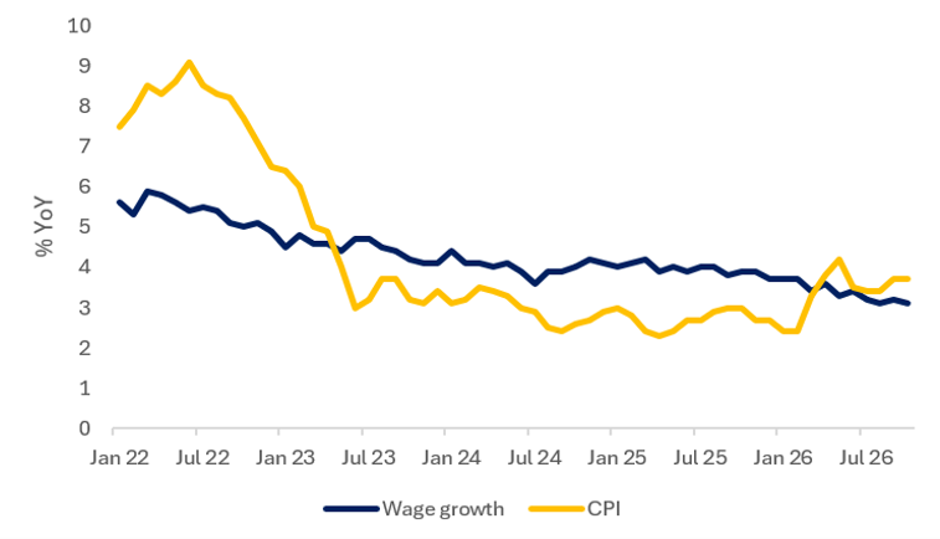
Markets anticipate three further rate hikes in 2027, but the eventual path could be less aggressive if energy prices remain lower and wage growth stays contained. So far, there’s limited evidence of a wage-price spiral.
In the U.S., October employment data showed continued economic resilience. 165,000 new jobs were added over the month, comfortably exceeding expectations of 65,000, while unemployment fell to 4.1%.
The stronger labour market marginally supports the case for further Federal Reserve tightening, though soft wage growth and the recent fall in oil prices may provide some waiting space.
U.S wage growth has not kept up with inflation recently
Source: Bloomberg
For both central banks, the key question is whether the energy shock proves temporary or feeds into more persistent inflation.
Please continue to check our blog content for advice, planning issues and the latest investment market and economic updates from leading investment houses.
Charlotte Clarke
11/11/2026