
Please see this week’s Markets in a Minute update below from Brewin Dolphin, received yesterday afternoon – 27/10/2026
Is the AI boom running out of steam?
Technology stocks fell last week as rising bond yields, geopolitical concerns and higher oil prices put pressure on markets.
Key highlights
- Is the AI bubble bursting? While AI investment has been a major driver of U.S. growth and corporate profits, investor sentiment is weakening – but doubts are focused on money rather than the machines.
- Earnings season: With a quarter of the U.S. season done, 80% of companies have been surprisingly positive on earnings. However, some still saw shares slip as guidance was either held or trimmed.
- UK inflation: Consumer prices rose 3.5% in the year to September, well above the 2% target, driven mainly by utility bills.
When fast is not fast enough
Amara’s Law states that we tend to overestimate the effect of a technology in the short run and underestimate the effect in the long run. It’s a paradox that’s reconciled by the idea of technological innovations tracking an S curve – slow at first, then accelerating, then levelling off.
That idea is also captured by the Gartner Hype Cycle, which begins with an innovation trigger, reaches a peak of inflated expectations, suffers a trough of disillusionment, before finding a slope of enlightenment as productivity gains eventually start to arrive.
There are clear fears that the cycle that began with the release of ChatGPT at the end of 2022 may now be approaching its peak of inflated expectations. The equity bull market has just entered its fifth year, but by age alone it isn’t especially long in the tooth. It’s younger than the median rallies we’ve seen since 1949, which tend to last about five years. Alongside these immutable cyclical fears is the secular trend of increasingly rapid technological deployment.
So, could it be possible that the Gartner Hype Cycle’s slope of enlightenment is able to arrive ahead of the trough of disillusionment? Or can disillusionment over the lack of profitability of AI chatbots be weathered by new peaks of expectations for enterprise, agentic and physical AI solutions? Going from inflated expectations to disillusionment is obviously painful but skipping that stage and getting straight to enlightenment (when technology goes from being interesting to becoming profitable) would be more benign. AI technology keeps advancing faster than most investors expected, and that’s what makes the market’s mood hard to read.
Investment in AI has become a major driver of U.S. growth and corporate profits, well beyond the technology sector itself. It’s based on leaps forward in capabilities. AI agents can now carry out multi-step business tasks on their own, and OpenAI says it has produced proof that resolves a 90-year-old mathematical problem. These aren’t incremental gains. But while the fundamentals seem positive, sentiment is weakening.
The doubts are about money rather than machines. A bullish set of earnings from Meta was badly received, probably because the firm intends to fund future capital expenditure into AI through more equity issuance. South Korea hosted its largest IPO of the year, neocloud Elice, which was nearly 400 times over-subscribed on retail demand and fell sharply on its debut.
Stock market listings have been meeting challenges with doubts over when the leading AI labs can tap the market. The cost of insuring the debt of some newer cloud computing providers has jumped, and investors are asking whether markets can absorb the sums being mooted.
So, what’s next?
We see this as a reset rather than a rupture: expectations had run ahead of even good numbers, and some companies’ spending plans, along with the prospect of issuing shares to fund them, may have unsettled investors.
Sentiment hands out labels and takes them back with little warning. A company can move from AI winner to AI loser, and back again, long before anything changes in its results. The launch of Meta’s new AI agent Muse sparked just such a scare. It hit hardest at businesses thought to depend on customer inertia, from banks to online travel platforms.
With a quarter of the U.S. earnings season gone already, the headline statistics are eerily familiar, with 80% of companies surprising positively on earnings, 50% positive on sales.
But the size of those surprises has slowed significantly so far. A good quarter is no longer enough to lift a share price; the outlook is more important, and it needs to be unequivocally good. Several companies reporting solid numbers last week saw their shares slip because guidance was either held rather than raised or trimmed in one corner of the business. When valuations rest on an expectation of steady upgrades, cautious management teams tend to be marked down, even when the caution looks sensible. That provides some opportunities to build resilience into portfolios.
The market isn’t treating every sector alike. Some previous weak spots, such as consumer staples, have caught a bid over the past month. Healthcare has been helped by an early start to the cold and flu season and by investors looking beyond the AI trade. The consumer looks resilient. How long that lasts depends partly on prices, and there the news was less comforting.
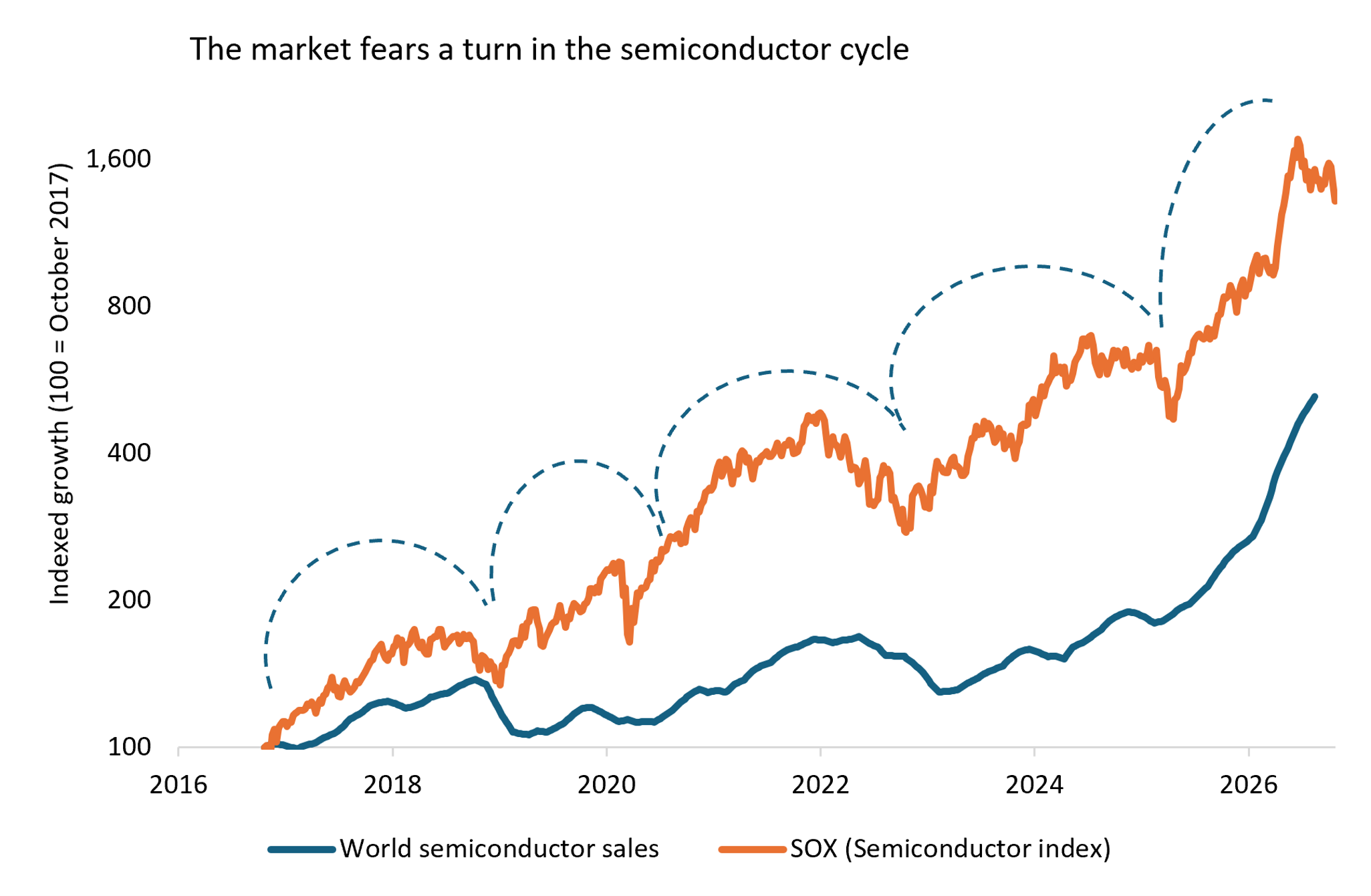
That’s why betting it all on semiconductors and AI labs isn’t the right path. There are different kinds of AI winners, and even some stocks which win despite AI, and these perform at different times too.
Source: LSEG Datastream
Stubborn costs and expensive money
Inflation is proving stubborn in the UK. Consumer prices rose 3.5% in the year to September, well above the 2% target and up from August. This was driven mainly by utility bills. The figure was slightly above forecasts, but the reaction in gilts was muted.
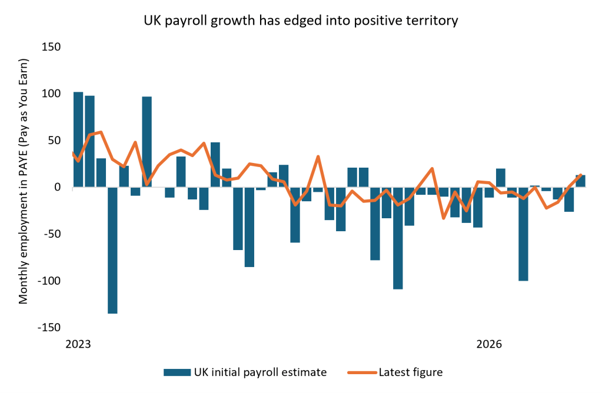
The jobs market and public finances give a mixed backdrop to this week’s Autumn Budget. Unemployment fell 0.2 percentage points in the three months to August, with around 100,000 jobs added. The early payroll figure for September was firmer than in recent months, though that measure is volatile. Borrowing came in slightly above expectations, but August’s figure was revised substantially lower.
Source: LSEG Datastream
Across the Channel, politics is setting the tone. French government bonds have been under pressure, with the extra yield over German government bonds (bunds) stretching to its widest amid uncertainty about elections in France. It has made for a testing autumn for bond investors, as our fund updates show.
Borrowing costs matter well beyond government bonds. The AI build-out is financed in capital markets, which is why the funding doubts we described earlier matter at least as much as any single earnings beat. For the story to keep rewarding investors, it has to keep paying its way in a world where money isn’t cheap.
Please continue to check our blog content for advice, planning issues and the latest investment market and economic updates from leading investment houses.
Charlotte Clarke
28/10/2026