
Please see this week’s Markets in a Minute update below from Brewin Dolphin, received yesterday afternoon – 15/09/2026.
What’s driving the surge in bond yields?
Oil has accelerated the sell-off, but it’s not the only force pushing yields higher.
Key highlights
- Global bond yields surged, as higher oil prices and hawkish central banks added to inflation concerns, but structural factors are at play too.
- The European Central Bank raised rates to 2.5% and revised up its inflation forecasts. Markets expect more rate hikes to come.
- U.S. inflation in August was broadly as expected but the monthly core Consumer Price Index (CPI) came in above estimates. This CPI does not yet capture the latest surge in oil prices as much of that happens in September.
Why are bond yields surging?
Bond markets were at the centre of market moves last week, with global government bond yields rising sharply across developed markets. The U.S. 10-year treasury yield moved close to 5%, while UK gilt yields reached nearly 5.4%, a level not seen since 2007.
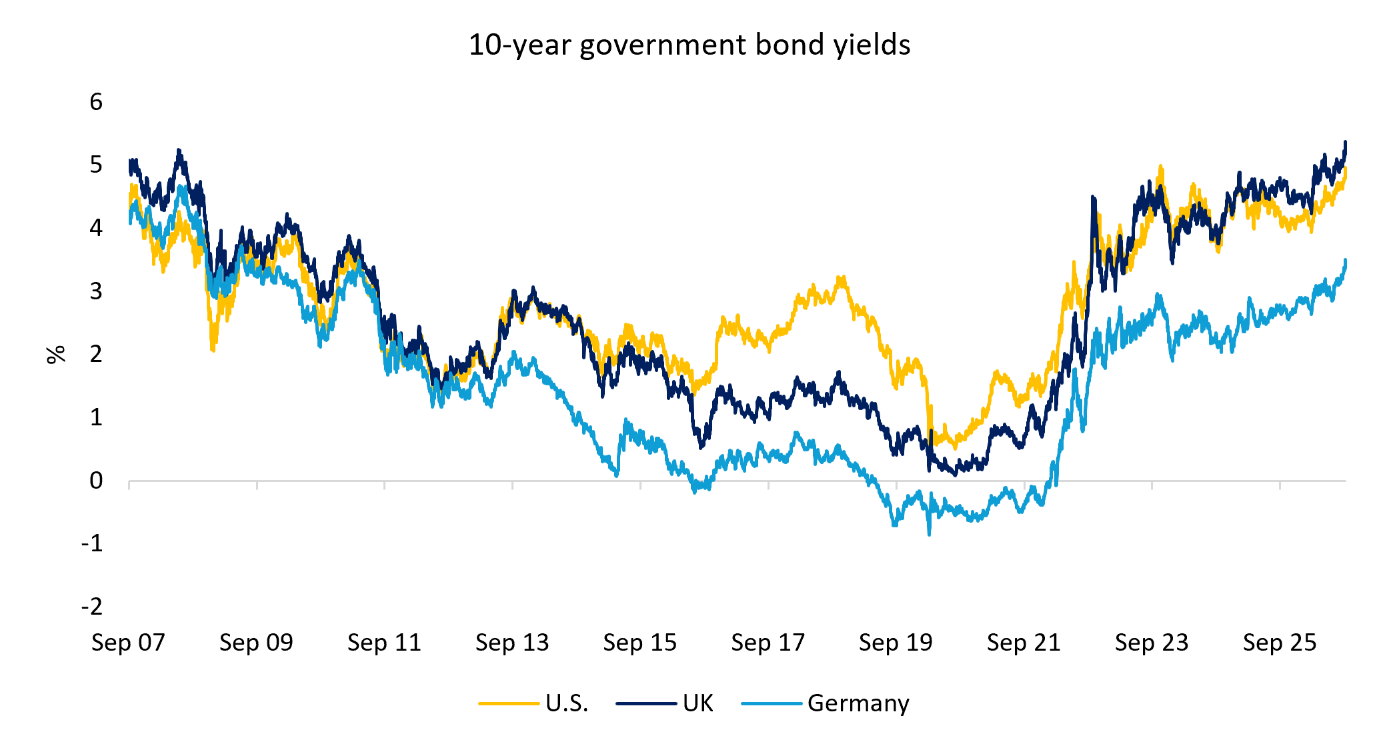
Source: Bloomberg
The immediate catalyst was another rise in energy prices, a result of the conflict in the Middle East intensifying. Escalation in Iran-U.S. tensions has pushed Brent crude oil prices back above $100 a barrel while U.S. diesel prices have moved to over $6 a gallon.
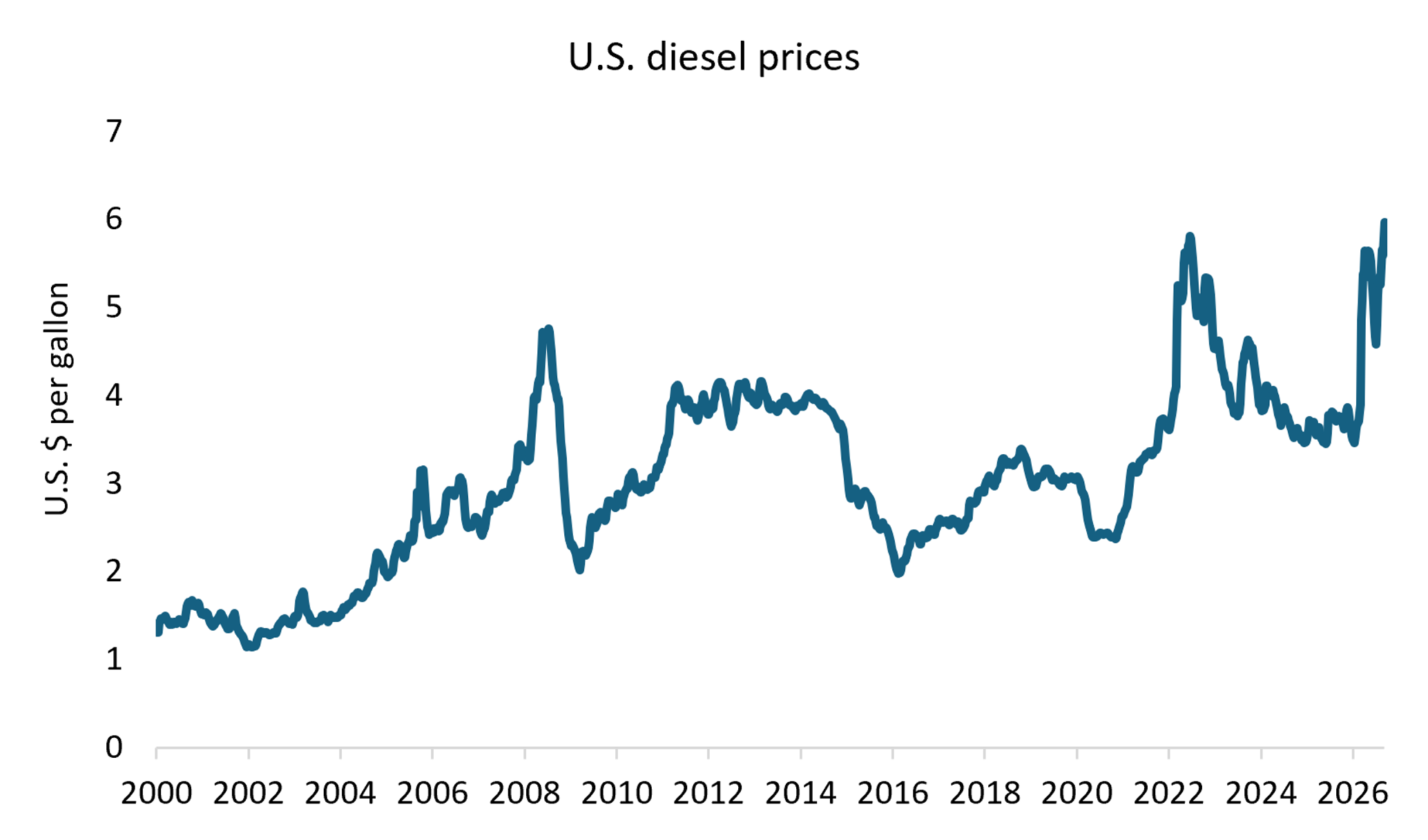
Source: Bloomberg
Higher oil prices have renewed concerns about inflation and pushed investors to expect more interest rate hikes. But we think oil is only part of the story.
Governments are borrowing heavily to fund large fiscal deficits. At the same time, the enormous investment required to build AI infrastructure is creating another source of demand for capital.
Put simply, there are a lot of borrowers competing for the same pool of money. Investors are therefore demanding higher yields to lend for 10 or 30 years.
This is also why the U.S. Treasury’s latest bond buyback failed to provide much relief. Buybacks can improve liquidity and help supply and demand at the margin, but they can’t address the fundamental issue of large fiscal deficits, heavy government borrowing and persistent inflation.
This is broadly consistent with our view that the latest geopolitical shock is only one part of a bigger, longer-term shift in bond markets.
For equity investors, higher yields are a near-term headwind. When investors can earn close to 5% from U.S. government bonds, equities face more competition for capital. Higher yields also reduce the present value of future corporate earnings, which can be particularly challenging for more highly-valued growth stocks.
This doesn’t change our longer-term constructive view on equities. But while bond yields remain elevated, we think equity markets could remain more volatile.
U.S. inflation adds interest rate pressure
The U.S. inflation reading adds pressure on the Federal Reserve (the Fed) to raise interest rates this week. Headline Consumer Price Index (CPI) inflation was broadly in line with expectations, coming in at 3.4% year-on-year, while annual core inflation eased slightly to 2.4%, the lowest since March 2021. But the more closely watched core CPI rose +0.3% month-on-month, above the 0.2% expected and the biggest increase since April.
This CPI data doesn’t yet capture the latest surge in oil prices, much of which occurred in the first half of September. Higher energy costs can also take time to feed through into other parts of the economy. Meanwhile, producer prices released last week pointed to continued pipeline inflation pressure and the latest U.S. jobs report was strong – both reinforcing the case for elevated inflation.
All this data adds pressure on the Fed to do its job to constrain price pressures.
Markets have responded quickly. Earlier this month, markets priced in a 70% probability of an interest rate hike, which rose to 90% immediately after the CPI release.
Interestingly, bond yields came in a bit lower and stocks reacted positively. The read is that if the Fed follows through with a rate hike, it would help restore its inflation-fighting credibility – anchoring long-term inflation expectations, which markets would welcome as a positive development.
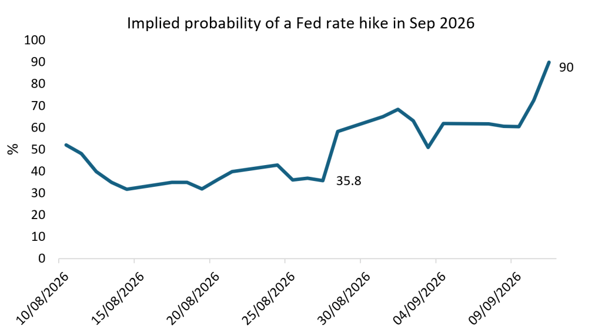
Source: Bloomberg
The ECB turns more hawkish
The European Central Bank (ECB) added to the more hawkish backdrop last week, raising its deposit rate by 25 basis points to 2.5%, which was widely expected.
More important was its outlook. The ECB revised up its inflation forecasts, with inflation now expected to average 2.5% in 2027 and 2.1% in 2028. At the same time, it upgraded its growth forecasts for this year and next, reflecting a more resilient Eurozone economy.
That resilience is important. Higher energy prices are hurting consumers and businesses, but so far, the economy has held up better than feared. This reduces the immediate risk of stagflation and gives the ECB more room to focus on inflation.
Markets have responded by pricing in more rate hikes. However, we think there’s a risk that markets are overestimating how much tightening will ultimately be needed.
The key is wages. So far, there’s little evidence that higher energy prices are creating a second-round wage-price spiral. Eurozone compensation growth has slowed, while the ECB’s wage tracker points to only a modest 2.7% increase in negotiated wage growth in the first half of next year. Longer-term inflation expectations also remain anchored at around 2%.
And this is not just a European story. U.S. wage growth eased to 3.1% in August, while UK private sector wage growth has slowed to 2.8%. Resilient economic growth means central banks can’t ignore the inflation shock, particularly if oil prices remain high. But slowing wage growth suggests the second-round effects aren’t there yet.
That means central banks may need to remain hawkish in the near term, without necessarily delivering as many rate hikes as markets currently expect.
Given the ECB’s rate hike, the recent data and market pricing, it will be a surprise if the Fed remains on hold this week. If it doesn’t, it will face serious credibility challenges and Fed Chair Kevin Warsh will need to explain its rationale clearly to the market.
Please continue to check our blog content for advice, planning issues and the latest investment market and economic updates from leading investment houses.
Charlotte Clarke
16/09/2026