
Please see this week’s Markets in a Minute update below from Brewin Dolphin, received yesterday afternoon – 28/07/2026.
Is inflation set to rise?
The conflict in the Middle East has broadened, leading to higher oil prices – but what could this mean for inflation?
Key highlights
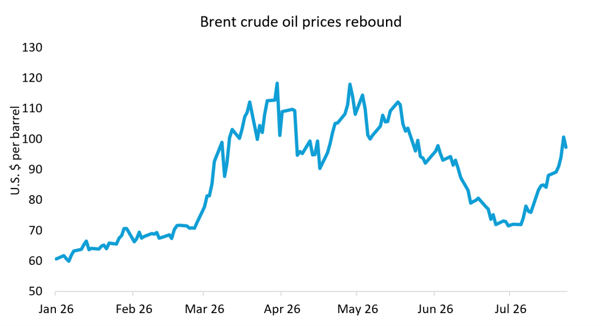
- Middle East conflict: Escalating tensions spread from the Strait of Hormuz to the Red Sea, pushing Brent crude oil prices to above $100 per barrel and renewing inflation concerns.
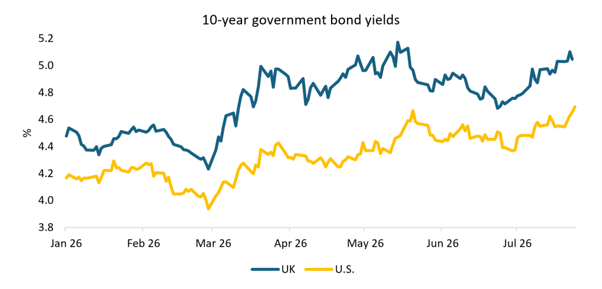
- Bond yields and rate expectations: Yields rose across developed markets as oil rebounded, with rate hikes increasingly priced in by the U.S. Federal Reserve, European Central Bank and Bank of England.
- AI investment promise: Alphabet raised capital expenditure guidance to up to $205 billion while Google Cloud revenue surged 82%, providing evidence that AI spending is beginning to translate into commercial growth.
A broadening conflict puts inflation back in focus
Markets were dominated by two powerful themes last week: geopolitics and AI capital expenditure (capex). Escalating tensions in the Middle East pushed oil prices higher, renewing concerns over inflation and driving a repricing of interest rate expectations. Meanwhile, corporate earnings provided further evidence that the AI investment cycle remains firmly intact, although the enormous scale of spending is prompting greater scrutiny over future returns.
Geopolitical tensions intensified as the conflict broadened beyond Iran and the Strait of Hormuz. Risks increasingly extended into the Red Sea, where Houthi militants in Yemen targeted Saudi-linked oil tankers, raising concerns that disruption could spread across multiple critical energy and shipping routes. This helped push Brent crude oil to above $100 per barrel as markets priced in a greater risk to global energy supplies.
Source: Bloomberg
The renewed surge in oil comes just as recent inflation data had started to show some improvement. Headline inflation in developed economies eased in June, helped in part by lower energy prices. With oil prices now rebounding sharply, that disinflationary tailwind is likely to fade – and could potentially reverse if higher prices persist.
President Donald Trump announced a new round of tariffs covering dozens of U.S. trading partners, with duties broadly ranging between 10% and 12.5%. Markets largely took the announcement in their stride; the measures are essentially a continuation and restructuring of existing tariffs under a new legal framework rather than a significant new escalation in the overall tariff burden.
Nevertheless, tariffs remain another potential source of price pressure alongside higher energy costs, adding further uncertainty to the inflation outlook at a time when inflation remains above central bank targets in many developed economies.
Bond yields rise as rate expectations turn more hawkish
Source: Bloomberg
Government bond yields rose across developed economies as investors reassessed how central banks may respond if higher energy prices lead to more persistent inflation. The shift in rate expectations has been significant.
In the U.S., markets are pricing in roughly a one-third chance of a Federal Reserve rate hike at its July meeting, with almost two quarter-point increases priced by year end. In Europe, the European Central Bank kept interest rates unchanged at its July meeting, but markets are increasingly pricing in the possibility of a rate increase as soon as September. The repricing has also been pronounced in the UK, where markets are now pricing in almost two rate hikes by year end.
For central banks, much will depend on whether the energy shock produces only a temporary increase in headline inflation or generates more persistent second-round effects. Policymakers will therefore be watching closely for signs that higher energy costs are feeding into broader prices and inflation expectations.
AI spending accelerates, but so does scrutiny
While geopolitics and inflation dominated the macroeconomic backdrop, AI remained the other major force driving markets last week. Alphabet provided perhaps the clearest illustration of both the extraordinary scale of the AI investment boom and the growing debate around its returns.
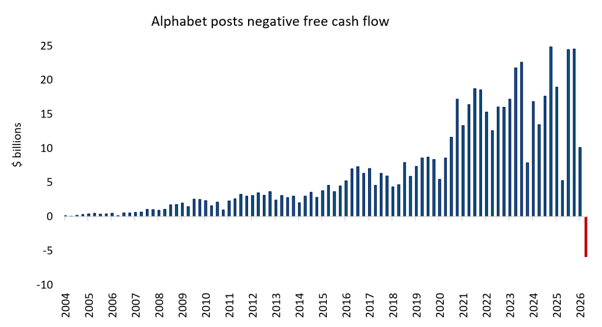
The Google parent raised its expected capex for this year to between $195 billion and $205 billion, as it accelerates investment into AI computing capacity and cloud infrastructure. That spending comes at a significant cost – Alphabet recorded its first ever quarterly negative free cash flow – of $5.9 billion – since going public approximately two decades ago.
Source: Bloomberg
However, there are increasingly clear signs that rapid AI development is translating into growth. Google Cloud revenue surged 82% year-on-year, making it one of Alphabet’s fastest-growing businesses, supported by strong demand for AI infrastructure and solutions. Intel reinforced the message, with data centre sales rising 59%, benefitting from continued investment in AI and computing infrastructure.
The investment case for AI therefore remains intact. However, as capex reaches extraordinary levels, investors are increasingly scrutinising whether hyperscalers – the largest cloud and technology operators – can generate sufficient revenue, profits and cashflow to justify that spending.
The earnings season is gathering pace, with updates from major technology companies likely to shape sentiment around the AI investment cycle.
UK activity rebounds thanks to football and weather
Amid the geopolitical uncertainty, there was some positive signals from the UK economy. UK inflation slowed to 2.6% in June – below expectations and the lowest level in more than a year. Lower energy prices contributed to the improvement, although the subsequent rebound in oil means this favourable effect may prove temporary.
Economic activity also provided a positive surprise. The latest flash purchasing managers’ indices (PMIs) showed the composite index rising from 49.3 in June to 52.1 in July, moving back above the 50 level that separates expansion from contraction. Services activity rebounded, helped partly by stronger hospitality activity around the World Cup and warm summer weather, while manufacturing also improved.
Taken together, softer inflation and stronger activity provide some welcome evidence that the UK economy has regained momentum. However, some caution is warranted – part of the improvement may reflect temporary factors, and higher oil prices could raise costs for businesses and squeeze household purchasing power.
It remains to be seen whether the improvement can be sustained.
Please continue to check our blog content for advice, planning issues and the latest investment market and economic updates from leading investment houses.
Charlotte Clarke
29/07/2026