
Please see this week’s Markets in a Minute update below from Brewin Dolphin, received yesterday afternoon – 03/11/2026
Are we seeing a repeat of the dotcom bubble?
The recent sell-off in AI stocks may be reminiscent of the 90s dotcom bubble, but there are important differences.
Key highlights
- AI faces a big test: Strong tech earnings growth continues to underpin the positive view on AI-related investments, but the extraordinary capital spending and financing requirements leave little room for disappointment.
- Credit markets are flashing caution: Widening corporate bond spreads and growing scrutiny of AI-related borrowing hurt market sentiment.
- Central banks remain vigilant: The Federal Reserve, European Central Bank and Bank of Japan all held interest rates in October, but inflation pressures mean further rate rises remain possible.
The ghost of 1999
With the largest AI companies reporting earnings last week, we ask a common question amongst our clients: is today’s AI-driven rally a rerun of the late 1990s technology bubble? Our answer is that the comparison is useful but not decisive. Some indicators look healthier than they did then. Others look much the same, and a few look more stretched.
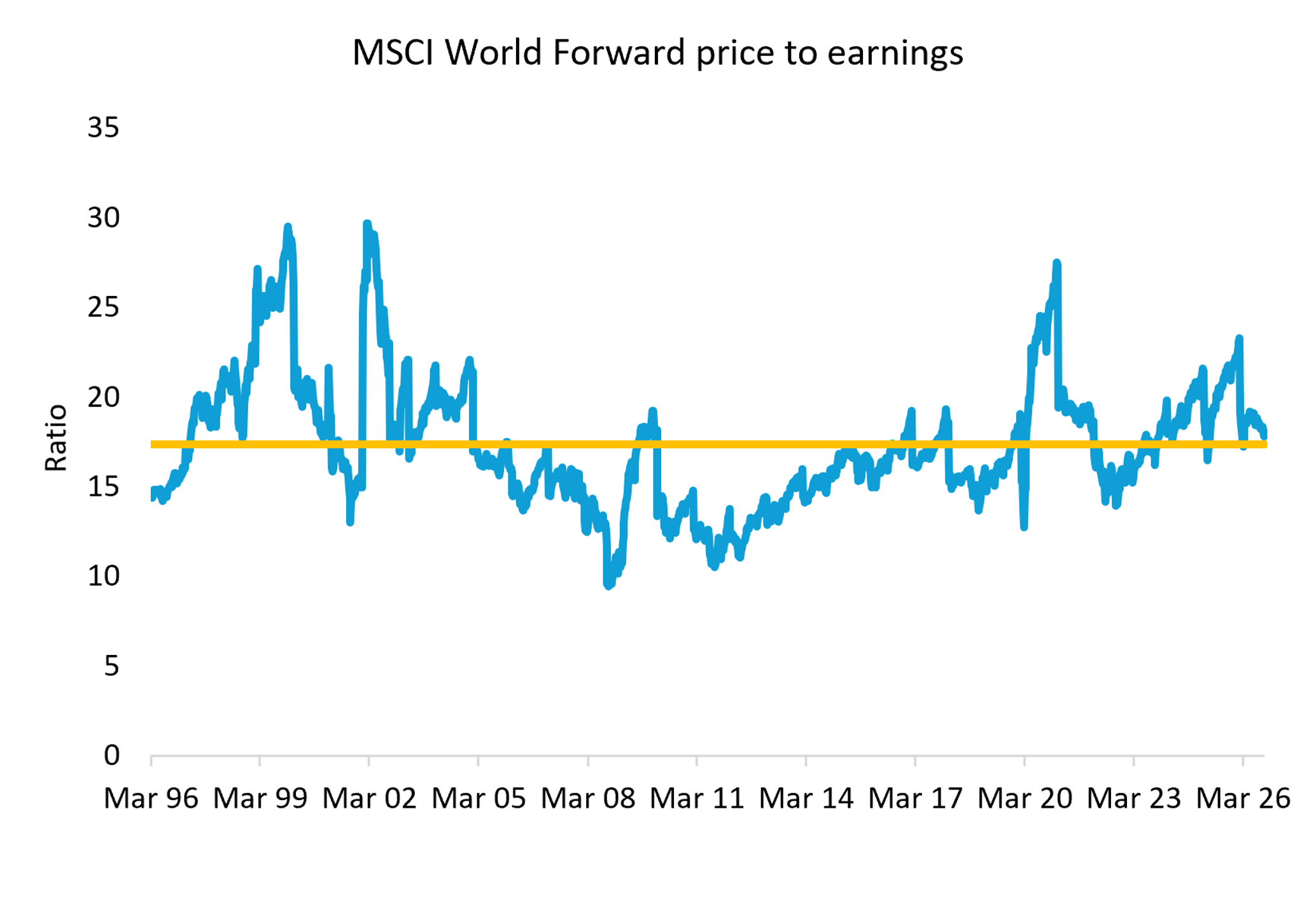
The reassuring evidence is substantial. Global shares trade on 16 times expected earnings, close to their long-run average. In 1999, the same measure ran from 21 to 24 times. Profits, rather than enthusiasm alone, have done more of the lifting this cycle, and company balance sheets are in better shape: U.S. corporate debt is growing by around 2% a year after inflation, against low double-digit growth in the late 1990s. The rally is broader, too. This year, between 50% and 70% of S&P 500 companies have typically traded above their 200-day average price, against around 30% at the end of 1999.
Source: Bloomberg
The less comforting evidence sits mostly in the U.S. On traditional yardsticks such as price-to-book and dividend yield, American shares are more expensive than at any point before the 2000 peak, although the rest of the world is far less stretched.
Concentration is starker still. AI-related companies now make up 49% of the S&P 500’s value, more than the 41% that technology, media and telecoms reached at their peak. Only the railway mania of the 1880s was more concentrated. The scale of investment is also extraordinary: a recent Brookings study estimates the AI build-out will absorb around 3.6% of U.S. gross domestic product (GDP) between 2025 and 2032, more than three times the late-1990s fibre and telecoms boom.
None of this proves AI is a bubble. It does mean AI has to deliver. In data going back to the late 1980s, corporate profit growth has never been further ahead of economic growth, and analysts are more optimistic than they were near the last peak.
Investors also seem calmer: the VIX (CBOE Volatility Index), Wall Street’s ‘fear gauge’, has typically sat around 17 over the past two years, against nearly 24 in the run-up to March 2000. That leaves little room for disappointment, which made last week’s results from the hyperscalers (the giant cloud computing companies) far more than routine.
Demand isn’t the question
On this season’s evidence, demand for computing power is not the problem. Microsoft’s Azure cloud business grew 48%, while its capital spending came in below expectations. That combination points to better returns on the money being spent. Amazon Web Services posted its fastest growth in 18 quarters. Its order backlog is up 190% and management describes capacity for 2027 and 2028 as essentially sold out. Further down the supply chain, Amphenol, which makes the connectors and cabling that wire data centres together, saw orders double. Rising rental prices for the most advanced chips suggest demand is still running ahead of supply.
The harder question is whether the spending earns its keep, and the market is keeping a tight rein.
Microsoft’s shares had already rallied hard recently, and despite strong results they fell with the broader market. Amazon’s shares dropped sharply as cloud growth came in just short of hopes, though we think it presents a buying opportunity. Alphabet’s cloud business more than doubled, but search revenue missed forecasts because AI-generated answers earn less than traditional adverts, for now. Its shares saw the largest daily percentage fall on record. New formats have historically been under-monetised at first, so at below 20 times next year’s earnings we find Alphabet attractive.
Pricing power is the longer-run test. The leading Chinese model has closed the gap from 38% behind the best U.S. model in May last year to just 5%, and it is cheaper to run. The hyperscalers that once kept to their own lanes now compete head-to-head. Booming demand never made airlines reliably profitable, and AI will need its moats.
Credit blinks first
The markets for borrowed money are asking the same question, and this is the signal we take most seriously.
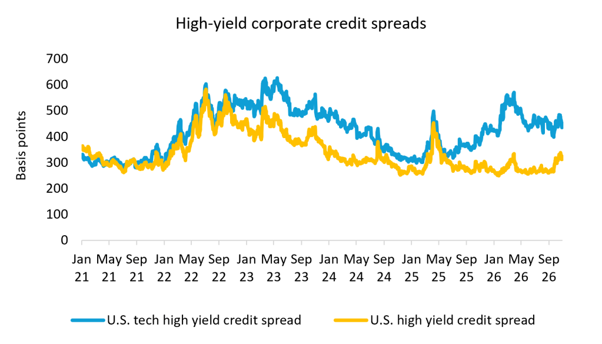
Credit spreads are the extra yield investors demand to lend to companies rather than governments. Since 1998, they consistently started widening before U.S. equities peaked, with a median rise of about 0.14 percentage points beforehand. Spreads on global investment-grade corporate bonds have risen from a low of 0.73 percentage points in January to around 0.95.
Source: Bloomberg
Over the past year, the cost of insuring Oracle’s debt against default has more than quadrupled. There have been false alarms before, and this may simply be a healthy repricing of AI build-out risk, but given credit’s track record we aren’t dismissing it lightly.
Those funding the boom at its riskier edges are also becoming choosier. Data centre company Firmus scrapped what would have been Australia’s largest-ever listing. UK-based developer Nscale met investor pushback on its roughly $30 billion valuation, and OpenAI is reported to have trimmed the valuation target for its latest funding round.
The market must also absorb a wave of new shares, including Meta’s plan to raise close to $100 billion. None of this inspires much confidence, even if it stops well short of a verdict.
Why, not when
The late 1990s offer one more parallel that’s hard to ignore. Back then, the Federal Reserve (the Fed) began raising rates again in June 1999 after a run of cuts, and the S&P 500 peaked nine months later. Today’s Fed cut rates in 2024 and 2025, restarted hiking last month and held steady at last week’s meeting, as expected. If the old template were followed exactly, the market would peak next June.
We think the more useful question is why the Fed raises rates and by how much: hikes that respond to a strong economy are manageable, but hikes forced by inflation from outside the economy are a bigger problem.
Oil is the obvious candidate. Brent crude has climbed quickly to around $116 per barrel. RBC Capital Markets and BCA Research both flag the risk that escalation with Iran may push it higher still, which would put pressure on central banks.
Perspective helps, though. In today’s money, oil passed $200 in 2008, and the global economy now uses less oil for each unit of output than ever before. Stronger household and company balance sheets also make the private sector less sensitive to higher bond yields than in the past, but higher yields still reduce what future profits are worth today and make bonds a stiffer competitor for shares.
Spending the headroom
Bond yields matter at home, too, and gilt investors watched last week’s UK Budget closely, even though its content was fairly uneventful.
The Office for Budget Responsibility revised up its borrowing projections. The government appears willing to run down a little of its fiscal headroom (the cushion it keeps against its own borrowing rules) while restating its commitment to fiscal discipline.
The more interesting question is political: what does the Budget imply for the prospect of a general election in the new year?
Weighing a step back
For equity investors, the most pressing question remains the one we began with: is today’s AI-driven rally a rerun of the late 1990s technology bubble?
We have held a modest overweight in global equities, deliberately small given the risks, because the balance of evidence has supported the rally running further. That evidence is now genuinely mixed.
AI adoption is still at an early stage and chip rental prices are rising. Against that, widening credit spreads, cooler appetites for new listings and productivity growth of 2.7% a year (still short of the 3.5% achieved in the late 1990s) argue for caution.
We’re debating whether to bring our equity position back to neutral and will share our decision next week, because the ghost of 1999 is a guide to what can go wrong, not a script for what will.
Central banks pause, but further hikes remain possible
Away from AI, the Fed, European Central Bank (ECB) and Bank of Japan all kept interest rates unchanged last week, although further tightening remains on the table.
The Fed struck a slightly more hawkish tone, acknowledging stronger economic growth, while two policymakers voted for another rate hike.
The ECB also signalled that another hike could come in December, although tighter financial conditions and limited signs of wage-driven inflation may reduce the need for further tightening beyond that.
Meanwhile, the Bank of Japan kept rates on hold but indicated that further increases remain likely as underlying inflation approaches a sustainable 2%.
Overall, central banks remain cautious about inflation, particularly with energy prices still elevated, but are taking time to assess the impact of previous rate increases.
Please continue to check our blog content for advice, planning issues and the latest investment market and economic updates from leading investment houses.
Charlotte Clarke
04/11/2026