
Please see the below article from Brooks Macdonald detailing their discussions on the US inflation report. Received this morning 15/10/2026.
What has happened?
A stronger-than-expected US inflation report initially pushed Treasury yields sharply higher and reignited fears of further Federal Reserve tightening. The 10-year Treasury yield briefly reached 5.33% before reversing to close at 5.19%, and has fallen a further 8bps overnight to around 5.10%. Despite lower yields by the end of the session, risk appetite weakened, with the S&P 500 falling -1.11%, its worst day since July. European markets was more resilient, with the STOXX 600 rising +0.43% and the FTSE 100 +0.70%.
US inflation above expectations
Headline CPI rose +0.65% m-o-m, lifting the annual rate to +3.7%, while core CPI increased +0.34%, pushing the y-o-y measure to +2.6%. Importantly, the upside surprise extended beyond energy prices, suggesting inflationary pressures were broad-based across the economy. Markets initially responded by sharply increasing the perceived likelihood of another Federal Reserve rate hike, with October hike expectations briefly rising above 50%. However, those moves largely reversed as investors shifted their attention to growing concerns around economic growth and tighter financial conditions. High-yield credit spreads widened to their highest level since March, highlighting a more cautious backdrop beneath the surface.
The AI trade faces a reality check
The sell-off in AI-related assets accelerated yesterday as investors scrutinised the sector’s heavy capital spending requirements and reliance on financing. The Philadelphia Semiconductor Index declined -4.30%, marking its sixth consecutive daily loss and leaving it down more than -11% over that period. The sell-off has continued into Asian trading this morning, with the KOSPI (-7.04%) and Nikkei (-5.08%) among the hardest-hit markets, while semiconductor leaders such as SK Hynix and Samsung also recorded sharp declines.
What does Brooks Macdonald think?
Yesterday’s market moves highlight the competing forces currently driving investor sentiment. On one hand, the inflation data suggests central banks may have less scope to ease policy than markets had hoped. On the other, growing concerns around the AI sector and broader financial conditions are raising questions about the strength of future economic growth. The sharp fall in Treasury yields after their initial post-CPI surge suggests investors are becoming increasingly focused on the economic consequences of tighter conditions, rather than inflation alone. Looking ahead, today’s US PPI inflation release and UK GDP data will provide further insight into the balance between inflationary pressures and economic momentum.
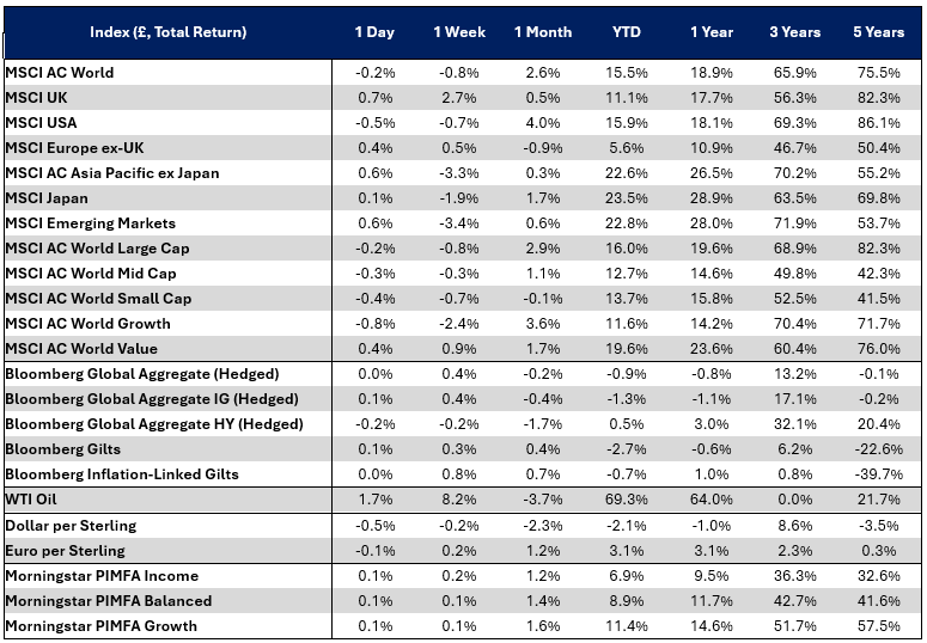
Bloomberg as at 15/10/2026.
Please continue to check our blog content for advice, planning issues and the latest investment, market and economic updates from leading investment houses.
Alex Clare
15/10/2026