
Please see this week’s Markets in a Minute update below from Brewin Dolphin, received yesterday afternoon – 06/10/2026
Will the Federal Reserve raise rates?
Softer U.S. economic data may have lowered the probability of a rate hike to 20%, but the inflation debate is far from over.
Key highlights
- The shadow of the Iran war: Energy prices and bond markets moved on signs Tehran may allow nuclear inspectors back.
- French fiscals: A 2027 budget deficit of 5.4% of GDP tests EU limits amid contentious spending cuts.
- U.S. labour data: The September jobs report came in below expectations, easing interest rate hike fears.
Europe’s bonds buffeted by foreign affairs
The U.S.-Iran war continues to cast a long shadow over European markets, and it’s increasingly dictating economic policy rather than merely disturbing it.
High energy prices have pushed inflation up and growth down across the continent, which makes the arithmetic of already strained public finances considerably harder. Chancellors and finance ministers are drafting budgets around a variable none of them control.
The news continues to ebb and flow as Iran appears to have offered to allow nuclear inspectors back into the country. This is a genuine concession rather than a repackaged proposal, like the one President Donald Trump dismissed at the start of last week – and perhaps the first hint that Tehran’s position is weaker than its rhetoric.
Energy prices fell on the news and bond markets rallied modestly. The U.S. has also deployed another carrier group to the region, though it won’t arrive until after the midterms – so whether it represents a potential military escalation or an idle threat is a matter of pure speculation.
The electoral clock is the live variable. Prediction markets now give the Democrats roughly a 62% chance of taking both chambers – the Senate and the House of Representatives – of the U.S. Congress.
A president who could get petrol flowing again at a sensible price would materially improve the Republicans’ chances, but it would need to happen very soon to reach household budgets in time. That’s precisely why the Iranians may judge their leverage to be at its peak right now.
For portfolios, energy remains the swing factor behind inflation and, therefore, interest rates.
The British Retail Consortium’s shop price index came in below expectations, a tentative sign of easing pressure. But with a backlog of energy increases still to pass through, the likely direction for UK inflation over the coming months is up until second-round effects wash out.
The circle France cannot square
The French government presented its 2027 budget last week, the last under President Emmanuel Macron, with the deficit running at around 5.4% of gross domestic product (GDP) for 2026. That sits above the previous plan’s 5% target, the International Monetary Fund’s 5.2% projection, and the 3% permitted under the European Union (EU)’s excessive deficit procedure.
Brussels is expected to show leniency, largely because it has no credible means of imposing anything on a member state that represents the ‘core’ of the euro area. The cuts being proposed fall on the most contentious ground available: pensions, welfare, public sector wages and state-funded sick leave.
France’s difficulty isn’t simply that cutting is politically hard, though with the highest public spending in the G7, there’s plenty to cut. It’s that cuts large enough to matter risk reducing GDP by as much as they reduce the deficit. When calculating the debt-to-GDP ratio, this is known as a ‘denominator trap’ (where cuts shrink the economy faster than the deficit).
It adds to a vicious cycle: weak growth widens the deficit, the deficit demands cuts, the cuts meet resistance in the Assembly and then on the streets, and investors price the resulting uncertainty into yields that make growth weaker still. The spread of French 10-year yields over German equivalents is out at levels last seen during the euro debt crisis that occurred from 2009 to 2018.
Some countries can let inflation erode their debt quietly instead, running the economy a little hot and keeping real returns on savings slightly negative. The UK and U.S. did this after both world wars and Japan has done so more recently. Inside a currency union, where monetary policy is delegated to the European Central Bank, that door is largely closed.
Westminster plays for time
The above is an option for the UK if the fiscal position continues to deteriorate. For now, spreads against other major markets have narrowed, yet gilt yields are still the highest in the G7, and the external environment has been every bit as unkind here as in Paris.
However, the UK’s fiscal framework means it does start from a better position than France. With four weeks until the Budget, Chancellor John Healey’s leeway against his predecessor’s fiscal rules has been eroded again by expectations of higher interest rates.
The Labour conference responded to the fiscal challenges by deferring the toughest issues. Prime Minister Andy Burnham has signalled openness to tax rises to fund social care but ruled out acting within this Parliament. The genuinely contentious items – electoral reform, a possible path back into the EU and softening the triple lock – are being lined up for the 2029 manifesto. The triple lock change is the substantive one. Each year, the state pension has risen by whichever is the highest of earnings growth, the consumer price index or 2.5% – a ratchet that lifts both cost (to the taxpayer) and benefit (to the recipient) as a share of the economy over time.
From 2030, all three measures will survive, but the earnings leg would restore pensions only to the level earnings growth implies, rather than compounding on top of it. The Institute for Fiscal Studies greeted it as a distinctly less-bad policy than the present one, which is about the warmest reception such reforms receive.
The prime minister appears to have a reformer’s instinct but a saint’s patience. Or he’s road testing these policies before he has to commit to them. If they land well, perhaps he could be tempted into an early election given that Labour is leading in the polls, and has planned an unprecedented fiscal tightening over the remaining years of the parliament.
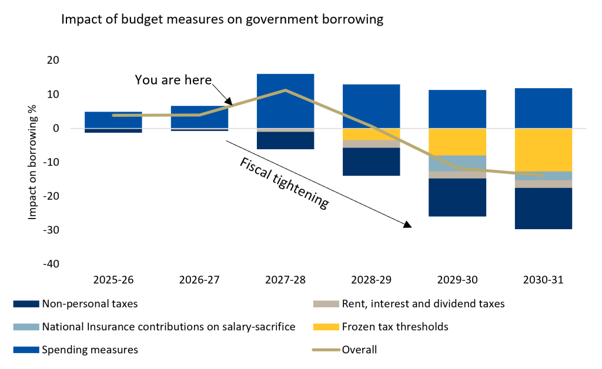
Source: Office for Budget Responsibility
One policy does arrive immediately. The ‘Your First Home’ scheme was announced at the Labour conference, with details to follow in the Autumn Budget. It’s essentially Help to Buy mark two: a government-backed equity loan of around 20% against a buyer deposit of roughly 2.5%, limited to new builds, with income and price caps still to be set. Housebuilder shares rose 10% to 15% on the news.
Goldilocks returns to the U.S. labour market
In a week full of labour market data, the general tone was one of moderate warmth. Thursday’s Challenger U.S. job cuts report generally indicated labour demand was stronger this year than last (even after stripping out government employment, which was distorted by the Department of Government Efficiency campaign).
The more interesting shift was in why companies say they’re cutting jobs. For the past five months, AI has been the single most commonly cited reason for layoffs, accounting for around a fifth of all announcements. In September, it fell to fifth place, overtaken by “economic and market conditions,” business closings, “downturn” and restructuring – all of which carry a distinctly cyclical rather than technological flavour.
It’s a small reversal, and the data only captures the slice of the jobs market covered by formal hiring and layoff announcements, but it suggests that whatever job losses are occurring right now are more about softening demand than automation.
The rest of last week’s data points were more straightforwardly reassuring. Initial jobless claims fell on Thursday. The ISM (Institute for Supply Management) manufacturing survey showed employment still expanding, albeit less enthusiastically than the PMI (Purchasing Managers’ Index) surveys had suggested. And globally, manufacturing has been expanding at its fastest pace in several years.
The JOLTs (Job Openings and Labor Turnover Survey) report added to the picture of a cooling – rather than cracking – U.S. labour market, with job openings slipping and the ratio of vacancies to unemployed workers easing further. When the September non-farm payroll jobs report itself landed, it came in below expectations, with downward revisions to prior months and softer wage growth than forecast.
For markets, whose principal anxiety has been that the Federal Reserve might hike interest rates more than expected, this was a welcome signal: a labour market losing a little momentum, without falling off a cliff, is close to the Goldilocks outcome (a market that’s not too hot and not too cool) investors want the most.
That dose of reassurance, combined with softer energy prices, took some of the pressure off bond yields and helped spark a rally across global sovereign markets. France, however, was a conspicuous underperformer.
Please continue to check our blog content for advice, planning issues and the latest investment market and economic updates from leading investment houses.
Charlotte Clarke
07/10/2026