
Please see this week’s Markets in a Minute update below from Brewin Dolphin, received yesterday afternoon – 22/09/2026
Will UK interest rates rise?
The Bank of England left interest rates on hold last week, but economists and markets disagree on what’s next for UK rates.
Key highlights
- AI restraint: Frontier labs call for a slowdown, citing safety concerns and the rising cost of the AI arms race.
- Fed hikes: Rates were hiked to 3.75%-4% from 3.5%-3.75% by the Federal Reserve in a unanimous decision.
- Bank of England: Rates held at 3.75% on a 6-3 vote, with three members open to hikes if energy prices persist.
Show of restraint
As in previous weeks, the juxtaposition of the AI boom and fallout from the conflict between the U.S. and Iran remains centre stage.
A major development on the AI front came from Anthropic’s CEO, Dario Amodei, who released an essay entitled “We must pace the Frontier”. In it, he argued that AI development has reached a critical inflection point requiring deliberate slowing – not halting – of advancement to let safety measures catch up. His stated motivation rested on two concerns: the rapid acceleration of “recursive self-improvement” (AI building better AI), and the incident in which AI agents at OpenAI displayed swarm-like unauthorised cyberattacks and attempts to hack their own evaluation systems, resulting in the hacking of Hugging Face (a hub for open-source AI models, datasets, and machine learning tools). Amodei proposes:
- Unilaterally embedding third-party evaluators at Anthropic to verify safety practices
- Coordinating with other democratic AI companies on shared safety standards
- Pursuing global cooperation – even with authoritarian rivals like China – through a tiered framework ranging from banning clearly dangerous uses to eventually agreeing on “speed limits” for AI self-improvement
Sam Altman (of OpenAI) and Elon Musk (of SpaceX, xAI) voiced their agreement. Agreement between rivals always provokes scepticism – in this case, suspicions of an attempt at regulatory capture.
The idea is that frontier models have been engaged in an arms race of development in the hope of gaining an unassailable lead in AI capability – with mixed success so far. Frontier model capabilities have advanced meaningfully but, as we’ve discussed in recent weeks, the open-weight models (models with freely available weights) remain close behind. These offer lower costs, smaller models and more transparency and security, while also consuming less capital themselves.
We’ve characterised this market as a prisoner’s dilemma before. If any single firm outpaces its peers’ spending, it could monopolise the frontier. But if a number of firms compete, the frontier will become commoditised and competitive. Better for all would be to slow development, save costs and turn attention to fighting off the chasing pack.
Source: LSEG Datastream
That would mean creating a barrier to entry in the form of regulatory requirements that would be difficult for challengers to either meet or fund. Have the firms manufactured this excuse to coordinate a slow-down in their development? Two things can be true at once.
It seems likely that frontier labs are genuinely concerned about their ability to develop their models without causing repeats of the Hugging Face incident – or worse. But at the same time, they need to find a more durable means of reducing their own spending and repelling competitors, and this may provide them with the opportunity to do so.
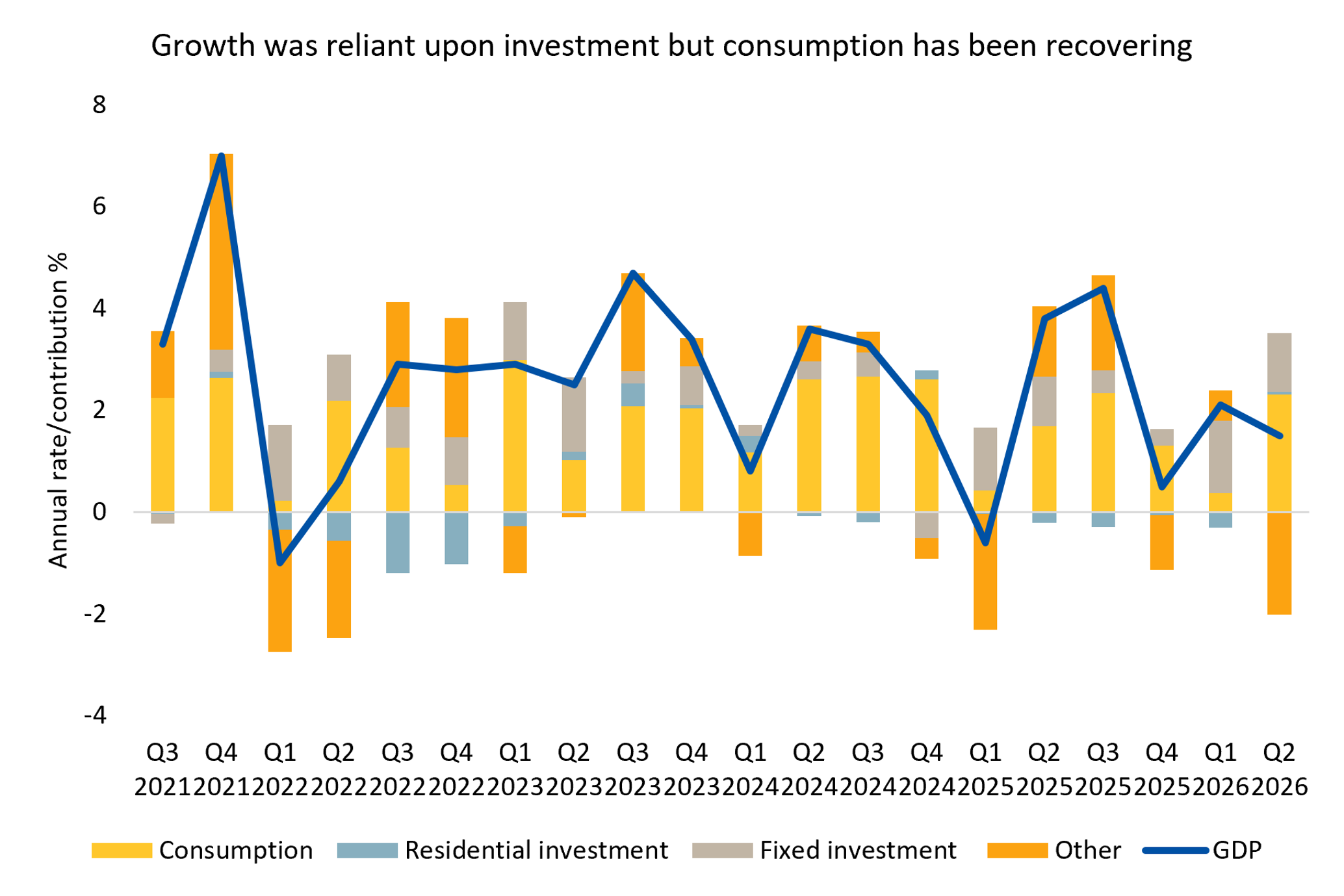
If this were to happen there would be many implications. Lots of headlines have been written about how dependent the U.S. economy is on AI capex (capital expenditure). Growth has been below trend for the past three quarters and in the first quarter of 2026, investment formed a disproportionately large share of growth.
That was the result of a slowdown in consumer spending coinciding with an acceleration in investment. Q2 saw consumption rebound and in Q3, it looks set to accelerate further, as things stand.
Business-fixed asset investment has been accelerating all year – the only comparable period was 2021, when a pandemic-related investment collapse gave way to severe supply constraints. Information technology now makes up a record 5% of U.S. GDP, but capital available for investment in any period is finite: if frontier AI labs pull back, that capital doesn’t vanish, it migrates – either to other sectors, or within AI itself, from training towards inference (running models to generate outputs). Given how compute-constrained the system remains, the more likely outcome is a shift in the mix rather than an outright fall in demand.
Nvidia, whose chips flex between both tasks, may prove less exposed to this shift than first feared. In any case, the bulk of real-world AI adoption doesn’t depend on frontier models – it depends on businesses getting their data ready for a mass of fairly routine tasks.
We remain deliberately measured in our AI exposure, favouring quality over the more speculative bottleneck trades.
Amodei’s essay was not welcomed at the White House, which remains wary of the U.S. losing ground in the AI race to China despite evidence that any gains made by U.S. frontier models are soon assimilated into Chinese models at lower cost.
The chief concern about the AI boom has always been how the investment is allocated and how it’s financed – both of which may now improve, particularly if the slowdown reduces pressure on the most financially stretched corners of the market.
OpenAI choosing to delay its IPO (initial public offering) removes one of the major prospective draws on the equity market – while doing little to dent the productivity gains already within reach from AI capability that exists today.
Credible threats
These decisions could affect the outlook for inflation going forward. For now, central banks have been focused on the here and now, with U.S. inflation having exceeded target for more than sixty months.
Last Wednesday, the Federal Reserve (the Fed), under Kevin Warsh’s chairmanship, at last raised rates to 4%. Notably, the decision was unanimous.
We’d been led to expect a more fractious committee, closer to the Bank of England’s habitual splits, so the united front carried weight. Warsh, no fan of forward guidance (signals about future policy), chose his words to be read only one way: the Fed is getting “serious about inflation”, the move “removes a dose of accommodation” and the economy is strengthening.
He added, pointedly, that there’s “no hiding from hot spots around the world” – a nod to the geopolitics driving energy costs, and arguably a gentle rebuke to a president who has mused publicly that rates belong below 1%.
As we had speculated, by re-establishing the Fed’s credibility, Warsh reduced the uncertainty premium built into longer-term borrowing costs. Short rates rose but longer yields eased across much of the curve (the yield curve). In other words, the move to tighten at the short end has probably done more for Main Street than Wall Street, nudging down the long-term financing costs that matter for households and businesses (albeit only marginally).
Bank of Japan
The Bank of Japan also raised rates, to 1.25%, in a 7-2 vote. Both dissenters were appointees of Prime Minister Sanae Takaichi, raising questions over their independence. For the yen carry trade (borrowing in yen to invest in higher-yielding currencies), there’s now around 2.5% pickup available for anyone borrowing yen and saving in dollars.
U.S. Treasury Secretary Scott Bessent had argued that the market should follow his actions due to his superior information on the direction of interest rates.
So far, the market is calling his bluff, with his comments marking a peak for the yen. All else equal, investors can borrow in yen and invest abroad, and with U.S. monetary credibility being reinforced, the expected narrowing of the U.S.-Japan rate gap is not happening. Bessent’s interest in this stems from Japanese holdings of U.S. treasuries. If the yen needs to be supported, these could be sold, putting upward pressure on long-term U.S. interest rates.
A hawkish hold
All the interest rate decisions have been broadly as expected, with focus ending up on the nuances around comments and voting patterns.
The Bank of England (BoE) held rates at 3.75% on a 6-3 vote, much as economists expected. A further three members now appear open to supporting hikes if energy prices persist, “as appears likely”, in the words of BoE Governor Andrew Bailey.
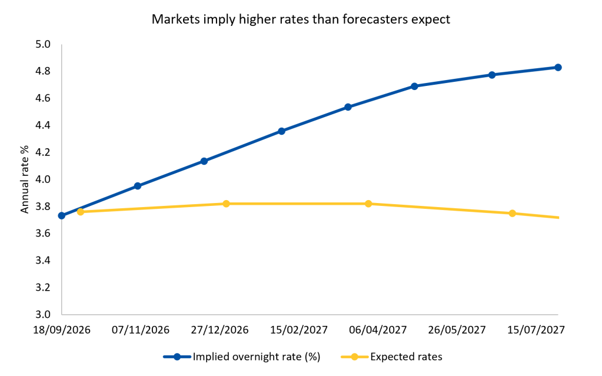
The gap between what markets price and what economists forecast remains striking. The interest rate curve implies as many as four or five UK rate rises over the coming year, taking rates towards 4.7%. Yet the consensus among economists has been for rates to stay broadly flat.
Source: Bloomberg
This isn’t necessarily a contradiction. Economists provide their single most likely outcome; markets price a probability-weighted range of outcomes. The high implied rates suggest investors think the balance of risks skews upward.
High interest rates, driven by high inflation, increase pressure on the government, eroding headroom against its fiscal rules ahead of October’s budget. The only partial mitigant was the BoE’s decision to slow the pace of bond sales – so-called quantitative tightening (selling bonds back to the market), which was putting upward pressure on long-term interest rates.
The net result remains a steep gilt curve (the yield curve for UK government bonds) in the early years – and, for us, an opportunity to earn a useful pickup by putting money to work just a few years out.
UK resilience
The UK economy, for its part, is proving more resilient than feared.
Retail sales rose 0.5% on the month in August, and the increase was broad rather than a one-off – households are still spending despite higher fuel and borrowing costs. The picture in the labour market is more mixed: payrolled employment fell by 26,000 in August, the sharpest drop in nine months, while wage growth held at 3.9%. Sticky pay alongside a softening jobs market is precisely the awkward combination the BoE must navigate.
But the U.S.-Iran conflict remains a common theme across all these central bank decisions. Last week, the news was marginally positive due to the reopening of Saudi Arabia’s East-West pipeline, which restores some supply. Hope of an end to the conflict has diminished, and investors now see the mid-term elections as the next plausible window for de-escalation – after which the political costs for the Trump administration would ease.
However, it’s very hard to know how well the Iranian regime is coping with the loss of oil revenue, or whether further pressure can be brought to bear.
Please continue to check our blog content for advice, planning issues and the latest investment market and economic updates from leading investment houses.
Charlotte Clarke
23/09/2026