
Team No Comments

AJ Bell Precious Metals Blog

An article received from Russ Mould of A J Bell over the weekend weighing up precious metals.

The silver price is cheap relative to gold

But silver miners aren’t quite the bargain relative to the metal

 Russ Mould

The Silver Surfer was the creation of Marvel Comics legend Jack Kirby and the character acted as the herald of Galactus, the devourer of planets. This intergalactic super-being was usually fended off by the Fantastic Four or The Avengers.

From the point of view of investors, inflation devours wealth as scarily as Galactus consumed solar systems. Rather than turn to superheroes for protection against this potential threat, markets are turning toward something else known for being nearly indestructible, precious metals – principally gold and silver.

At the time of writing gold is setting new record highs above $1,900 an ounce but at $24 an ounce silver is still trading way below its prior peaks of 2011 and 1979, even if silver’s 34% year-to-date gain in 2020 outpaces that of gold by several percentage points.

PRECIOUS HAVENS

Precious metals tend to arouse strong feelings among investors. Some investors love them as a potential hedge against inflation, some against deflation and some against unforeseeable disasters and market dislocations, while others detest them, viewing gold in particular as a barbarous relic or inert useless lump.

But bulls are putting bears to flight right now and there may be three possible reasons why gold and silver are both doing well.

First, the market may be pricing in the almost unthinkable return of inflation, thanks to rampant central bank money creation through quantitative easing (QE) schemes, governments’ accumulation of ever-higher deficits, supply-side dislocation thanks to Covid-19 and possibly firms putting up their prices to help the meet the additional costs of staying in business in a post-pandemic world.

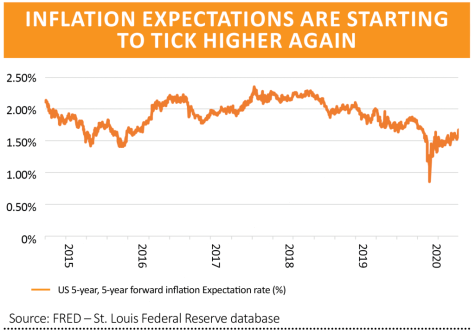
A five-year forward expectation for inflation of 1.67% in the US is hardly earth-shattering stuff, compared to the double-digit rates of the 1970s and early 1980s, but it does seem as if investors are becoming more wary of inflation.
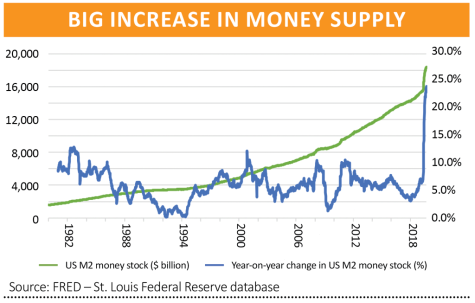
Second, so-called ‘Austrian school’ economists do not define inflation by price changes, but change in money supply, relative to the volume of services and goods produced. The 24% year-on-year surge in US M2 money stock will have anyone who follows their theories on a state of high alert.

Third, related to the money supply, central bank money creation and higher government deficits could be driving fears of monetary debasement, prompting a rush to perceived havens and stores of value such as gold and to a lesser degree silver.

The US Federal Reserve has ramped up QE in 2020 in response to the pandemic, taking its total assets from $4 trillion to $7 trillion, through a series of programmes designed to buy a wide range of financial instruments.
Gold and silver surged between 2008 and 2011 as the Fed ran its first three rounds of QE but they then lost ground as it looked like the monetary authorities had regained control of the economic situation.

The pandemic may have changed all that, and the cost of keeping the show on the road this time around has already been much higher. One question that buyers of gold may already be asking themselves is what action will be taken by the Fed and other central banks next time a recession hits, as the system will feature even more debt and potentially be even more susceptible to an unexpected shock.

HOT STUFF

There is a fourth angle which pertains to silver only. Unlike gold, silver has industrial uses and as such is a more ‘cyclical’ play, because it is the best conductor of all metals and has antimicrobial attributes which make it a perfect biocide.

Demand from the traditional film photography industry is probably all but gone but these chemical properties means silver is ideal for the medical equipment, electronics, water purification and solar power industries.

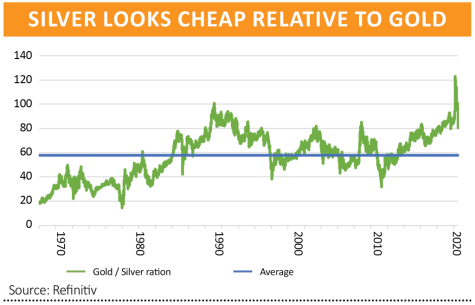
As the world focuses more on renewable energy, solar panels could be a driver of silver demand. Whether this proves more potent than demand for a haven remains to be seen, but historical data does suggest silver is trading cheaply relative to gold.

The gold/silver price ratio has average 56 since 1970 but an ounce of gold currently trades at 80 times the price of an ounce of silver.
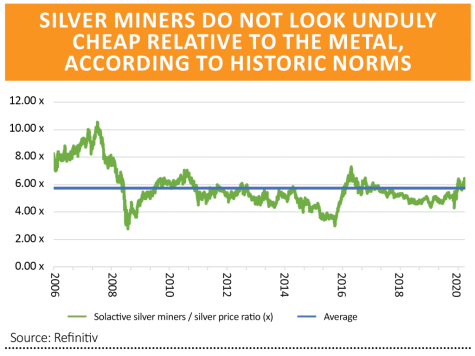
While the HUI Golds Bugs index trades below its average ratio to the metal price, silver miners do not look especially cheap compared to the physical commodity, based on the relationship between the metal and the Solactive Silver Miners index.

That benchmark has a fairly limited history and silver miners traded a lot more expensively relative to the metal in 2008 and 2011, so investors who prefer miners to metal still have much to ponder.

There is no guarantee that silver’s run will continue – if Covid-19 is beaten and the economy bounces back more strongly than hoped then the appeal of haven assets might not be anywhere near as strong.
As an investment on its own precious metals are a little different.  Safe haven assets but with the physical cost of storage and no income yield.  Fund Managers may occasionally use precious metals as part of a portfolio in heightened volatility, but they don’t tend to hold for example gold for the long term.

Trying to buy and sell precious metals and get your timing right is difficult.  George Soros, a famous Hedge Fund Manager, managed to call it right a few times but he also shorted sterling and was known as ‘The man who broke the Bank of England’ in the 1992 Black Wednesday UK currency crisis.

Steve Speed

03/08/2020

Team No Comments

AJ Bell Youinvest – The Growth of China’s Consumer Economy

Please see article below from AJ Bell Youinvest received 30/07/2020

The growth of China’s consumer economy

The country could stoke domestic demand to become more self-reliant

Thursday 30 Jul 2020 Author: Tom Sieber

In the last decade or more the Chinese economy has undergone a significant transition as it moves away from an infrastructure-driven and export-reliant economy to one fired by domestic consumption.

This change can be tracked by looking at how the country’s current account surplus has moved to a deficit. Broadly speaking a current account surplus means an economy is exporting a greater value of goods and services than it is importing.

Having peaked in 2008 when China truly lived up to its reputation as ‘The World’s Factory’ the surplus has declined significantly.

There are several factors underpinning the growth of the consumer economy, one being a natural offshoot of the maturation of the Chinese economy. A larger Chinese middle class is more likely to have disposable income to spend on products and services at home.

In the short term at least, exports have been hit by the coronavirus crisis as demand has dried up and trade routes have been affected by lockdown restrictions. Chinese tourists who might have taken their renminbi overseas are also shopping domestically instead.

There are signs China wants to move further in this direction as it looks to become more self-reliant. This may reflect pressure on the country and its businesses from other countries concerned about its growing global influence, and about its recent actions in Hong Kong and in the immediate aftermath of the Covid-19 outbreak.

A report by the Chinese Academy of Social Sciences, a think tank closely affiliated to the state, suggests the next five-year policy plan – due for 2021 – should prioritise home-grown innovation and look to tap into a substantial domestic market.

Please continue to check back for our latest blog posts and updates.

Charlotte Ennis

31/07/2020

Team No Comments

Prudential Update on Recent Investment Scams

Please see below an article just received from Prudential detailing an ongoing Investment Scam:

It is important to remain vigilant with your data and if you have received a communication that you are unsure of, please do not hesitate to contact our office on 0151 546 1969.

Please continue to check our Blog content for advice and planning issues and the latest investment, markets and economic updates from leading investment houses.

Please keep safe and healthy.

Carl Mitchell – Dip PFS

IFA and Paraplanner

30/07/2020

Team No Comments

J.P. Morgan – Multi-Asset Solutions Weekly Strategy Report

Please see below an article published by J.P. Morgan on the 27/07/2020 detailing their view on current market conditions and their position:

Please continue to check our Blog content for advice and planning issues and the latest investment, markets and economic updates from leading investment houses.

Please keep safe and healthy.

Carl Mitchell – Dip PFS

IFA and Paraplanner

30/07/2020

Team No Comments

Brewin Dolphin – Markets in a Minute

Please see below the latest market update article from Brewin Dolphin – received 28/07/2020.

Markets in a Minute: Equity markets lose ground as investors seek safe havens 28 . 07 . 2020

Markets in a Minute: Equity markets lose ground as investors seek safe havens

Global share markets struggled to hold on to recent gains over the past week as tensions between the US and China escalated, with tit-for-tat consulate closures in Houston and Chengdu. There were also signs that the rebound in the US economy was waning, with initial jobless claims rising for the first time since March. Increasing coronavirus cases in numerous countries added to worries.

Bond yields fell, the gold price hit a record high as investors looked for safe havens and the US dollar fell to its lowest level for two years when compared to a basket of other currencies.

Last week’s markets performance*

  • FTSE100: -2.64%
  • Dow Jones: -0.75%
  • S&P500: -0.3%
  • Dax: -0.63%
  • Hang Seng: -1.5%
  • Shanghai Composite: -0.54%

*Data for the week to close of business on Friday 24 July.

Holiday chaos

Markets started the week cautiously yesterday. Asian shares were mixed, the US rose, but equities in the UK and Europe lost ground. The FTSE100 closed down by 0.3%, and the Eurostoxx600 index also fell by 0.3%. Travel stocks shouldered the worst of the losses on the back of the government decision to impose a two-week quarantine on travellers returning from Spain. It had a knock-on effect as many travellers to other destinations cancelled their holidays fearing a similar last-minute change to the rules. But the UK was not alone; France also warned against citizens travelling to Catalonia, and said those returning from a list of 16 countries outside the EU would be subject to mandatory testing at the border on arrival.

Dollar woes

We have been calling a decline in the dollar for some time now and it has fallen against virtually everything over the past week, especially when compared to the euro which is continuing its strong run. Recent data suggests that the European economy is performing better than the US, and given European interest rates are negative, while they are still (just) in positive territory in America, investors perceive US rates have further to fall, putting downwards pressure on the dollar. The euro gained 0.95c yesterday to $1.17.81, above the $1.17 level for the first time since late 2018. The pound also strengthened 0.7% to $1.29.01.

Dollar exchange rates

Virus news

While global case numbers continue to rise, driven largely by emerging economies, there have been renewed spikes in numerous locations including Japan, Hong Kong, France, Canada, Germany and, of course, Spain. However, it is the progress of the virus and policy response in the US that will have the greatest impact on the global economy.

In that sense at least, there were hopeful signs in the US that new infections were peaking, and there are several factors which suggest that the economic impact of the virus in the coming months won’t be as severe as it has been in the past.

Firstly, the rise in cases is partly explained by the increase in testing. That means the headline case number is less worrying and it also means more people who know they are infected can self-isolate and be treated.

Hospitalisation rates have been lower and are falling. That means more minor cases are being identified and people are self-isolating, and it also suggests that high-risk groups are isolating to keep out of harm’s way.  Additionally, those who are hospitalised are getting better faster. Treatments have improved and the ICU mortality rate has declined. All these factors suggest that repeating the total lockdowns seen earlier in the year is not a viable option.  

Stimulus deadlock

While the EU eventually approved its €750bn recovery package after a marathon summit early last week, US Congress is still debating how to proceed. The Democrats approved a bill for $3trn in additional stimulus two months ago, including a proposal to keep paying the $600-a-week in extra unemployment benefits until the end of the year. The payments are due to expire this week.

Yesterday, however, the Republican-controlled Senate unveiled a $1trn plan that involves cutting the $600-a-week benefits to $200 in September, then setting unemployment benefits at a maximum of 70% of the claimants’ most recent salary. The idea is to make sure that nobody earns more for staying at home than they would going to work.

However, the Democrats said the plan fell far short of what was needed to ensure the US recovery stayed on track, and said the cut to benefits was a “slap in the face” for the 30m Americans relying on unemployment payments. The two parties are now negotiating a compromise.

Road to recovery

While recent economic data has generally been better than expected, that trend has been less pronounced in the UK than other regions. Although the initial purchasing managers’ indices for July show activity is improving, the data is only relative to the previous month and so does not really tell us a great deal other than things aren’t quite as bad as they were in June.

While the direction of travel is welcome, there’s every reason to expect the UK recovery to be slow as the job retention scheme is unwound over the coming months.

We compared the Office of Budgetary Responsibility (OBR) and US Congressional Budget Office (CBO) forecasts for UK and US GDP respectively. They anticipated that the US will reach its pre-COVID level of activity in 2021, a year ahead of the UK.  

Brexit and trade deals

The current state of Brexit negotiations also implies a slower trajectory for the UK. Whilst opinions differ, the market views any frictions between the UK and EU as inhibiting UK economic activity. Last week the Telegraph reported that government insiders are resigned to the fact that they may be trading with the EU on WTO terms in 2021.  The FT reported that the government are equally resigned to the fact that a trade deal with the US will not happen ahead of the US elections this year (and therefore will be pushed back to the next congressional session starting in the new year).
The first of these stories is presumably part of the bargaining strategy and doesn’t necessarily change our view that a thin trade deal can be achieved later in the year, but will likely still mean some economic disruption. The second weakens the UK hand in further negotiations but is not a surprise given that the US has typically been a tough partner for smaller countries to negotiate with. Both scenarios present some headwinds which could add to volatility.

A good overview of the current market situation from Brewin Dolphin. High levels of volatility continue in the markets and the impacts of the virus are still being felt globally.

Please continue to check back for our latest blog posts and updates.

Charlotte Ennis

29/07/2020

Team No Comments

Jupiter Insight: Will we see a more regenerative form of capitalism?

Please see the below insight from Jupiter Asset Management’s Environment & Sustainability Fund Manager, Abbie Llewellyn-Waters, which we received earlier this week:

It has become clear that we are at a precipice of change. The status quo has been shattered and there is an opportunity to reconsider a new normal. This applies to capital markets as well and underpins the need to deliver a more regenerative approach to investing and how we rebuild our economies to become structurally more sustainable.

Despite the easing of lockdowns throughout the world, there remains speculation about whether the old demand trends for fast or luxury fashion, as well as eating, drinking and travel, will hold. For example, only 9% of people polled by YouGov in the UK wanted things to return to exactly how they were before the crisis.

From our perspective, we see a great opportunity in companies that are positioned to transition to a more regenerative form of capitalism – where companies that treat workers well, don’t exploit vulnerable communities in their supply chain, that take proactive action in a crisis, and that limit their impact on the environment, will be more attractive to investors.

We anticipate that asset prices will increasingly reflect this. In fact, Harvard published a white paper in May  that looked at parallels between US share prices and salient corporate social responses to Covid-19 (such as sick pay policies, appropriateness of government aid acceptance, dividend cuts), and concluded that there was a clear alpha correlation between the two.

Sustainable investment themes have accelerated

Sustainable themes have accelerated as a result of the Covid-19 crisis. Firstly, momentum for environmental policy has gathered pace, despite the fragile state of the global economy. Policymakers have been quick to draw the link between the coronavirus and the environment – like viruses, greenhouse gases care little for borders. The debate around carbon policy, and specifically carbon tax, has notably speeded up. The recent eye watering impairments within the oil sector brings further caution to the broader carbon capital at risk in the system.

There has also been important research quantifying pollution reduction, one of the few positives from this crisis. There has been a staggering drop in emissions through the crisis, at a level that is obviously unsustainable but has at least demonstrated the efficacy of urgent policy response. As a result of the global measures to combat Covid-19, the IEA (International Energy Agency) expects global CO2 emissions this year to decrease to levels of 10 years ago. This is significant and could support the case for a more agile economic culture that includes more working from home. It is effectively an ‘investment-free’ solution to help deliver the legal commitments of the Paris Agreement.

There also continues to be strong momentum in human capital management within the sustainable companies that we focus on, with an increasing correlation between fair treatment of workers and share price returns.

Finally, another interesting new theme is sustainable supply chain management. For years, efficiency has been the overriding aim in supply chains – “just enough, just in time”. Covid-19 has shifted the focus to security. While this has implications for working capital, it also offers new revenue opportunities. For example, infectious diseases have previously been mischaracterised as an issue mainly for developing markets. But R&D investment into non-Covid infectious diseases in developed markets is increasing, which has the potential to create entirely new revenue streams.

All in all, we expect the journey ahead to be much more complex than the Q2 market rally might suggest. As active long-term investors, our focus remains finding high quality companies that are leading the transition to a more sustainable world.

As we have highlighted over the past few months, sustainable investment themes and ESG are being talked about now in the press more and more by the regulator, fund managers and investors.

If you haven’t already caught up with these blogs, please see the below links which will take you to our 3-part blog series, ‘An Introduction to ESG’ which we posted over the past month for a basic introduction to what ESG is, how its measured and what we at People and Business are doing to make sure we are moving in the right direction with regards to sustainable investment themes.

Part 1 – https://www.pandbifa.co.uk/what-is-esg-an-introduction-part-1/
Part 2 – https://www.pandbifa.co.uk/what-is-esg-an-introduction-part-2/
Part 3 – https://www.pandbifa.co.uk/what-is-esg-an-introduction-part-3/

Andrew Lloyd

29/07/2020

Team No Comments

PruFund Series E – Monthly Review

Please see below the monthly update for July, which was published by Prudential yesterday for their PruFund Series E funds only, which details no Unit Price Adjustments (UPA) will be applied:

There are no Unit Price Adjustments (UPAs) for the Series E PruFund range of funds at this month’s PruFund Investment Date.

On the monthly PruFund Investment Date, a UPA is applied if the unsmoothed price is:

  • 4%, or more, higher than the smoothed price, for our PruFund Cautious, PruFund Risk Managed 1 or PruFund Risk Managed 2 funds, or
  • 5%, or more, higher than the smoothed price for our PruFund Growth, PruFund Risk Managed 3, PruFund Risk Managed 4 of PruFund Risk Managed 5 funds

The next quarterly review of the entire PruFund range of funds, which will include a review of Prudential’s long-term growth expectations and subsequently the funds underlying Expected Growth Rates (EGRs) will take place on the 25th August 2020.

In exceptional circumstances, as was seen in March, Prudential can make Unit Price Adjustments outside of their normal review dates and these adjustments can be either upwards or downwards.

Please continue to check our Blog content for advice and planning issues and the latest investment, markets and economic updates from leading investment houses.

Please keep safe and healthy.

Carl Mitchell – Dip PFS

IFA and Paraplanner

28/07/2020

Team No Comments

Blackfinch – Monday Market Update

Please see the below market update received from Blackfinch Asset Management earlier today:

UK COMMENTARY

  • Tensions between the UK and China continue to rise over Huawei’s ban from the UK’s 5G network and the suspension of the Hong Kong extradition treaty.
  • The IHS Markit Household Finance Index (HFI) for July rose to 41.5 from 40.7 in June. However, 31% of the survey’s respondents said their jobs were less secure than before the pandemic hit the UK.
  • Data from Rightmove suggests that the average price of a house in the UK has risen to £320,265, an increase of 2.4% since March.
  • Boris Johnson’s self-imposed July Brexit deadline looms, with the potential for an agreement seeming unlikely.
  • The CBI Industrial Trends Survey for July showed the total orders balance recovered to -46 from -58 in June. Economists had, however, expected a stronger recovery to -38.
  • Retail sales show a 13.9% month-on-month increase in June, following on from May’s 12.9% increase.
  • The IHS Markit/CIPS Flash UK Composite Purchasing Managers Index (PMI) for July rose to 57.1 from June’s 47.7.

US COMMENTARY

  • COVID-19 case numbers continue to rise, however weekly numbers to the 20th July show that the rate of increase has slowed in 36 states over the previous week.
  • US government orders the closure of the Chinese consulate in Houston, raising further questions around ongoing tensions between the countries. China retaliates by ordering the closure of the US consulate in Chengdu.
  • Donald Trump admits that the COVID-19 pandemic is likely to get worse before it improves.
  • US home sales show their biggest monthly rise on record, increasing by 21% in June, albeit the recovery was slightly lower than expected.
  • US jobless claims show their first increase since late March, rising by 109,000 to 1.42mln.
  • US Secretary of State Mike Pompeo accuses China of being “increasingly authoritarian at home, and more aggressive in its hostility to freedom everywhere else”.

EUROPE COMMENTARY

  • European leaders reach agreement on a €750bn pandemic recovery fund consisting of both loans and grants.

COVID-19 COMMENTARY

  • UK based small-cap drug developer Synairgen has potentially discovered a life-saving treatment for acute cases of COVID-19. Results from a recent trial ‘could signal a major breakthrough in the treatment of hospitalised patients’.
  • The vaccine being developed by Oxford University and Astrazeneca continues to provide positive and safe results in trials.

This update provides you with a short summary of events from around the world over the past week.

Please check back for our regular market updates from a range of providers.

Andrew Lloyd

27th July 2020

Team No Comments

Cover Magazine – Health Insurance Scams up 15% During Pandemic

Please see below an article uploaded by Cover Magazine last week and received on 24/07/2020, detailing scammers efforts to exploit people during the ongoing Coronavirus pandemic:

Research by Aviva has shown that unscrupulous tactics and fraudulent communications related to financial services products have risen as a result of coronavirus.

According to the Aviva Fraud Report, suspicious emails, texts and phone calls related to health insurance have increased by 15% since the pandemic – up from 11% pre-Covid (1 January 2019 – 29 February 2020) to 27% during Covid (1 March – 15 June 2020).

For life insurance, the percentage of people who reported receiving suspicious communication were up 10% – from 14% to 24% – during this period.

This compares to a 7% rise in car insurance, 3% rise in pensions and 2% increase in annuities related scams.

According to the report, a typical health and life insurance scam involves a cold call telling consumers “It’s time to review your policy”. The fraudsters will claim they’re from a reputable insurance company or that they’ve been asked to do this by the regulators – all in a bid to gain trust. They may offer lower premiums but what they don’t mention is that the lower premium also means reduced cover – often leaving the consumer with a worthless policy.

The survey of 2009 Brits also found one in five (22%) reported having been targeted by suspicious communications which mentioned coronavirus – which equates to 11.7 million people in the UK.

Almost half (46%) said they didn’t report these suspicious communications, even though they suspected it was a financial scam. The most common (41%) reason given was because they didn’t know who to report the communication to.

Peter Hazlewood, group financial crime risk director at Aviva, said: “While the types of financial scams are generally the same as those before the pandemic, fraudsters are exploiting the pandemic to take advantage of people when they are at their most vulnerable. They are using coronavirus as a pretext to lure potential victims. The scams range from attempts to sell people unsuitable insurance to, at worst, stealing their entire retirement savings. The impact on victims is not just financial either, it has a detrimental effect on people’s mental wellbeing too.”

The research found that one in 12 (8%) of those surveyed have been the victim of a financial scam which related to coronavirus. Of those, 41% said being the victim of a scam negatively affected their mental health.

In June this year, Action Fraud reported £5million having been lost to fraud since February – a figure likely to be far higher due to a lack of reporting. Hazlewood added: “It’s clear from our research that fraudsters will use whatever tactics necessary to get hold of people’s hard-earned money. If you’re interested in getting a lower premium or taking out a new insurance policy, do a bit of research yourself – and don’t be forced into anything by unexpected phone calls from strangers. If you’re not sure whether a financial services company or a communication is legitimate, report it – to us, Action Fraud or the Police. And, while this may feel like an unsettling time for many, the advice we’d give to people is not to panic. When it comes to investments, decisions made in haste and under stress are rarely good ones.”

It is important to remain vigilant with your data and if you have received a communication that you are unsure of, please contact your provider or financial adviser for further details.

Please continue to check our Blog content for advice and planning issues and the latest investment, markets and economic updates from leading investment houses.

Please keep safe and healthy.

Carl Mitchell – Dip PFS

IFA and Paraplanner

27/07/2020

Team No Comments

AJ Bell Youinvest – How to beat the potential capital gains tax hike

Please see article below from AJ Bell Youinvest on the potential capital gains tax hike – received 23/07/2020.

How to beat the potential capital gains tax hike

The tax system could soon change to help the Government raise money to cover some of its Covid-19 support efforts

Thursday 23 Jul 2020 Author: Laura Suter

Chancellor Rishi Sunak has signalled he is looking to shake up how capital gains tax (CGT) is paid, which could leave taxpayers with a higher tax bill.

Sunak has asked the Office for Tax Simplification to look at how CGT is structured, whether the tax can be simplified and if more help can be given to individuals in the administration of the tax.

While he doesn’t explicitly say so, many people assume that the timing of the review indicates the Chancellor could be looking at changing the tax as one way to raise money in order to pay for the Government’s cost of the current Covid-19 pandemic.

The Government has spent a large amount of money on helping the country to stay afloat during the current crisis and everyone expects this year’s Autumn Statement to reveal how it plans to pay for this support. While additional Government borrowing is one solution, tax hikes may also be on the agenda.

The review will look at the differences between the CGT system and the income tax system, how private residence relief works and the reliefs and exemptions on offer.

PUBLIC OPINION

The move might not be entirely unpopular with the British public. Research from AJ Bell showed that two thirds of people think we have a responsibility to contribute towards the cost of the recent measures.

When questioned, the most popular tax to increase was either dividend taxes or CGT, with 37% of respondents thinking it was acceptable to raise those taxes. This was followed by a third of people who said income tax and 22% who said inheritance tax.

WHAT COULD CHANGE?

Changing tax rates: One area that may change is the rates charged on CGT (see below for current rates). There is a big difference between the rates charged for income tax and CGT.

An additional rate taxpayer, for example, would pay 45% tax on any income they make over their personal allowance, but only 20% on their investment gains. One thing the Government could do is bring these rates in line with each other.

Cutting allowances: In a similar vein to above, individuals have a tax-free rate for their income and for their capital gains – currently £12,500 before income tax kicks in and £12,300 for CGT.

These allowances could be brought together, so someone only has one lot of £12,500, for example, before they incur tax. This would bring lots more people into the bracket of having to pay CGT.

Scrapping main home relief: At the moment you pay no CGT on the gains you make on your main home – in part this is offset by the fact that you have to pay stamp duty tax when you buy a new home.

However, one suggestion has been that the Government could remove or limit this relief. This would mean lots of people who had made a gain on their property would face a large tax bill, but in turn could raise a lot of money for the Government. It would be an odd move to make just as the Government has put in other measures to try to get the housing market moving.

HOW CAN YOU BEAT THE HIKE?

If you’re worried about any rise in the tax rates or cuts to allowances, you could think about locking in gains now. Remember, anything in an ISA or SIPP is exempt from CGT, so you don’t need to worry about those gains. But outside of these tax wrappers your investments could face CGT.

You can choose to cash in gains up to your annual allowance this year, in order to lock in some gains and make use of that allowance. If your gains are higher than your allowance, you could transfer assets to your spouse so they can use their allowance.

Transfers to spouses are exempt from CGT, but if they then sell the assets they’ll face CGT on any profit between the price you bought the investment and the price at which they are selling. If you transfer assets to them, they can then cash in the gains and use their annual allowance to avoid a large tax bill.

For example, let’s assume Mrs Smith has investments that have a £25,000 gain on them, and she is a higher-rate taxpayer. If she sold those investments in one tax year, she’d use her £12,300 allowance but still pay tax at 20% on the remaining £12,700 gain – which would equal a £2,540 tax bill.

However, if she transferred the investments with the remaining £12,700 gain on them to her husband, who is a basic-rate taxpayer, he could use his £12,300 tax free allowance – leaving just £400 of gains to pay tax on. At his lower 10% CGT rate this would mean a tax bill of just £40 – saving £2,500.

Another option is cashing in the gain and rebuying the asset in your ISA, assuming you have some of your annual ISA allowance remaining. This is called ‘bed and ISA’ and means you can use your annual allowance, keep hold of the investment and future gains will be exempt from CGT.

HOW DOES CAPITAL GAINS TAX WORK?

You pay capital gains tax on any profit you make when you sell an asset that has risen in value.

Some assets are tax free, including your main home. Everyone gets a tax-free allowance each year, which is currently £12,300 per person.

Beyond this level any gains are taxed depending on your income tax rate, so basic-rate taxpayers pay 10% (or 18% on property) while higher and additional-rate payers pay 20% (or 28% on property).

If you give money to your spouse you don’t have to pay CGT, nor on assets including land, property or shares you gift to charity. If you make a loss on an asset you can offset that against any gains you make on other assets in order to reduce your tax bill – and you can carry forward losses into future years.

A useful article covering the potential changes to capital gains tax and a breakdown of how capital gains tax works. The Government has spent a large amount of money on helping the country during the Coronavirus Pandemic and it will be interesting to see how the Government plans to pay for this support and what changes will be made.

Please continue to check back for our latest blog posts and updates.

Charlotte Ennis

24/07/2020