
Please see below article received from Brooks Macdonald this afternoon.
What has happened?
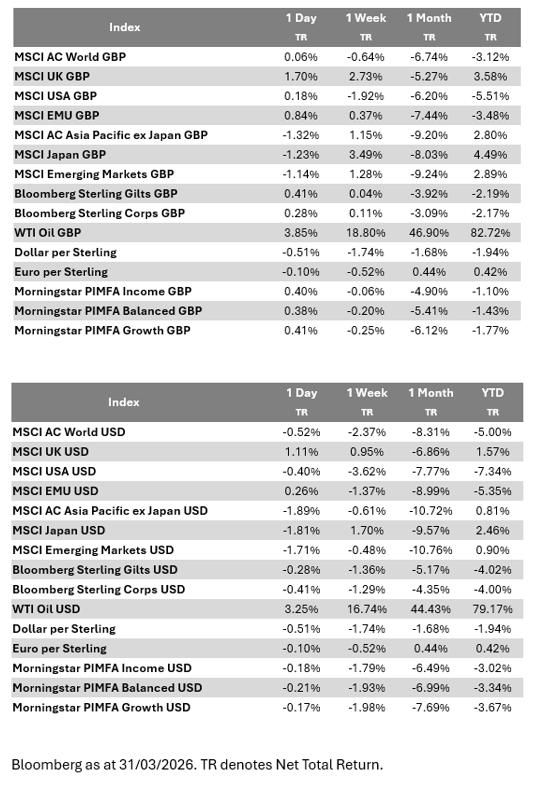
Energy markets remained a focal point, with Brent crude ending the session broadly flat but still edging up +0.2% to $112.78/bbl, which was its highest close since July 2022. Equity markets were initially more constructive. European stocks outperformed, with the STOXX 600 (+0.9%), FTSE 100 (+1.6%) and DAX (+1.2%) all posting solid gains, helped by a firmer energy sector and resilient financials. That positive tone did not carry through to the US close. The S&P 500 finished -0.4% lower, leaving the index around 9% below its late‑January peak and within touching distance of technical correction territory. Yesterday’s weakness was narrowly concentrated, led by a sharp sell‑off in semiconductor stocks (the Philadelphia Semiconductor Index fell -4.2%) even as the majority of S&P 500 constituents ended the day higher. Sentiments improved overnight, with futures markets responding positively to reports suggesting the US may be open to end its military campaign against Iran.
Hints of de‑escalation but uncertainty remains
Overnight sentiment was buoyed by a Wall Street Journal report indicating that President Trump is willing to end US military operations against Iran even if the Strait of Hormuz remains partially disrupted. According to the report, US officials judged that a sustained effort to reopen the strait would risk prolonging the conflict beyond a four‑to‑six‑week horizon. Instead, the apparent focus is on degrading Iran’s naval and missile capabilities while increasing diplomatic pressure to restore trade flows. Markets took this as a modest positive, as it raised the perceived likelihood of a contained conflict and reduced the risk of more severe outcomes, such as widespread damage to regional energy infrastructure. That said, the messaging has been mixed. Yesterday, President Trump posted that the US could target Iranian power plants, oil fields and Kharg Island if negotiations fail, while also signalling that discussions were under way with a potentially more accommodating regime. Adding to the diplomatic complexity, Pakistan’s foreign minister is due to visit China following meetings with Middle Eastern counterparts, prompting speculation that Beijing could play a future role in supporting any ceasefire process.
What does Brooks Macdonald think?
Amid heightened geopolitical noise, monetary policy signals offered a measure of reassurance. Fed Chair Jerome Powell struck a dovish tone, noting that inflation expectations remain “well anchored beyond the short term.” This reinforced the view that central banks remain attentive to growth risks and are unlikely to overreact to near‑term volatility in energy prices or markets more broadly. We continue to monitor developments around energy supply, diplomatic progress, and financial conditions, but we would caution against drawing strong conclusions from short‑term market moves driven by rapidly evolving newsflow.
Please check in again with us soon for further relevant content and market news.
Chloe
31/03/2026