
Please see below article received from Brooks Macdonald this morning, which provides a global market update for your perusal.
What has happened
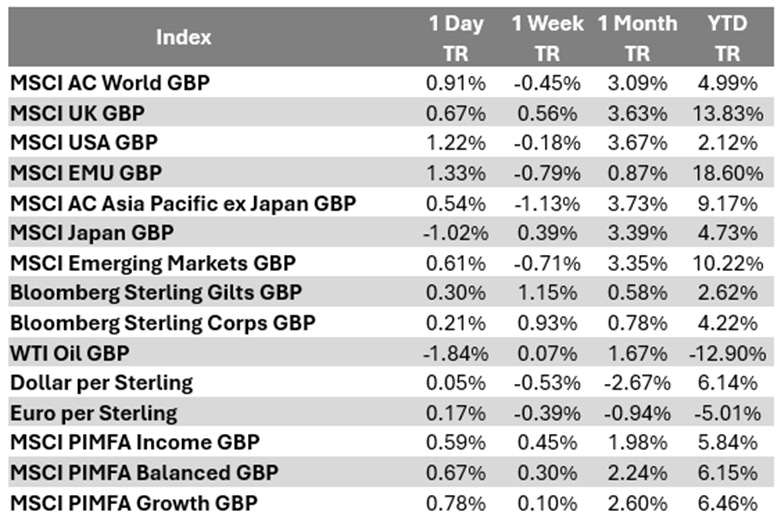
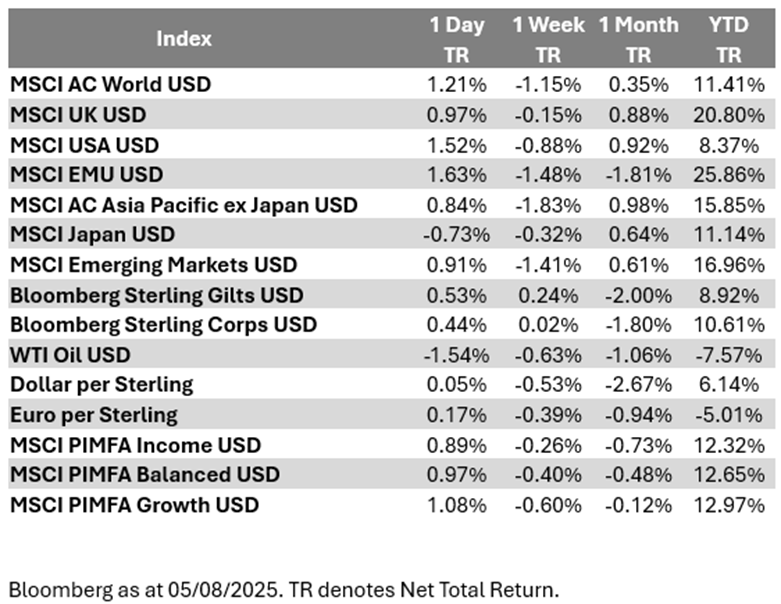
Markets bounced on Monday, but only partly unwinding the bigger falls from Friday. For the US S&P500 and the pan-European STOXX600, both equity indices still closed yesterday below where they had closed last Thursday. Furthermore, not all stocks saw a bounce – of particular note, US ‘Magnificent Seven’ megacap tech stock Amazon, which fell -8.27% on Friday, dropped a further -1.44% yesterday (all in local currency price return terms).
US dollar resumes its slide
The US dollar fell again yesterday, with the DXY index (which tracks the dollar against a basket of major global currencies) down for the second day in row. For context, while the DXY index had a relatively good July, its best month since last year, that was only on the back of the dollar suffering its weakest calendar 1H performance since 1973. Trying to make sense of the moves, some market watchers are suggesting that dollar weakness this year is in part reflecting ebbing investor confidence in owning US assets given US President Trump’s tariff policy consequences in particular.
Trade tariff escalation
US President Trump threatened higher trade tariffs again India yesterday, saying that he would be “substantially raising” tariffs on India’s goods coming into the US because of India’s continued willingness to buy oil from Russia. That would be over and above the 25% tariff rate on India announced last week. India’s stock market has been weak recently, arguably reflecting a marked recent deterioration in US-India relations. Highlighting the war of words, Trump said last week that if India maintains its close ties with Russia, then “they can take their dead economies down together”.
What does Brooks Macdonald think
According to data complied by the ‘Washington Service’ research company and reported by Bloomberg, only 151 US S&P500 constituent company executive insiders bought their own shares in July, the fewest in a month since 2018. Furthermore, the ratio of insiders’ buying-to-selling was the lowest in a year. While it is important not to try to read too much into one month’s data, a cautious stance among those that likely know their businesses best might be signalling concerns around either relatively high valuations and/or slower economic growth expected ahead.
Please check in again with us soon for further relevant content and market news.
Chloe
05/08/2025