
Please see this week’s Markets in a Minute update below from Brewin Dolphin, received yesterday afternoon – 24/11/2026
Tech stocks bounce back after sell-offs
Tech stocks recovered from last week’s falls, aided by the return of Nvidia CEO Jensen Huang.
Key highlights
- What’s next for AI stocks? The AI space saw positive developments in Nvidia’s quarterly results and Anthropic’s stock market debut, but technology remains in the crosshairs.
- The financial state of Britain: Economic data painted a mixed picture for the UK. Consumer prices rose 3.6% in the year to October, payrolls fell by 34,000 compared to the month before and real wages turned negative for the first time in three years. Meanwhile, services inflation came in below forecasts.
- France in the doldrums: French shares have lost 3% over the past year while its government debt is expected to exceed 118% of GDP by year end. But what lies at the root of France’s economic woes?
Looking for the marginal buyer
The question investors keep returning to is whether the vast sums being spent on AI will keep coming. This week brought two tests of that thesis: Nvidia’s quarterly results and Anthropic’s stock market debut.
On paper, both passed. Nvidia’s data centre revenue more than doubled and the company raised its outlook, while Anthropic’s flotation was the largest on record.
The market’s verdict was harsher. Anthropic’s shares jumped around 25% when trading opened, then steadily gave the gains back, raising an awkward question: if the world’s most anticipated AI listing can’t hold its opening level, where is the marginal buyer for AI assets?
Nvidia’s numbers were competing with uncertainty over who would lead the company when founder and CEO Jensen Huang had gone; Huang has now been reinstated. Washington added to the overhang by closing a loophole that let Chinese firms reach Nvidia chips remotely through data centres in countries such as Singapore. After the Democratic sweep in the midterms, we doubt it’ll be the last such step.
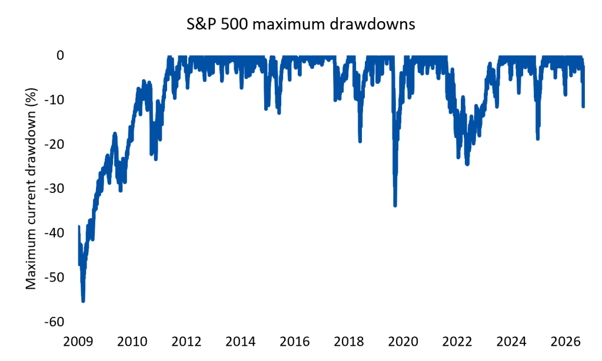
What began as a technology story has become a test of markets more broadly. At close on Friday, the S&P 500 had fallen 11.6% from its peak. That’s within the range of corrections which have been seen since 2022.
Source: LSEG Datastream
But technology remains in the crosshairs. Taiwan’s stock market, in effect a proxy for the global chip supply chain, had its worst week since 1991. Emerging markets as a whole are close to 20% below their June peak, the usual definition of a bear market. Defensive shares have fallen alongside growth stocks, leaving little shelter. Copper, which often moves ahead of broader growth expectations, has had one of its worst weeks in a decade on doubts about AI-driven industrial demand.
The underlying demand for AI may well be intact, but a recovery needs more than good numbers. Company setbacks, tighter rules and an unwinding of crowded positions all stand in the way for now, and the one institution that might once have steadied nerves has made clear it won’t.
The Federal Reserve declines to catch the market
Government bonds, caught in the tension between demand for safety and worries about inflation, rallied in the face of sharp equity declines, with 10-year U.S. Treasury yields dipping below 5%.
U.S. policymakers are fighting inflation rather than supporting share prices. Minutes of the Federal Reserve (the Fed)’s October meeting showed that nearly all officials expect further rate rises to be needed, and Governor Christopher Waller said inflation is still headed in the wrong direction. Markets are rethinking where this hiking cycle ends, and the Fed has shown no inclination to offer a backstop.
Gold, usually a refuge, has fallen to its lowest point since September 2025, at around $3,550 an ounce, pressed by the hawkish Fed and a firmer dollar, as investors sell positions to cover losses elsewhere.
Oil is the one source of relief. Brent crude is steady at around $92 per barrel, as the geopolitical risk premium has largely unwound and the physical market looks well supplied. Lower oil eases one pressure on inflation; in Britain, the others are still building.
British prices rise, payrolls slide
The inflationary outlook is similarly nuanced in the UK, where consumer prices rose 3.6% in the year to October. The good news is that services inflation came in below forecasts. However, further pressure is to come; factory input prices are up almost 11% on the previous year, and household energy bills are set to rise by 26% in January.
Payrolls fell by 34,000 in October, and real wages (pay that has been adjusted for inflation) have turned negative for the first time in over three years. That’s an uncomfortable mix for the Bank of England.
Britain’s dilemma rests with its central bank; in France, it rests with the government, and the bond market has taken charge of the discipline.
France takes the sick man’s mantle
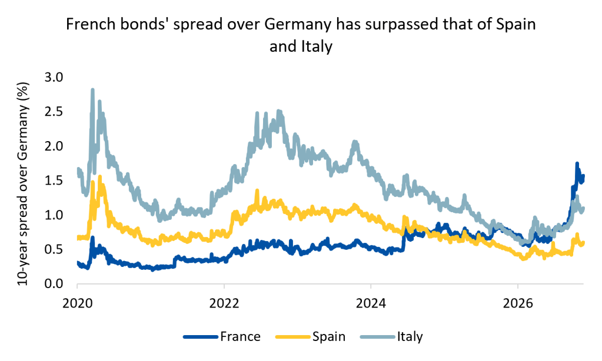
France had been edging towards ‘sick man of Europe’ status; investors now treat it as the title holder. France has overtaken Italy and Spain in terms of the extra spread it pays over Germany to borrow for 10 years. French shares have lost 3% over the past year, while the wider Europe ex UK market has returned 8%.
Source: LSEG Datastream
The fiscal arithmetic explains the worry. After years of recession-sized deficits without a recession, the International Monetary Fund expects French government debt to exceed 118% of GDP by the end of this year, against 88% for the Eurozone. Higher borrowing costs compound the problem by restraining an economy that has contracted in two of the last three quarters.
Politics lies at the root of it. The National Assembly rejected the 2027 budget by 458 votes to none, and the government will probably force one through without a vote.
The bigger question is the presidential election, with the first round taking place on 18 April 2027. Marine Le Pen of the National Rally leads first-round polls at around 32%, assuming the courts allow her to stand after her embezzlement conviction. However, prediction markets give her only a coin flip. She promises €141 billion in savings while also holding the retirement age at 62.
Meanwhile her nearest rival, the far-left Jean-Luc Mélenchon, would raise taxes, nationalise industries and try to turn the €600 billion of French bonds held by the European Central Bank (ECB) into interest-free loans.
Investors face an election in which no likely outcome delivers the fix France needs, but much of that disappointment is already in the price. The winner will most likely lack a parliamentary majority, which would limit a centrist’s reforms and restrain Le Pen; we put the chance of her winning without a majority at around 40%. A Mélenchon victory would be by far the worst outcome for French bonds.
France’s borrowing premium sits well above the roughly 1.2% implied by its expected debt burden, and French shares trade on just under 13 times expected earnings, against just over 15 for the rest of Europe ex UK.
Fund managers are strongly underweight on French shares, and French banks are far better capitalised than around the financial crisis, so a repeat of the early 2010s debt crisis looks unlikely. That premium could still widen, and the ECB will not lean against it: its chief economist, Philip Lane, has said the bank shouldn’t intervene, because the widening reflects genuine fiscal risk rather than a market breakdown.
So, there are a number of assets under pressure. However, the reversal of trends looks stretched. Technology equity valuations are very low and shares are overbought despite confidence about high earnings growth. Bonds, including and beyond France, are offering high yields and have started to reflect an inverse correlation with equities.
Please continue to check our blog content for advice, planning issues and the latest investment market and economic updates from leading investment houses.
Charlotte Clarke
25/11/2026